FPGA families | XILINX VIRTEX | Part-3/3 | VLSI | Lec-82
TL;DR
The Vertex Xilinx FPGA family features high performance, advanced architecture, and innovative technologies for modern applications.
Transcript
hi everyone in this video you are going to see the vertex xilinx fpga family so vertex families are very high performance families we have seen in the beginning of this fpga families all these vertex families are high performance families high performance fpga family where the change in the evolution of this transistor model we can say like a 220 n... Read More
Key Insights
- 👨 The Vertex FPGA family exemplifies a leap in technology, showcasing a miniaturization from 220 nm to 40 nm, allowing for higher transistor density and performance.
- 💄 Advanced features such as configurable logic blocks enable extensive application flexibility, making these FPGAs adept for a variety of complex tasks.
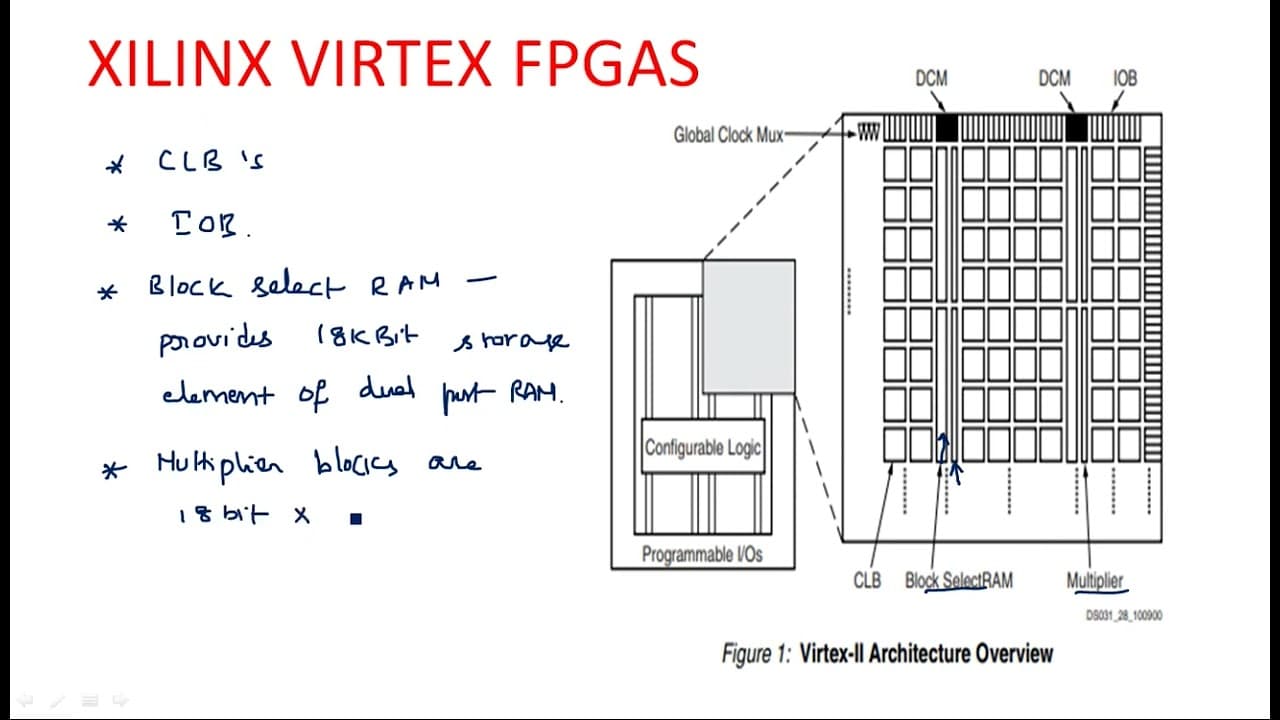
- 🐏 Block select RAM and dedicated multipliers are critical enhancements over earlier models, providing efficiency that supports sophisticated system designs.
- ⏰ The digital clock manager significantly enhances clock reliability and performance, catering to the precise timing needs of modern electronic circuits.
- ☢️ Active interconnect technology ensures swift and dynamic interconnections between components, improving data handling and overall system responsiveness.
- 🙈 The integrated approach of combining various functions into a single chip, as seen in Vertex, reduces system complexity and physical footprint.
- ☠️ The evolution of programmable routing resources aids in optimizing on-chip data transfer rates, which is critical for high-performance applications requiring prompt interactions.
Install to Summarize YouTube Videos and Get Transcripts
Explore YouTube Video Summarizer or Get YouTube Transcript Extractor
Questions & Answers
Q: What distinguishes the Vertex FPGA family from older FPGA models?
The Vertex FPGA family utilizes advanced technology, transitioning from 220 nm to 40 nm transistors, significantly enhancing performance and efficiency. Older models, such as Spartan and Altera, lack the cutting-edge features and integrated capabilities found in Vertex, which are essential for modern industrial applications.
Q: How do configurable logic blocks function in Vertex FPGAs?
Configurable logic blocks (CLBs) are fundamental components in Vertex FPGAs that enable the implementation of combinational and synchronous logic. These blocks are flexible and can be configured to perform various logic functions, allowing for efficient design and execution of complex processing tasks.
Q: What role does block select RAM play in the Vertex architecture?
Block select RAM in Vertex FPGAs provides temporary data storage essential for transferring information between configurable logic blocks. It allows for efficient data handling, facilitating operations during processing and improving overall performance in applications requiring quick data retrieval and manipulation.
Q: Can you explain the function of the digital clock manager (DCM) in Vertex FPGAs?
The digital clock manager (DCM) is designed for precise clock management within Vertex FPGAs. It allows for clock frequency adjustments, phase shifting, and delay compensation, enabling customization of clock distribution across circuits. This feature greatly enhances timing accuracy and synchronization in complex designs.
Q: What advantages do multipliers in the Vertex FPGA family offer?
Multipliers in the Vertex family support 18 x 18-bit operations, providing efficient execution of arithmetic tasks. This capability allows for faster processing and reduces the computational load on other resources within the FPGA, making it suitable for high-performance applications that require intensive calculations.
Q: How does active interconnect technology improve performance in Vertex FPGAs?
Active interconnect technology enhances the routing resources in Vertex FPGAs, allowing for rapid changes in signal connections. This innovation streamlines the communication between logic blocks, facilitating faster data transfers and reducing latency, which is vital for high-speed applications.
Q: In what ways does the architecture of Vertex FPGAs support modern design needs?
The architecture of Vertex FPGAs integrates advanced features such as programmable input-output blocks, embedded memory, and high-density logic components. These elements collectively support modern design requirements, enabling designers to create complex, high-performance systems efficiently and effectively.
Q: Why are Vertex FPGAs preferred over traditional FPGA families in industries?
Vertex FPGAs are preferred due to their high performance, compact design, and innovative features that make them suitable for demanding industrial applications. Their ability to handle larger data sets, perform faster computations, and integrate advanced technologies makes them more effective compared to traditional families like Altera and Spartan.
Summary & Key Takeaways
-
The Vertex Xilinx FPGA family represents a significant evolution from earlier models, moving from 220 nm to 40 nm technology, emphasizing high performance suitable for industrial applications.
-
Key features include configurable logic blocks, block select RAM, and multipliers, which enhance efficiency and enable complex processing not achievable with older FPGA families.
-
Innovations like digital clock managers and active interconnect technology provide improved clock management and flexible routing capabilities, positioning the Vertex family at the forefront of design solutions for modern system-level applications.
Read in Other Languages (beta)
Share This Summary 📚
Summarize YouTube Videos and Get Video Transcripts with 1-Click
Try YouTube Summary with ChatGPT & Claude or YouTube Transcript Generator