Lecture 15: Orthonormal Bases and Fourier Series
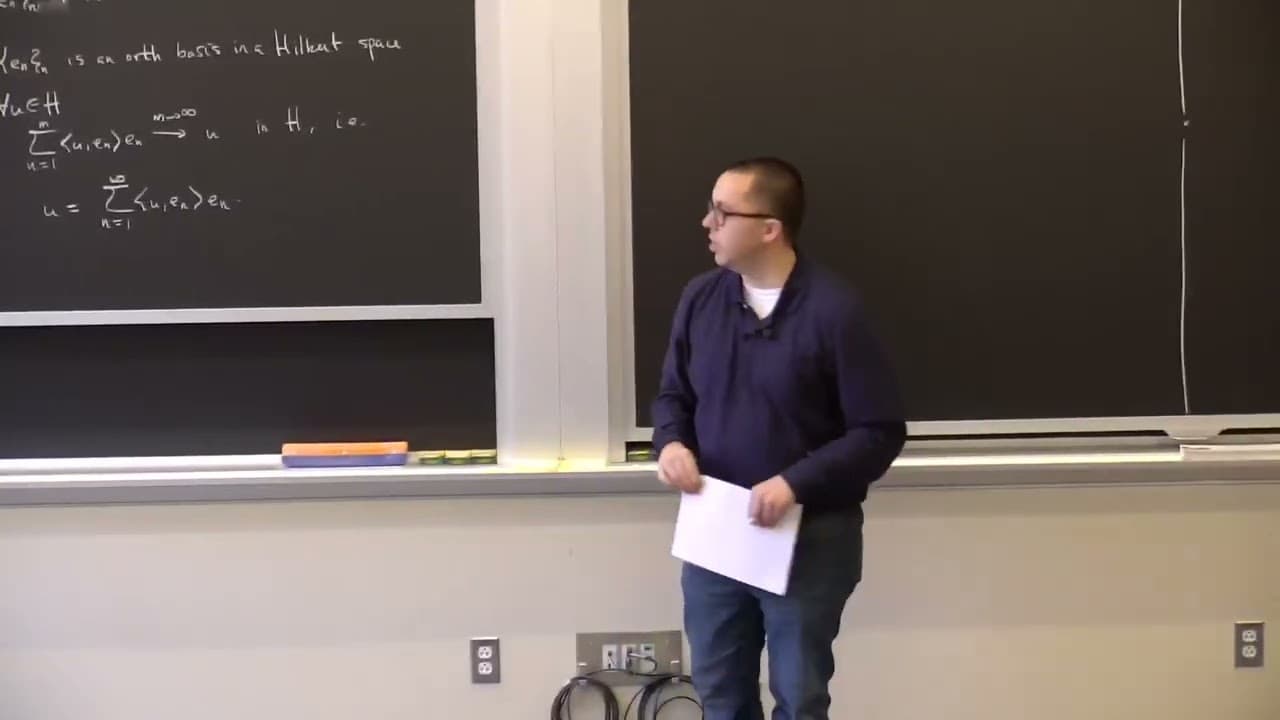
TL;DR
The convergence of Fourier series in L2, specifically the Cesaro-Fourier means, can be shown to converge to a given function in L2, making it a maximal orthonormal basis.
Transcript
[SQUEAKING] [RUSTLING] [CLICKING] PROFESSOR: OK, so ortho-- today, we're going to be discussing orthonormal bases of a Hilbert space. So let me just recall what we did at the end of last time. We introduced maximal orthonormal sets, so a collection of vectors in a-- we could say a pre-Hilbert space, but let's say in a Hilbert space. So this is maxi... Read More
Key Insights
- 🤨 The orthonormal basis e to the inx over root 2 pi is maximal in L2.
- 🍽️ Fourier coefficients are calculated using the inner product with the basis functions.
- 🌞 The n-th partial Fourier sum can be expressed using the Dirichlet kernel.
- 🌞 The Cesaro-Fourier means of a function f are the average of the partial sums.
Install to Summarize YouTube Videos and Get Transcripts
Explore YouTube Video Summarizer or Get YouTube Transcript Extractor
Questions & Answers
Q: What is the significance of the orthonormal subset e to the inx over root 2 pi in L2?
This subset serves as the basis for the Fourier series expansion of functions in L2, allowing functions to be represented as infinite linear combinations of these basis functions.
Q: How are the Fourier coefficients of a function f calculated?
The Fourier coefficients are obtained by taking the inner product of f with e to the inx over root 2 pi, integrated over the range minus pi to pi.
Q: Why is the Cesaro-Fourier mean used instead of the partial sums in studying the convergence of Fourier series?
The Cesaro-Fourier means have better convergence properties compared to the partial sums, making them a more suitable tool to study the convergence of Fourier series in L2.
Q: How does proving the convergence of the Cesaro-Fourier means in L2 help establish the completeness of the orthonormal basis?
If all Fourier coefficients of f are zero, then the Cesaro-Fourier means of f would also be zero. Showing that the Cesaro-Fourier means converge to f in L2 implies that the orthonormal basis is maximal, as any function orthogonal to the basis would have all its Fourier coefficients equal to zero.
Summary & Key Takeaways
-
The orthonormal subset e to the inx over root 2 pi in L2 minus pi to pi is shown to be maximal.
-
The Fourier coefficients of a function f are defined as the inner product of f with e to the inx over root 2 pi.
-
The n-th partial Fourier sum of f can be expressed as an integral involving the Dirichlet kernel dn of x.
-
The Cesaro-Fourier means of an L2 function f are defined as the average of the partial sums and are denoted by sigma n of f of x.
-
The goal is to prove that the Cesaro-Fourier means converge to f in L2, which implies the convergence of the Fourier series to f.
Read in Other Languages (beta)
Share This Summary 📚
Summarize YouTube Videos and Get Video Transcripts with 1-Click
Try YouTube Summary with ChatGPT & Claude or YouTube Transcript Generator
Explore More Summaries from MIT OpenCourseWare 📚



Summarize YouTube Videos and Get Video Transcripts with 1-Click
Try YouTube Summary with ChatGPT & Claude or YouTube Transcript Generator