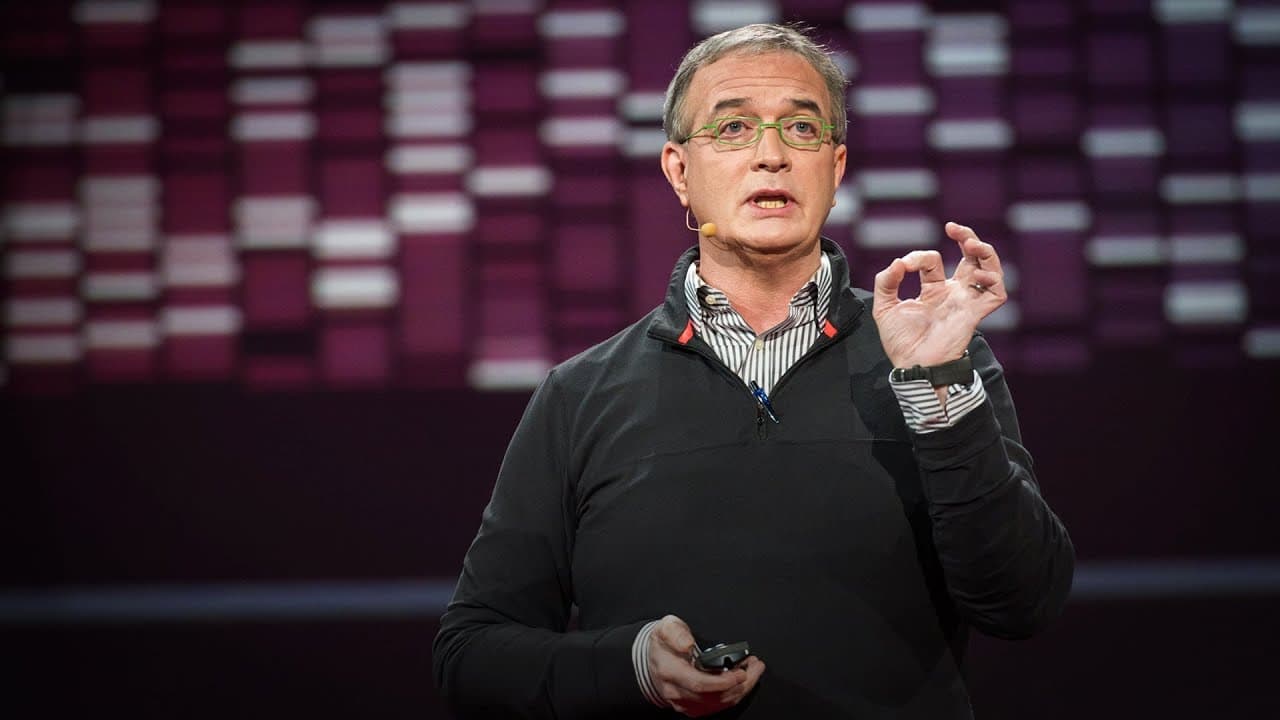
Stephen Friend: The hunt for "unexpected genetic heroes"
TL;DR
This content discusses the importance of studying those who don't get sick in order to develop preventive therapies for diseases.
Transcript
Approximately 30 years ago, when I was in oncology at the Children's Hospital in Philadelphia, a father and a son walked into my office and they both had their right eye missing, and as I took the history, it became apparent that the father and the son had a rare form of inherited eye tumor, retinoblastoma, and the father knew that he had passed th... Read More
Key Insights
- 🔍 Advances in genetic understanding have not translated into more efficient development of drugs, indicating a disconnect between diagnosis and treatment.
- 🧬 Shifting focus from studying sick individuals to studying those who are healthy could uncover protective factors against diseases.
- 💡 Looking at rare individuals who carry genes for childhood diseases but do not exhibit symptoms can reveal hidden protective factors.
- 🌍 The Resilience Project aims to find unexpected heroes with hidden protective factors by studying a million individuals from diverse genetic and environmental contexts.
- 💰 Costs for genetic analysis have significantly decreased, making large-scale studies more feasible.
- 📊 Over half a million samples have already been analyzed, yielding dozens of strong candidate unexpected heroes.
- 🚀 The beta phase of the project will begin, requiring DNA swabs and a willingness to participate in a crowd-sourced approach to finding preventive therapies.
- 🔮 In order for the project to succeed, individuals must take an active role in understanding their own genes and sharing information to advance disease prevention strategies.
Install to Summarize YouTube Videos and Get Transcripts
Explore YouTube Video Summarizer or Get YouTube Transcript Extractor
Questions & Answers
Q: What moment in the speaker's career propelled them to co-lead a team that discovered the first cancer susceptibility gene?
Approximately 30 years ago, when the speaker was in oncology at the Children's Hospital in Philadelphia, a father and son with a rare form of inherited eye tumor, retinoblastoma, walked into their office. This encounter changed the speaker's life and inspired them to co-lead a team that discovered the first cancer susceptibility gene.
Q: Why hasn't the increase in knowledge about genetic variations led to more efficient drug development?
Despite the seismic shift in our understanding of genetic variations and their role in diseases, the efficiency of drug development has not significantly improved. One reason for this is that we are still in the early stages of understanding genetic codes and how to read and interpret them. Additionally, many of the genetic changes associated with diseases involve a loss of function, making it challenging to develop drugs that can restore function.
Q: What alternative approach does the speaker suggest for developing therapies for prevention?
The speaker proposes a shift in focus from studying individuals who are already sick to studying those who are healthy and unaffected by diseases. By identifying a small set of individuals who carry the genetic risk for a disease but do not exhibit symptoms, researchers can potentially uncover hidden protective factors. This approach may help in developing preventive therapies.
Q: Can you provide examples of studies that have successfully identified hidden protective factors?
The speaker mentions two examples of studies that have identified individuals with hidden protective factors. In the 1980s and 1990s, clinicians discovered that some individuals with high levels of the HIV virus did not develop AIDS because they carried protective mutations from birth. This knowledge has led to advancements in therapy. More recently, a study found individuals with high lipid levels who did not develop heart disease due to protective mutations present from birth.
Q: What is the Resilience Project, and what is its objective?
The Resilience Project is an initiative aimed at finding rare individuals who possess hidden protective factors against childhood inherited diseases. It seeks to decipher the genetic context of these individuals and identify resilience factors that could be used to develop preventive therapies. The project is an open, crowd-sourced effort that involves analyzing a large number of samples from individuals willing to participate.
Q: How does the Resilience Project plan to identify individuals with hidden protective factors?
The Resilience Project aims to screen a million individuals, predominantly adults over 40 years of age who were healthy as children. By scanning their genes for known alterations associated with childhood diseases, the project hopes to find individuals who carry the genetic risk but remain unaffected. The project also considers looking in diverse populations and remote places for distinct genetic contexts and environmental factors that may contribute to protection.
Q: How many samples have been analyzed so far in the Resilience Project?
The Resilience Project has already analyzed over half a million samples. Collaborating with organizations such as the Children's Hospital in Philadelphia, 23andMe, and BGI, the project has received access to existing, anonymized samples and has found dozens of strong candidate unexpected heroes with hidden protective factors.
Q: What is needed from individuals to further the success of the Resilience Project?
To advance the Resilience Project, individuals are needed to play an active role in understanding their own genes and health. This requires providing a swab of DNA and being willing to be re-contacted for further information. Individuals must embrace the concept of an open, crowd-sourced project and actively participate in discovering unexpected heroes and developing preventive therapies for various diseases, including Alzheimer's and Parkinson's.
Summary & Key Takeaways
-
The speaker had a life-changing moment when a father and son with a rare inherited eye tumor came to his office, inspiring him to discover the first cancer susceptibility gene.
-
Despite advancements in understanding genetic variations and disease risk, drug development efficiency has not improved significantly.
-
The speaker proposes a shift in focus from studying those who are sick to studying those who are healthy but carry potential risk factors, in order to find individuals with hidden protective factors against diseases.
Read in Other Languages (beta)
Share This Summary 📚
Summarize YouTube Videos and Get Video Transcripts with 1-Click
Try YouTube Summary with ChatGPT & Claude or YouTube Transcript Generator
Explore More Summaries from TED 📚


Summarize YouTube Videos and Get Video Transcripts with 1-Click
Try YouTube Summary with ChatGPT & Claude or YouTube Transcript Generator