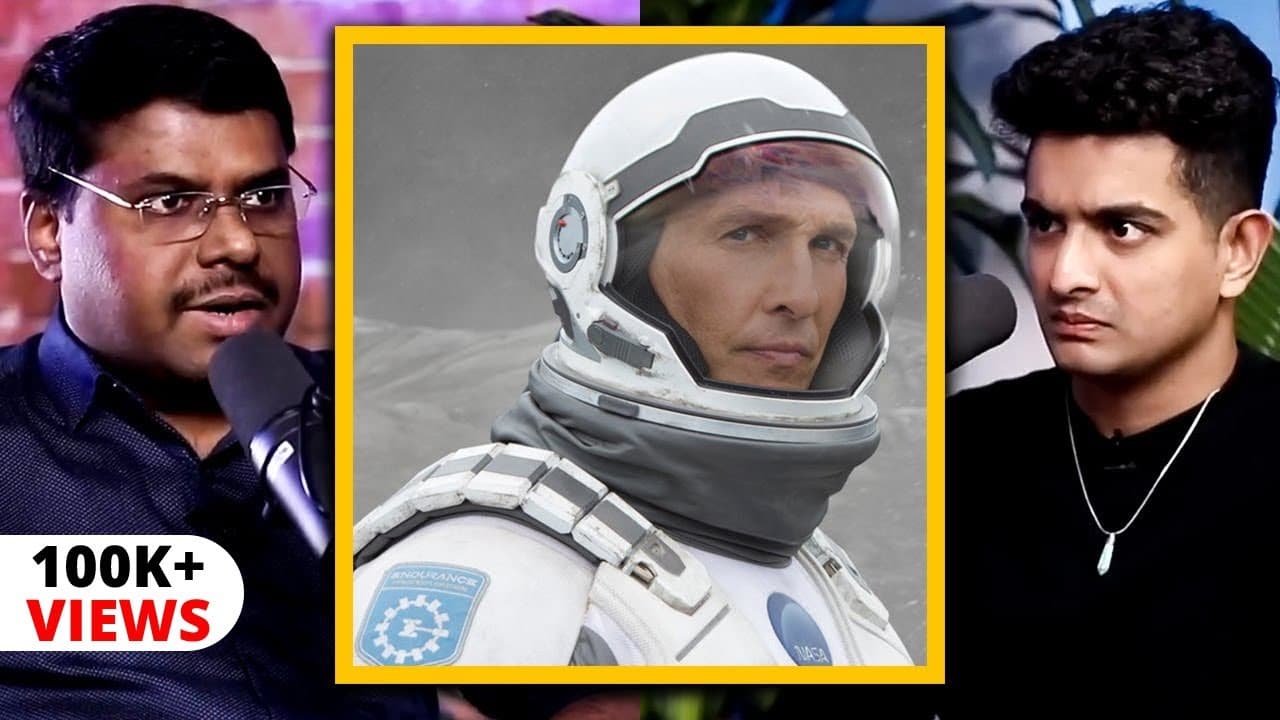
Shocking Truth About Time Travel - Scientist Explains - IT IS POSSIBLE!
TL;DR
Time travel is theoretically possible according to Einstein's theories but faces challenges in practice.
Transcript
happiness through Curiosity on Dr eclipse is time travel scientifically possible and if yes how and is this something you've thought about is time machine something you've thought about yes yeah uh so the answer for the first question that is a time travels scientifically possible yeah that is the kind of answer that comes from the general theory o... Read More
Key Insights
- ⌛ Einstein's general theory of relativity posits time as a fourth dimension, suggesting theoretical avenues for time travel.
- 🧑🏭 The grandfather paradox and entropy act as significant challenges to the notion of backward time travel, presenting philosophical and scientific dilemmas.
- ❓ Multiverse theory provides a framework to potentially sidestep paradoxes by introducing alternate timelines.
- 🖐️ Current advances in brain mapping and information technology may lay foundational groundwork for futurist concepts of time travel.
- 💁 Localized wormholes might provide a method to transmit information across time without the need for physical mass.
- 🙏 Analogies, such as folding a piece of paper, simplify advanced scientific concepts and enhance understanding.
- 👨🔬 Practical time travel remains unrealized, with significant research still required to develop necessary technologies and methodologies.
Install to Summarize YouTube Videos and Get Transcripts
Explore YouTube Video Summarizer or Get YouTube Transcript Extractor
Questions & Answers
Q: What is the basis for considering time travel scientifically possible?
Time travel is scientifically considered possible based on Einstein's general theory of relativity, which indicates that time functions as a fourth dimension akin to spatial dimensions. The theory posits that one could theoretically navigate time as one does through space, moving backward and forward along the temporal axis. However, practical implications are still under exploration.
Q: What are the major obstacles to traveling back in time?
The primary challenges to traveling back in time include the grandfather paradox, which questions existence if you alter past events, and the principle of entropy, which states that certain processes, such as breaking a glass, cannot be reversed. Both principles complicate the idea of altering past events through time travel.
Q: How does multiverse theory play a role in time travel?
Multiverse theory posits that if one were to time travel to the past and change events, it would create a diverging timeline or alternate universe. This means that occurrences in the original timeline remain unaffected, thereby averting paradoxes and allowing multiple outcomes to coexist.
Q: Is there any ongoing research into practical time travel technology?
While there is no official research directed solely at developing time travel, scientists are exploring advanced technologies related to information transmission. Current advancements in mapping human thoughts and brain activity suggest a future possibility for transmitting consciousness or data into different points in time.
Q: How can information be transmitted into the future?
Theoretical frameworks suggest that by utilizing concepts like quantum tunneling and localized wormholes, information (including consciousness) can be sent into the future without the physical body accompanying it, as transmitting data carries fewer complications than sending mass itself.
Q: Can you explain the analogy of folding paper in relation to black holes?
The analogy involves drawing two points on a piece of paper and then folding the paper to join them. This simulates how a black hole might warp spacetime, allowing a shortcut through the fabric of spacetime, effectively connecting distant points in time and space.
Q: What applications do current technologies have that could contribute to understanding time travel?
Technologies such as brain-computer interfaces can map and transmit thoughts, indicating a preliminary step toward transferring information. These developments can provide insights into extracting and reconstructing consciousness, further bridging the gap between current capabilities and theoretical concepts of time travel.
Q: Why is the idea of time travel still difficult to understand for many people?
Time travel involves complex scientific theories and dimensions that challenge human comprehension. Relativity and concepts such as the fourth dimension are abstract, making it difficult for individuals to visualize or accept them. Educational aids and analogies, like that of folded paper, can help encapsulate these ideas.
Summary & Key Takeaways
-
The concept of time travel is rooted in Einstein's general theory of relativity, which proposes that time is a fourth dimension paralleling our three spatial dimensions.
-
Time travel into the future is theoretically viable, while traveling into the past presents challenges like the grandfather paradox and entropy.
-
Advanced technology and theories, such as multiverse theory, could offer potential solutions for practical time travel, including transmitting information rather than physical bodies.
Read in Other Languages (beta)
Share This Summary 📚
Summarize YouTube Videos and Get Video Transcripts with 1-Click
Try YouTube Summary with ChatGPT & Claude or YouTube Transcript Generator
Explore More Summaries from TRS Clips 📚





Summarize YouTube Videos and Get Video Transcripts with 1-Click
Try YouTube Summary with ChatGPT & Claude or YouTube Transcript Generator