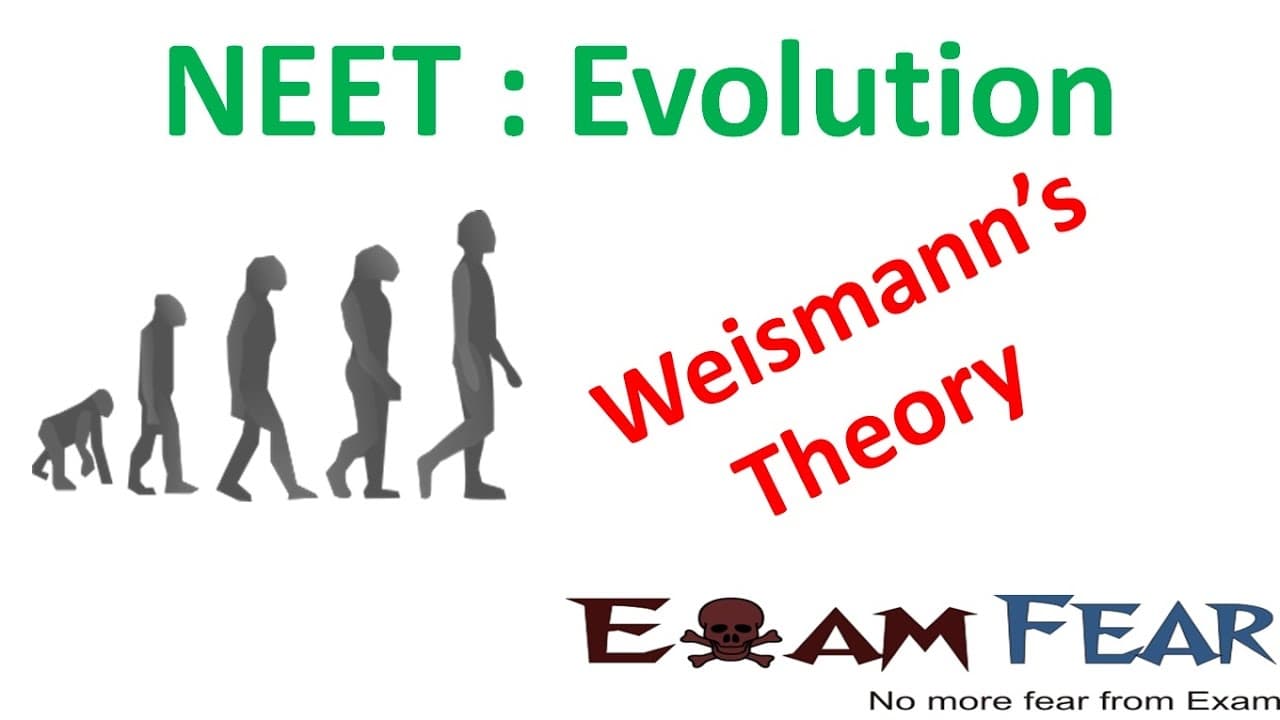
NEET Biology Evolution : Weismann Theory of Continuity of Germplasm
TL;DR
The theory of continuity of germ plasm states that only the characteristics influencing the germ cells get inherited, while acquired traits are not passed down to the next generation.
Transcript
hello friends this video on eat evolution is brought to you by exam fear calm normal fear from an Mis men's theory of continuity of germ plasm this theory is also known as the theory of continuity of germ plasm so what does germ plasm so job has some red force to the protoplasm of germ cells so germ cells are basically we have two categories of cel... Read More
Key Insights
- 🦠 The theory of continuity of germ plasm suggests that only the characteristics influencing the germ cells are inherited.
- 💪 Acquired traits, such as strong muscles or body piercings, are not inherited because they are related to somatic cells, not germ cells.
- 🥳 Whisman's experiment with tail cutting in rats provided evidence against Lamarck's theory of acquired traits being inherited.
- 🥺 The theory of continuity of germ plasm modified Lamarck's theory and led to the development of the new Lamarckism.
- 🇩🇪 Germ cells are involved in the process of reproduction, while somatic cells are not.
- 🖤 The distinction between germ plasm and somatic plasm helps explain the lack of inheritance of acquired traits.
- 💪 Examples of acquired traits, like powerful muscles or body piercings, illustrate the limitations of inheritance to germ cells only.
Install to Summarize YouTube Videos and Get Transcripts
Explore YouTube Video Summarizer or Get YouTube Transcript Extractor
Questions & Answers
Q: What is the theory of continuity of germ plasm?
The theory states that only the characteristics influencing the germ cells are inherited, while acquired traits are not passed down to the next generation. It emphasizes the distinction between germ cells and somatic cells in terms of their participation in reproduction.
Q: Why are acquired traits like powerful muscles not inherited?
Acquired traits, such as powerful muscles in wrestlers, are not inherited because they are acquired during an individual's lifetime and are related to somatic cells rather than germ cells. Only traits limited to germ cells can be passed on to the next generation.
Q: Does body piercing affect future generations?
No, body piercing does not affect future generations. As an acquired trait, body piercing only affects the individual who undergoes the piercing and is unrelated to the inheritance of germ cells. It supports the theory of continuity of germ plasm.
Q: How did Whisman's experiment contribute to the theory?
Whisman conducted an experiment involving tail cutting in rats for 22 generations. Despite cutting the tails, rats with tails continued to be born. This experiment demonstrated that the acquired trait of tail cutting did not affect the germ cells and, therefore, was not inherited in subsequent generations.
Summary & Key Takeaways
-
The theory of continuity of germ plasm, also known as the theory of continuity of germ cells, explains that germ cells participate in the process of reproduction, while somatic cells do not.
-
According to the theory, the protoplasm of germ cells is called germ plasm, and it is the only part transmitted to the next generation.
-
Examples of acquired traits like strong muscles in wrestlers and body piercings in females do not get inherited because they are not related to the germ cells.
Read in Other Languages (beta)
Share This Summary 📚
Summarize YouTube Videos and Get Video Transcripts with 1-Click
Try YouTube Summary with ChatGPT & Claude or YouTube Transcript Generator
Explore More Summaries from LearnoHub - Class 11, 12 📚


Summarize YouTube Videos and Get Video Transcripts with 1-Click
Try YouTube Summary with ChatGPT & Claude or YouTube Transcript Generator