DC Compound motor | Long shunt & Short shunt DC generator | Types of DC Machines | Lec-24
TL;DR
This session covers the types and operations of compound DC machines.
Transcript
hello everyone in this session we will discuss about the the continuation part of the compounding combination so you know about the compound machine compound motor or compound generator compound dc machine that is a simple thing name itself it is a combination of series as well as shunt winding connection these series finding and shanti winding the... Read More
Key Insights
- ⚡ Compound DC machines combine series and shunt windings to regulate voltage output under various loads effectively.
- ⚡ The relationship between load voltage and generated EMF distinguishes the three types of compounding, influencing machine behavior and application suitability.
- 🍰 Proper configuration of windings, whether long or short shunt, significantly impacts the efficiency and performance of the DC machine in practical applications.
- 💦 Voltage drops must be accounted for in calculations, ensuring accurate predictions regarding machine behavior under load.
- ✊ Effective understanding of compound machines is essential for designing systems in electrical and mechanical engineering, particularly in applications requiring consistent power delivery.
- ⚡ Compound machines have diverse applications across industries, leveraging their variable voltage performance to meet different operational demands.
- 👻 Knowledge of current flow through different windings allows engineers to troubleshoot and optimize machine performance effectively.
Install to Summarize YouTube Videos and Get Transcripts
Explore YouTube Video Summarizer or Get YouTube Transcript Extractor
Questions & Answers
Q: What defines an over-compounded DC machine?
An over-compounded DC machine is characterized by a load voltage that is greater than the generated electromotive force (EMF). This condition leads to higher efficiency under certain load conditions, allowing the machine to handle larger loads without dropping voltage, which is beneficial in various applications.
Q: How does an under-compounded DC machine operate?
An under-compounded DC machine operates with a load voltage that is less than the generated EMF. This condition can lead to voltage drops under heavy loads and is typically utilized in applications where maintaining a constant voltage is less critical, impacting overall system stability and performance.
Q: What is the significance of shunt and series windings in compound machines?
Shunt windings are designed to provide a stable voltage under varying load conditions by ensuring that the machine can maintain a constant output. In contrast, series windings adjust the current based on the load, enhancing performance under higher loads by maximizing the magnetic field strength, which is essential for efficient operation.
Q: Can you explain the difference between long shunt and short shunt configurations?
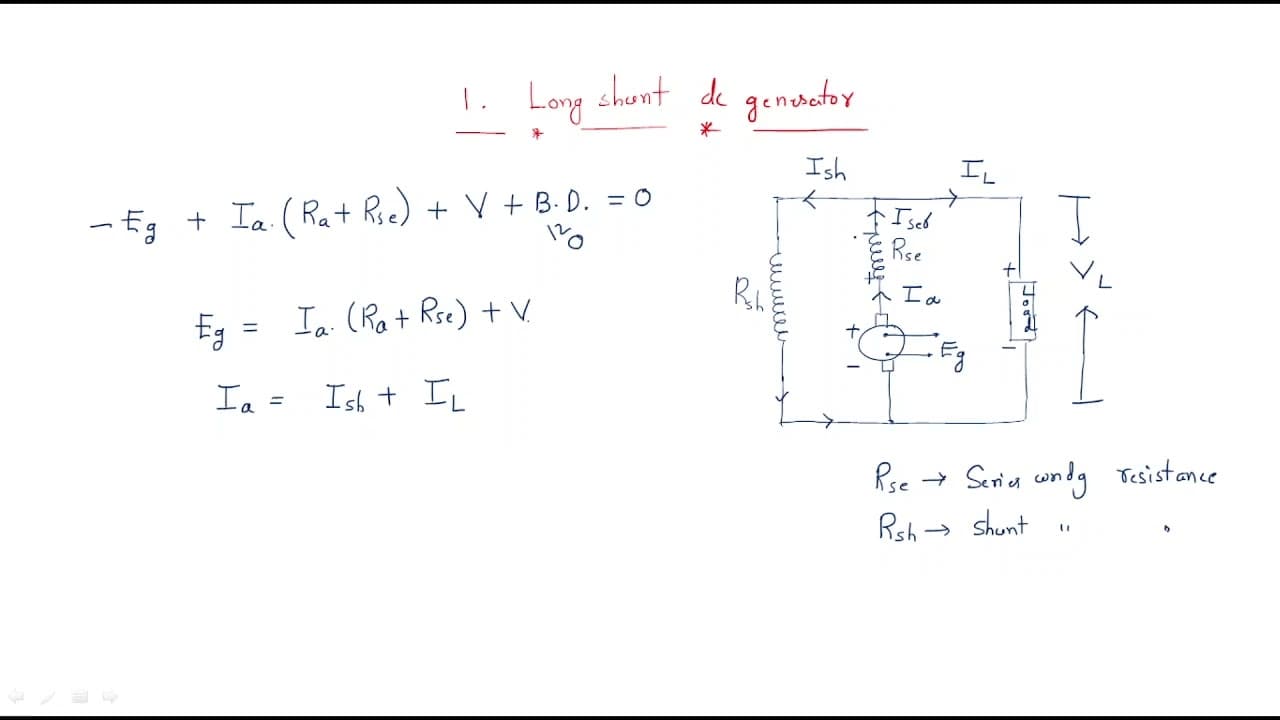
Long shunt configurations have the shunt winding connected across the load, while short shunt configurations connect it in parallel with only the series winding. This distinction affects the current distribution and efficiency of the machine, influencing factors like voltage regulation and overall performance in applications.
Q: How do you calculate the armature current in a compound machine?
The armature current in a compound machine can be calculated using the equation I_a = (E_g - V) / (R_a + R_s), where E_g is the generated EMF, V is the load voltage, R_a is the armature resistance, and R_s is the series resistance. This formula accounts for various voltage drops in the machine circuit.
Q: What factors influence the degree of compounding in DC machines?
The degree of compounding in DC machines is influenced by the turns ratio between the series and shunt windings, the load conditions, and the design of the machine itself. Proper design ensures that the machine can efficiently handle varying loads, maintaining stability and performance.
Summary & Key Takeaways
-
The session explains the basics of compound DC machines, focusing on the combination of series and shunt windings that create various types of machines.
-
Three types of compounding—over-compounding, under-compounding, and flat-compounding—are defined by the relationship between load voltage and generated EMF.
-
The difference between long shunt and short shunt configurations is explored, detailing how windings impact the machine's operation and current distribution.
Read in Other Languages (beta)
Share This Summary 📚
Summarize YouTube Videos and Get Video Transcripts with 1-Click
Try YouTube Summary with ChatGPT & Claude or YouTube Transcript Generator