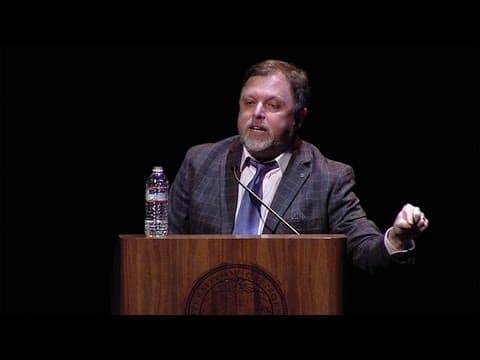
Lynn Hunt: Inventing Human Rights

TL;DR
The lecture addresses the evolution of human rights concepts and their connection to societal changes, particularly regarding torture.
Transcript
good afternoon my name is David Marshall and I'm executive Dean of the College of Letters and science and you know humanities and Fine Arts at UC Santa Barbara I'm very glad to welcome you here today to this inaugural lecture of the Wade Clark roof lectures on human rights and you'll be hearing from Professor Lynn hunt in a few minutes I've known p... Read More
Key Insights
- 🗯️ The Wade Clark Roof Lecture series serves to honor contributions to the discourse on human rights and promote ongoing civic dialogue and action.
- 🗯️ A fundamental theme in Hunt's lecture is the paradox of self-evident rights, illustrated through Jefferson's and the Universal Declaration's historical contexts and implications.
- 🗯️ Key Enlightenment thinkers catalyzed a significant shift in public perception of torture, transitioning from acceptance to moral opposition grounded in emerging individual rights.
- 💦 Hunt’s work emphasizes the role of literature in promoting empathy, suggesting that narratives shaped public understanding of justice, individual rights, and societal responsibility.
- 🗯️ The evolution of human rights concepts is linked to broader societal changes, including personal autonomy and shifts in how individual bodies were viewed and treated in the legal system.
- 🖐️ Emotional responses to suffering, both in literature and social views, played a critical role in advancing the case against judicial torture and correlating it with human dignity.
- 💋 Historical campaigns against torture formed alongside evolving views of morality and human sentiment, marking a critical phase in shaping contemporary human rights discourse.
Install to Summarize YouTube Videos and Get Transcripts
Explore YouTube Video Summarizer or Get YouTube Transcript Extractor
Questions & Answers
Q: What motivated the establishment of the Wade Clark Roof Lectureship on Human Rights at UC Santa Barbara?
The lectureship was founded to honor the legacy of Wade Clark Roof, the center's founding director, following a successful fundraising campaign. It aims to promote dialogue and debate about human rights issues, reflecting Roof's commitment to ethical public discourse, emphasizing the importance of civic action in securing basic human rights.
Q: How does Professor Hunt link the concept of human rights to the historical context of torture and punishment?
Hunt argues that shifts in societal attitudes towards punishment, especially torture, were influenced by Enlightenment thinkers and cultural transformations in the 18th century, which emphasized individual autonomy and empathy. This change led to questioning judicial torture practices, ultimately resulting in their abolition as part of the broader human rights advancement.
Q: What role did literature, particularly novels, play in shaping modern notions of human rights?
Novels, especially the epistolary genre, fostered empathy by allowing readers to identify with diverse characters. This identification created awareness of shared human experiences, promoting individual autonomy and moral values central to human rights. Authors like Richardson and Rousseau encouraged readers to understand others’ situations, thus cultivating an empathetic public consciousness.
Q: What historical figures and moments does Hunt reference in her analysis of human rights evolution?
Hunt references Thomas Jefferson’s Declaration of Independence and the French Declaration of the Rights of Man, along with the influence of Enlightenment figures like Rousseau and Voltaire. She highlights key events, such as rising public disdain for torture in the 1760s, which culminated in significant legal reforms regarding punishment and individual rights.
Summary & Key Takeaways
-
The lecture commemorates the Wade Clark Roof Lecture series at UC Santa Barbara, highlighting the importance of human rights discourse in contemporary society and saluting Professor Roof’s contributions.
-
Professor Lynn Hunt discusses the historical underpinnings of human rights, tracing key influences from the Enlightenment, particularly the relation of these rights to perceptions of torture and authority.
-
The emerging understandings of individual autonomy and empathy in the 18th century played a pivotal role in transitioning societal views on punishment, ultimately contributing to the abolition of torture practices.
Read in Other Languages (beta)
Share This Summary 📚
Summarize YouTube Videos and Get Video Transcripts with 1-Click
Try YouTube Summary with ChatGPT & Claude or YouTube Transcript Generator
Explore More Summaries from University of California Television (UCTV) 📚





Summarize YouTube Videos and Get Video Transcripts with 1-Click
Try YouTube Summary with ChatGPT & Claude or YouTube Transcript Generator