JIT Just In Time
TL;DR
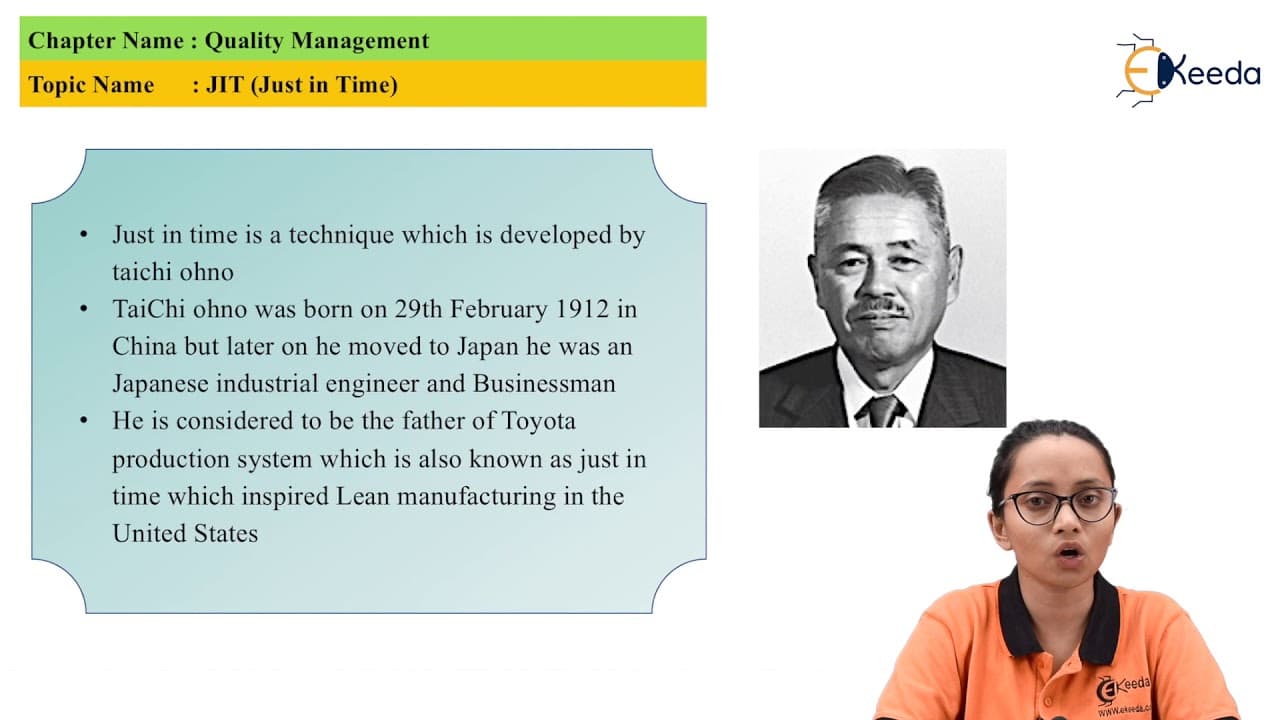
Just-In-Time (JIT) is a technique developed by Japanese engineer Chihiro Ohno, known as the father of the Tokyo Production system, which revolutionized manufacturing by reducing waste and inventory levels.
Transcript
hello guys in this video we are going to study about just-in-time JIT Just In Time is a technique which is developed by heo No Chi Chi Ohno was born on 29th February 1912 in China but later on he moved to Japan he was in Japanese industrial engineer and businessman he is considered to be the father of Tokyo Production system which is also known as ... Read More
Key Insights
- 🎚️ Chihiro Ohno developed Just-In-Time (JIT) manufacturing, which focused on reducing waste and inventory levels in the manufacturing process.
- 🇺🇸 JIT was inspired by the Toyota Production system and gained popularity in the United States and other countries.
- 🗑️ The 7 wastes concept in JIT helps identify non-value-adding activities in the manufacturing process.
- 😃 Japan adopted JIT due to financial constraints, limited space for big factories, scarcity of resources, and a need for high labor efficiency.
- 🍉 JIT manufacturing was later overtaken by the term "lean manufacturing" in the 1990s.
- 💐 Other companies implemented JIT manufacturing under different names, such as Motorola's short circle manufacturing and IBM's continuous-flow manufacturing.
- ❓ Kanban is an element of the Toyota Production system and JIT production.
Install to Summarize YouTube Videos and Get Transcripts
Explore YouTube Video Summarizer or Get YouTube Transcript Extractor
Questions & Answers
Q: Who is considered the father of the Tokyo Production system and the creator of Just-In-Time manufacturing?
Chihiro Ohno, a Japanese industrial engineer and businessman, is considered the father of the Tokyo Production system and the creator of Just-In-Time manufacturing.
Q: What is the 7 wastes concept in JIT manufacturing?
The 7 wastes, also known as Buddha in Japanese, are non-value-adding activities in the manufacturing process. These wastes include overproduction, waiting, transportation, excess processing, inventory, unnecessary motion, and defects.
Q: Why did JIT manufacturing become popular in Japan after World War II?
Japan's lack of cash for big batch production methods, limited space for large factories, scarcity of natural resources, and high unemployment led them to adopt JIT. Smaller factories, low inventory levels, and efficient use of resources became the key focus.
Q: What replaced the term "just-in-time" in the 1990s?
The term "just-in-time" was replaced by the term "lean manufacturing" in the 1990s as the preferred term to describe the efficient production methodology.
Summary & Key Takeaways
-
Just-in-Time (JIT) is a manufacturing technique developed by Chihiro Ohno, a Japanese industrial engineer and businessman, that emphasizes reducing waste and inventory levels.
-
Ohno devised the concept of the 7 wastes, also known as Buddha in Japanese, as part of the JIT system.
-
JIT manufacturing became popular in the 1980s but was later overshadowed by the term "lean manufacturing" in the 1990s.
Read in Other Languages (beta)
Share This Summary 📚
Summarize YouTube Videos and Get Video Transcripts with 1-Click
Try YouTube Summary with ChatGPT & Claude or YouTube Transcript Generator
Explore More Summaries from Ekeeda 📚






Summarize YouTube Videos and Get Video Transcripts with 1-Click
Try YouTube Summary with ChatGPT & Claude or YouTube Transcript Generator