What Is the Rule of 70?
TL;DR
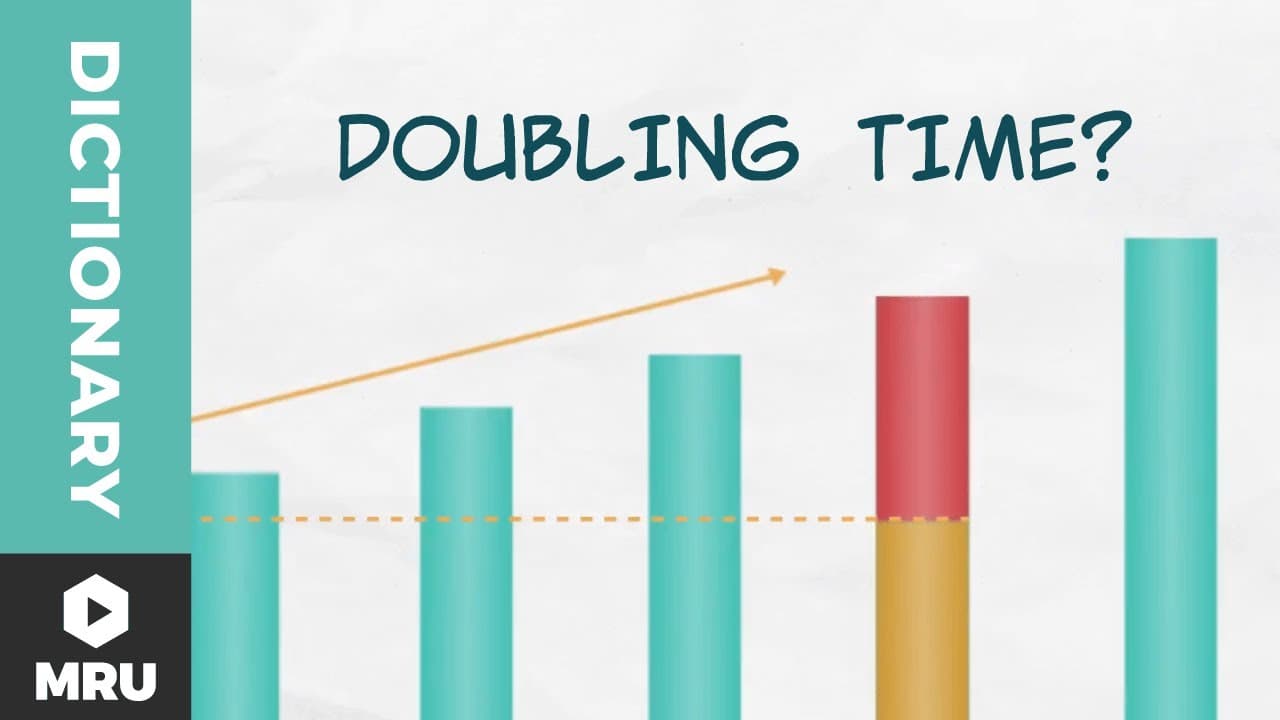
The Rule of 70 estimates doubling time using growth rates.
Transcript
♪ [music] ♪ [Narrator] The Rule of 70 is a quick and easy method to tell you how fast something that is growing will double in size over time. It doesn't matter what is growing -- it could be your savings account, the world population, computing power, the number of bacteria in a petri dish, or a country's economy -- the Rule of 70 will allow you t... Read More
Key Insights
- The Rule of 70 is a simple method to approximate the doubling time of a growing variable by dividing 70 by the growth rate percentage.
- This rule applies to various contexts, including savings accounts, world population, computing power, and economies, demonstrating its wide applicability.
- It provides a quick estimation method, bypassing the need for complex compounding calculations, making it accessible for everyday use.
- In high-growth economies like China, the Rule of 70 illustrates the dramatic impact of sustained growth rates over time, such as GDP per capita increasing 32 times in 35 years.
- For developed countries with lower growth rates, the Rule of 70 highlights the stark contrast in economic expansion compared to rapidly growing nations.
- The rule can be applied in reverse to determine the growth rate if the doubling time is known, offering flexibility in economic analysis.
- Understanding the Rule of 70 can enhance one's ability to analyze economic trends, investment growth, and demographic changes efficiently.
- The concept is a valuable tool in macroeconomics, helping to explain differences in growth rates and their long-term impacts on living standards.
Install to Summarize YouTube Videos and Get Transcripts
Explore YouTube Video Summarizer or Get YouTube Transcript Extractor
Questions & Answers
Q: What is the Rule of 70?
The Rule of 70 is a straightforward method used to estimate the time it takes for a variable to double, given its annual growth rate. By dividing 70 by the growth rate percentage, you can quickly approximate the doubling time, making it a useful tool for analyzing economic growth, investment returns, and other scenarios involving exponential growth.
Q: How does the Rule of 70 apply to economic growth?
In economics, the Rule of 70 can be used to estimate how long it takes for a country's GDP to double based on its annual growth rate. This helps in comparing the economic growth of different countries, illustrating the significant impact of sustained high growth rates in rapidly developing economies compared to more developed nations with lower growth rates.
Q: Can the Rule of 70 be used for investments?
Yes, the Rule of 70 is particularly useful for estimating how long it will take for an investment to double in value, given a specific annual growth rate. By dividing 70 by the investment's growth rate, investors can quickly gauge the time frame for doubling their money, aiding in financial planning and decision-making.
Q: What are some practical applications of the Rule of 70?
The Rule of 70 can be applied in various scenarios, such as calculating the doubling time of savings accounts, understanding population growth, analyzing computing power increases, and estimating the growth of bacteria in a laboratory setting. Its versatility makes it a valuable tool in both personal finance and broader economic analysis.
Q: How accurate is the Rule of 70?
The Rule of 70 provides a close approximation for doubling time, though it is not exact. For example, with a 5% growth rate, the rule estimates a doubling time of 14 years, while the exact calculation is 13.86 years. Despite this slight discrepancy, the rule remains a reliable and quick estimation method.
Q: How can the Rule of 70 be used in reverse?
The Rule of 70 can be applied in reverse to determine the growth rate if the doubling time is known. By dividing 70 by the doubling time, one can calculate the approximate annual growth rate, offering a flexible approach to understanding growth dynamics in various contexts.
Q: Why is the Rule of 70 important in macroeconomics?
In macroeconomics, the Rule of 70 is important because it provides a simple way to visualize and compare the growth rates of different economies over time. This helps in understanding the long-term impacts of growth on living standards, economic development, and the disparities between rapidly growing and more stable economies.
Q: What insights does the Rule of 70 offer about China's economic growth?
The Rule of 70 highlights the extraordinary impact of China's sustained high growth rates over several decades. With growth rates often between 7% and 10%, China's GDP per capita doubled multiple times, leading to a 32-fold increase over 35 years. This dramatic growth illustrates the power of compounding in transforming economies.
Summary & Key Takeaways
-
The Rule of 70 provides a quick method for estimating how long it takes for a variable to double, based on its growth rate. This rule is versatile and can be applied to various scenarios, such as economic growth, population increases, and investment returns, simplifying the understanding of compounding effects.
-
By dividing 70 by the annual growth rate, one can approximate the doubling time of any growing entity. This method is particularly useful in comparing growth rates between different economies, highlighting the significant differences in economic expansion over time, especially in rapidly growing countries like China.
-
The Rule of 70 is not only useful for estimating future growth but can also be applied in reverse to determine the growth rate from known doubling times. This flexibility makes it a powerful tool in economic analysis, offering insights into the long-term impacts of growth rates on various sectors.
Read in Other Languages (beta)
Share This Summary 📚
Summarize YouTube Videos and Get Video Transcripts with 1-Click
Try YouTube Summary with ChatGPT & Claude or YouTube Transcript Generator
Explore More Summaries from Marginal Revolution University 📚


Summarize YouTube Videos and Get Video Transcripts with 1-Click
Try YouTube Summary with ChatGPT & Claude or YouTube Transcript Generator