Case Study How SDN Changed Traditional Enterprise Network Design - Software Defined Networks
TL;DR
SDN, or software-defined networking, is a software-based solution that offers benefits such as traffic programmability, agility, and policy-driven network supervision, while allowing for centralized control and reduced operating costs.
Transcript
hello students hope you are doing well in this video we are going to discuss case study how sdn changed traditional enterprise network design of unit 6 software defined network for the subject enterprise network design of b7 semester it university of mumbai now there is a question what are the benefits of software defined network sdn and how it is ... Read More
Key Insights
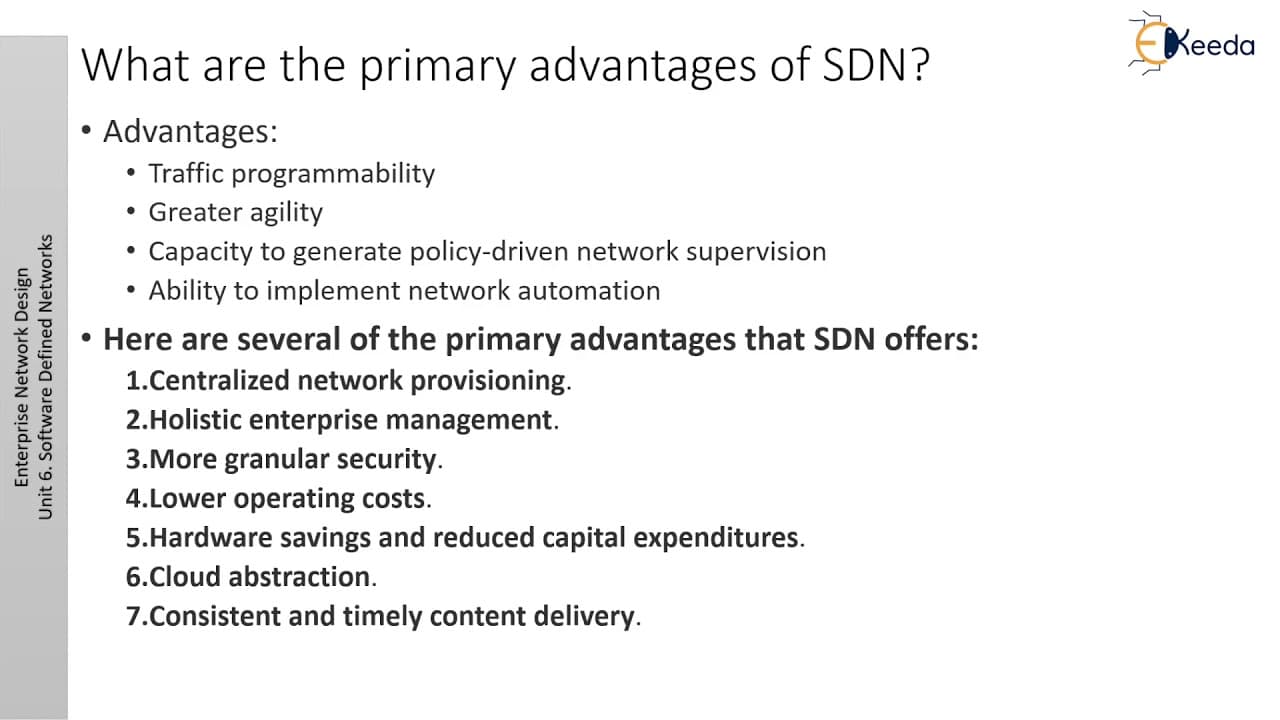
- 🚥 SDN provides traffic programmability, agility, and policy-driven network supervision.
- ❓ SDN enables centralized network provisioning and holistic enterprise network management.
- 😘 SDN offers granular security, lower operating costs, and reduced capital expenditures through hardware savings.
- 😶🌫️ SDN facilitates cloud abstraction and consistent content delivery.
- 🪡 Companies are transitioning to SDN due to the demands of untethered access, bring your own device policies, and the need for improved network performance and innovation.
- 👻 SDN infrastructure decouples control and forwarding, streamlining network changes and allowing for scalability and flexibility.
Install to Summarize YouTube Videos and Get Transcripts
Explore YouTube Video Summarizer or Get YouTube Transcript Extractor
Questions & Answers
Q: What is SDN and how does it differ from traditional networking?
SDN is a software-based solution that separates control and packet forwarding in a network, offering greater flexibility and control compared to traditional hardware-centric networking.
Q: What are the benefits of SDN in enterprise network management?
SDN offers benefits such as centralized network provisioning, holistic management, granular security, lower operating costs, hardware savings, cloud abstraction, and improved content delivery.
Q: How does SDN enable network automation and policy-driven network supervision?
SDN allows for the automation of network administration tasks, centralizes network control and management, and provides a platform for implementing policies to govern network traffic and security.
Q: Why are companies transitioning to SDN from traditional network infrastructure?
Companies are adopting SDN for its benefits such as increased agility, scalability, and visibility, as well as the ability to adapt to changing demands without investing in additional physical infrastructure.
Summary & Key Takeaways
-
SDN is a software-based solution that decouples control and packet forwarding in a network, allowing for direct connection to applications and creating a flexible network architecture.
-
Traditional networking infrastructure, with manual configurations and proprietary provisioning software, is unable to keep up with the demands of modern networks.
-
SDN offers advantages such as centralized network provisioning, holistic enterprise network management, granular security, lower operating costs, hardware savings, cloud abstraction, and consistent content delivery.
Read in Other Languages (beta)
Share This Summary 📚
Summarize YouTube Videos and Get Video Transcripts with 1-Click
Try YouTube Summary with ChatGPT & Claude or YouTube Transcript Generator
Explore More Summaries from Ekeeda 📚






Summarize YouTube Videos and Get Video Transcripts with 1-Click
Try YouTube Summary with ChatGPT & Claude or YouTube Transcript Generator