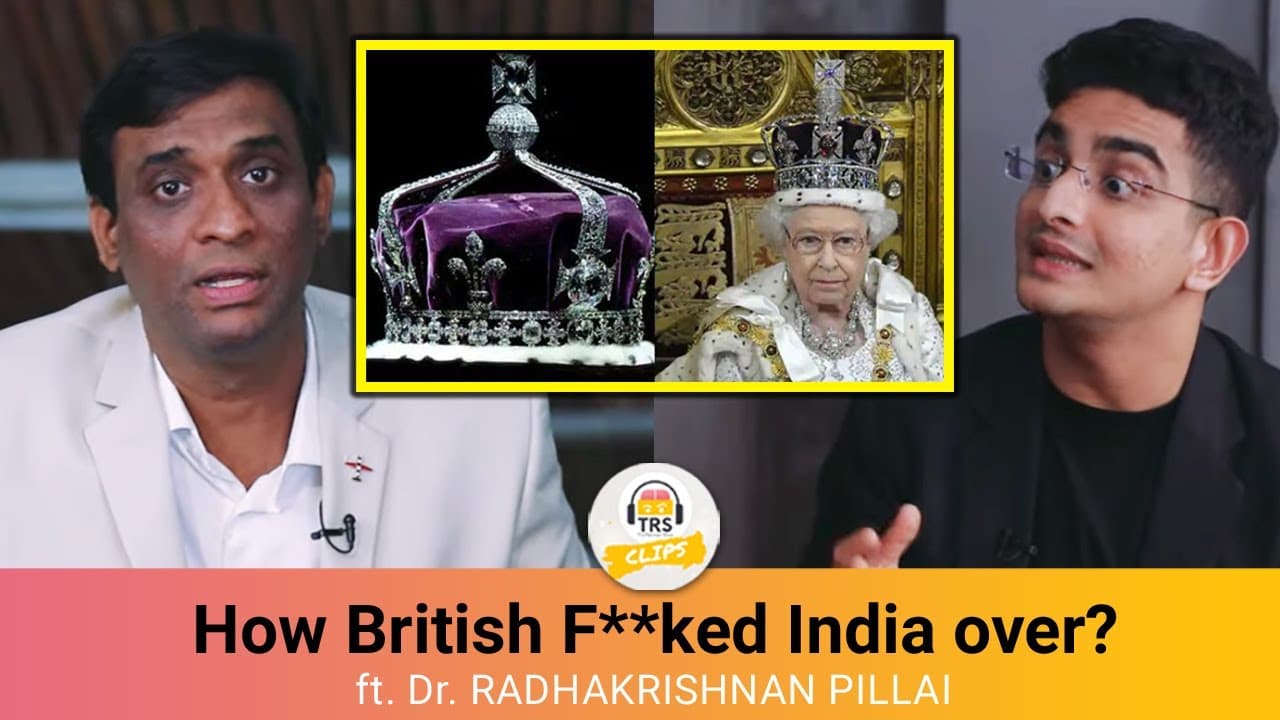
Dr. Radhakrishnan Pillai - How British F*cked India Over | TheRanveerShow Clips
TL;DR
India's economic liberalization in 1991 transformed its growth trajectory and integrated global best practices.
Transcript
so what's happening now things are changing we've read about two important factors in the history of India becoming rich after independence one was something called liberalisation of the Indian economies which is that Manmohan Singh opened up the economy so very simply to a junior ad student can you explain that in like few sentences what happened ... Read More
Key Insights
- 🏣 India's economic growth post-liberalization was a result of attracting foreign direct and institutional investments, transforming its economic landscape.
- 🥺 The period leading up to 1991 illustrated the struggle of a nation burdened by poor infrastructure and a need for resources, which liberalization helped address.
- 👋 The focus on global best practices facilitated the development of a competitive workforce in sectors such as IT, changing the dynamics of employment in India.
- 👻 Institutions like JP Morgan and other foreign companies contributed to knowledge transfer, allowing Indian professionals to gain experience without needing to relocate.
- 🌐 The integration of global businesses also fostered innovation in Indian companies, enabling them to better serve local markets while leveraging international expertise.
- 💨 India's eventual acceptance of globalization and liberalization paved the way for becoming an appealing destination for multinational corporations.
- 💢 The liberalization era highlighted the importance of adaptive strategies in business, encouraging local firms to re-evaluate and enhance their operational protocols.
Install to Summarize YouTube Videos and Get Transcripts
Explore YouTube Video Summarizer or Get YouTube Transcript Extractor
Questions & Answers
Q: What was the economic condition of India before 1991?
Before 1991, India faced a dire economic situation characterized by low growth rates of one to two percent post-independence. The country was war-torn and impoverished, struggling with a large population that required food, jobs, and education. Despite this, the foundational work by the earlier generation laid the groundwork for future advancements and reforms.
Q: Who played a pivotal role in India's 1991 economic liberalization?
The pivotal figures in India's 1991 economic liberalization were Prime Minister Narasimha Rao and Finance Minister Manmohan Singh. Their acceptance of foreign investments and policies encouraging liberalization marked a significant shift in the Indian economy towards a more market-driven approach, fostering economic opportunities and growth.
Q: How did liberalization affect India's IT industry?
The liberalization policy led to a boom in India's IT industry around the year 2000, largely driven by the demand for addressing the Y2K problem. This created an unprecedented need for skilled computer professionals capable of reprogramming systems, allowing India to showcase its talent on a global scale and establishing itself as a leader in tech services.
Q: What are some examples of global best practices introduced into India post-liberalization?
Post-liberalization, India welcomed global best practices in various sectors, including fast food. A notable example is McDonald's, which adapted its operational efficiencies to Indian standards, showcasing consistent quality and service. Such practices helped improve the overall work culture and operational effectiveness within Indian firms, promoting modernization.
Q: What misconceptions existed before liberalization regarding foreign investment?
Prior to liberalization, there was a prevailing fear that foreign investors would exploit India's resources similarly to historical British colonization. Many feared that foreign companies would dominate the economy without contributing to local growth. However, over time, this perception changed as the benefits of foreign investment and collaboration became evident.
Q: What was the significance of the year 2000 for India's economy?
The year 2000 was significant for India as it marked the culmination of the IT boom driven by the Y2K crisis. The potential chaos predicted from unprepared computer systems thrust India into the global spotlight, allowing Indian professionals to demonstrate their technical skills and problem-solving capabilities on an international stage.
Q: How did the idea of foreign investments evolve in India since 1991?
Initially met with skepticism and distrust, foreign investments gradually became accepted and welcomed post-1991. The perception shifted as success stories emerged, showcasing that foreign companies not only brought in capital but also shared transformative practices and technologies, significantly contributing to the Indian economy's modernization.
Q: In what ways did economic liberalization prepare India for global challenges?
Economic liberalization equipped India with the exposure to global market dynamics and practices that were previously inaccessible. By embracing best practices and improving operational efficiency across various industries, Indian businesses became more competitive, capable of adapting to international standards and better managing global challenges.
Summary & Key Takeaways
-
The liberalization of India's economy in 1991, initiated by Manmohan Singh and Narasimha Rao, opened the country to foreign investments and led to significant economic growth.
-
Prior to liberalization, India faced severe economic challenges, with low growth rates and a burgeoning population requiring education, employment, and resources.
-
The introduction of global business practices not only brought in investment but also enhanced operational efficiency within Indian businesses, leading to the rise of sectors like IT.
Read in Other Languages (beta)
Share This Summary 📚
Summarize YouTube Videos and Get Video Transcripts with 1-Click
Try YouTube Summary with ChatGPT & Claude or YouTube Transcript Generator
Explore More Summaries from TRS Clips 📚



Summarize YouTube Videos and Get Video Transcripts with 1-Click
Try YouTube Summary with ChatGPT & Claude or YouTube Transcript Generator