L23.3 Permutation operators on N particles and transpositions
TL;DR
Permutation groups consist of rearranging objects and can be represented using transpositions. Any permutation can be expressed as a product of transpositions. There are equal numbers of even and odd permutations in any permutation group.
Transcript
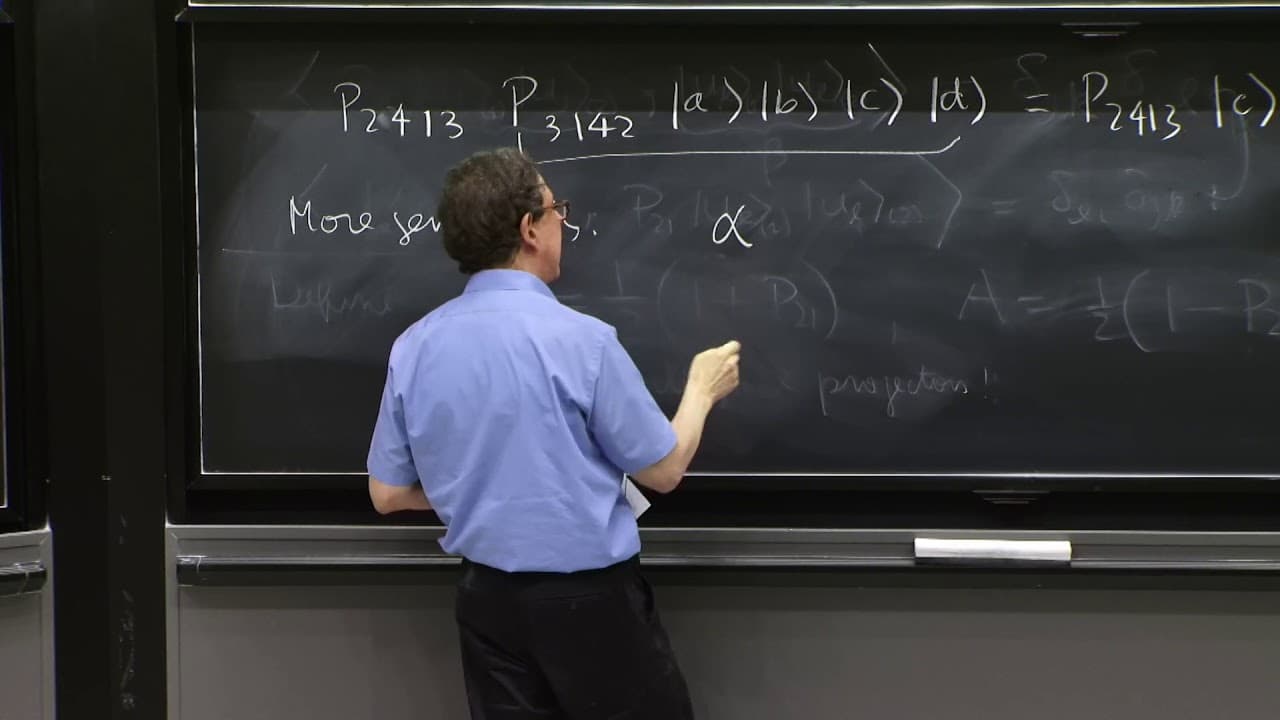
PROFESSOR: Two particles is interesting in many cases. But in order to see what really is happening and how much structure you have to go to more than two particles. Two particles is a little too special. So we need to go beyond two particles and see what happens with this operator. So I'll do that. So we'll add more particles. So let's do that. So... Read More
Key Insights
- ❓ Permutations involve rearranging objects, and they can be represented using transpositions.
- ❓ Transpositions are both Hermitian and unitary.
- 😑 Any permutation can be expressed as a product of transpositions.
- 👥 Permutation groups have equal numbers of even and odd permutations.
- 👥 Permutations form a finite discrete group, distinct from continuous transformation groups.
- 👥 Permutation groups have important mathematical properties worth studying.
- 👥 The permutation group can be used to understand the structure and behavior of larger systems involving more than two particles.
Install to Summarize YouTube Videos and Get Transcripts
Explore YouTube Video Summarizer or Get YouTube Transcript Extractor
Questions & Answers
Q: How are permutation groups defined?
Permutation groups involve rearranging objects, and permutations can be represented using transpositions. A permutation is a reordering of objects, and the number of possible permutations is n factorial, where n is the number of objects.
Q: What is a transposition?
A transposition is a permutation that involves changing the positions of two objects while leaving the others unchanged. Transpositions are both Hermitian and unitary. For example, p21 is a transposition that swaps the first and second objects.
Q: How can any permutation be expressed as a product of transpositions?
Any permutation can be expressed as a product of transpositions. By swapping two objects at a time, one can rearrange the objects according to the desired permutation. This means that any permutation is achievable using transpositions.
Q: What is the relationship between even and odd permutations?
All permutations can be classified as either even or odd. An even permutation is built with an even number of transpositions, while an odd permutation is built with an odd number of transpositions. The number of even and odd permutations in any permutation group is always equal.
Summary & Key Takeaways
-
Permutation groups involve rearranging objects, and permutations can be represented using transpositions.
-
Any permutation can be expressed as a product of transpositions.
-
There are equal numbers of even and odd permutations in any permutation group.
Read in Other Languages (beta)
Share This Summary 📚
Summarize YouTube Videos and Get Video Transcripts with 1-Click
Try YouTube Summary with ChatGPT & Claude or YouTube Transcript Generator
Explore More Summaries from MIT OpenCourseWare 📚



Summarize YouTube Videos and Get Video Transcripts with 1-Click
Try YouTube Summary with ChatGPT & Claude or YouTube Transcript Generator