How to Use Mental Models for Strategic Thinking
TL;DR
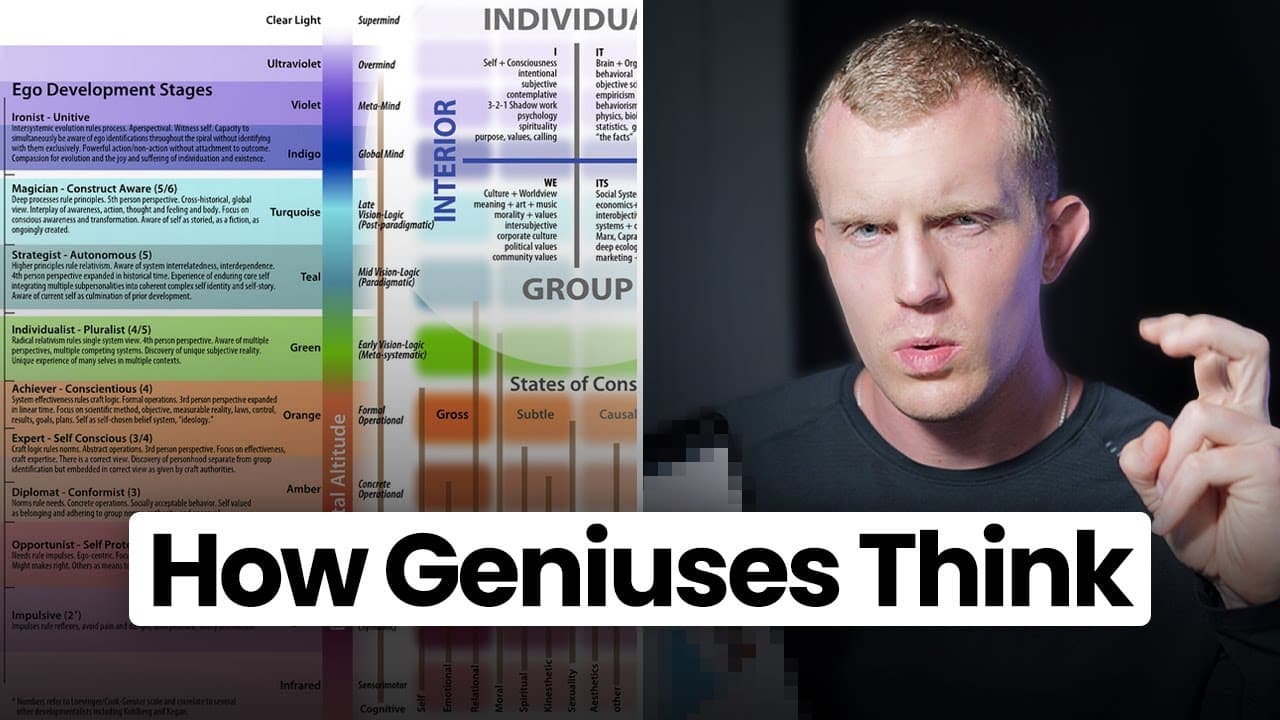
Genius thinking isn't about intelligence but clarity and understanding. By using Ken Wilber's mental model, individuals can systematically examine challenges from multiple perspectives to achieve goals. This model integrates personal, cultural, and systemic insights, allowing for a comprehensive understanding of problems and solutions. Practicing this model can lead to achieving significantly more in life.
Transcript
This is going to sound a bit stupid, but you don't need to be smart to think like a genius. In fact, you probably don't want to be like most smart people because smart people often aren't that smart. What we consider a smart person right now, at least for most people, is someone who has memorized a lot of facts in order to achieve some level of sta... Read More
Key Insights
- Genius thinking focuses on clarity rather than intelligence.
- Ken Wilber's mental model synthesizes global philosophies and sciences.
- The model includes four quadrants: individual interior, individual exterior, collective interior, and collective exterior.
- Thinking through all quadrants provides a comprehensive problem-solving approach.
- Many people fail to achieve their goals due to limited thinking perspectives.
- The model encourages understanding problems deeply and creating effective strategies.
- Levels of consciousness influence how individuals perceive and solve problems.
- Second-tier thinkers synthesize truths from multiple perspectives for complex problem-solving.
Install to Summarize YouTube Videos and Get Transcripts
Explore YouTube Video Summarizer or Get YouTube Transcript Extractor
Questions & Answers
Q: How can I think like a genius without being 'smart'?
Thinking like a genius involves gaining clarity and understanding rather than relying solely on intelligence. By using mental models like Ken Wilber's, you can systematically analyze problems from multiple perspectives, including personal, cultural, and systemic angles. This comprehensive approach allows you to identify and solve problems effectively, ultimately leading to achieving your goals more efficiently.
Q: What is Ken Wilber's mental model?
Ken Wilber's mental model is a synthesis of global philosophies, scientific discoveries, and psychological patterns. It consists of four quadrants: individual interior (personal thoughts and emotions), individual exterior (behaviors and actions), collective interior (shared cultural values), and collective exterior (social systems). This model provides a framework for understanding and solving problems from a holistic perspective.
Q: Why do smart people often fail to achieve their goals?
Smart people often fail to achieve their goals because they focus on intelligence and memorization rather than clarity and understanding. They may overanalyze risks and become paralyzed by information. By using a mental model like Ken Wilber's, individuals can gain a comprehensive understanding of challenges and develop effective strategies, avoiding the pitfalls of narrow, dogmatic thinking.
Q: How does the mental model help in achieving goals?
The mental model helps achieve goals by providing a structured approach to problem-solving. By examining challenges from multiple perspectives—personal, cultural, and systemic—individuals can gain a comprehensive understanding of problems and develop effective strategies. This holistic approach allows for better decision-making and faster achievement of goals compared to traditional, narrow thinking methods.
Q: What are the four quadrants in Ken Wilber's model?
The four quadrants in Ken Wilber's model are: 1) Individual Interior, which includes personal thoughts, emotions, and beliefs; 2) Individual Exterior, encompassing behaviors and actions; 3) Collective Interior, involving shared cultural values and group consciousness; and 4) Collective Exterior, which consists of social systems and structures. Together, these quadrants provide a comprehensive framework for understanding and solving problems.
Q: What is the significance of levels in the mental model?
Levels in the mental model represent stages of consciousness and value systems that influence how individuals perceive and solve problems. Understanding these levels helps identify personal and systemic challenges, allowing individuals to develop a more nuanced perspective. Second-tier thinkers, who can synthesize truths from multiple perspectives, are better equipped to solve complex problems effectively.
Q: How can I apply the mental model to my life?
To apply the mental model to your life, start by examining challenges from all four quadrants: personal thoughts, behaviors, cultural values, and social systems. Ask yourself questions related to each quadrant to gain a comprehensive understanding of your situation. Use this insight to identify problems, develop strategies, and make informed decisions, ultimately leading to achieving your goals more efficiently.
Q: What are the benefits of second-tier thinking?
Second-tier thinking allows individuals to synthesize truths from multiple perspectives, providing a more comprehensive understanding of complex problems. This approach enables better problem-solving and decision-making, as it considers various factors and viewpoints. Second-tier thinkers can effectively navigate challenges by integrating insights from personal, cultural, and systemic angles, leading to more successful outcomes in personal and professional endeavors.
Summary & Key Takeaways
-
Ken Wilber's mental model offers a structured approach to thinking like a genius by integrating insights from personal, cultural, and systemic perspectives. This method allows individuals to understand problems deeply and create effective strategies for achieving their goals.
-
The model consists of four quadrants that examine personal thoughts, behaviors, cultural values, and social systems. By considering all quadrants, individuals can gain a comprehensive understanding of challenges and avoid narrow, dogmatic thinking.
-
Understanding different levels of consciousness is crucial for problem-solving. Second-tier thinkers, who synthesize truths from various perspectives, can solve complex problems more effectively than those who are stuck in rigid, single-perspective thinking.
Read in Other Languages (beta)
Share This Summary 📚
Summarize YouTube Videos and Get Video Transcripts with 1-Click
Try YouTube Summary with ChatGPT & Claude or YouTube Transcript Generator
Explore More Summaries from Dan Koe 📚




Summarize YouTube Videos and Get Video Transcripts with 1-Click
Try YouTube Summary with ChatGPT & Claude or YouTube Transcript Generator