Lecture 1: Motivation, Intuition, and Examples
TL;DR
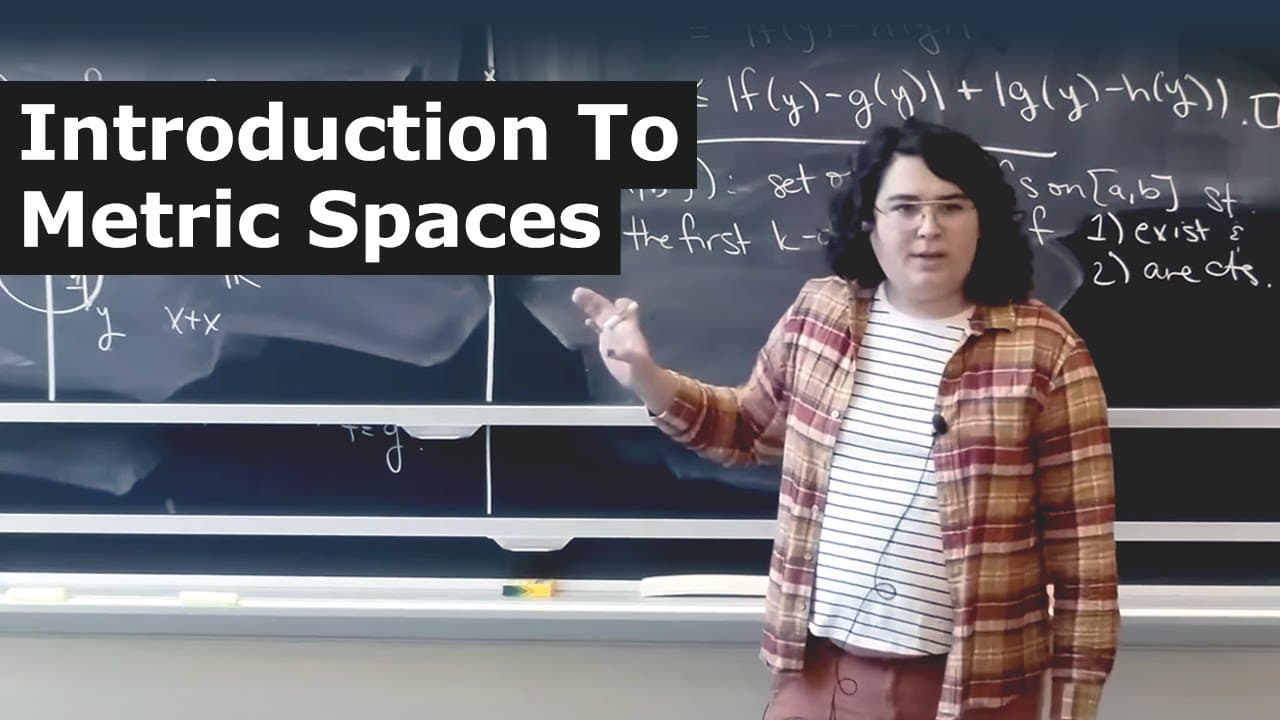
Metric spaces provide a way to measure distances between points in a set, allowing for the study of various mathematical concepts and functions.
Transcript
[SQUEAKING] [RUSTLING] [CLICKING] PAIGE BRIGHT: So welcome to 18.S190, Intro to Metric Spaces. My name is Paige BRIGHT, though sometimes you'll see it as Paige Bright online. That's just because I'm going to change my name, but you can just call me Paige. And, yeah, this is Intro to Metric Spaces, where today we're going to talk about the connectio... Read More
Key Insights
- 😥 Metric spaces provide a way to measure distances between points in a set, allowing for the study of various mathematical concepts and functions.
- 👾 Differentiation and integration can be viewed as continuous operators on metric spaces, providing ways to analyze and manipulate functions within these spaces.
Install to Summarize YouTube Videos and Get Transcripts
Explore YouTube Video Summarizer or Get YouTube Transcript Extractor
Questions & Answers
Q: What is a metric space?
A metric space is a set with a distance function that satisfies properties like symmetry, positivity, and the triangle inequality. It allows for the measurement of distances between points in the set.
Q: How are differentiation and integration related to metric spaces?
Differentiation and integration can be viewed as continuous operators on certain metric spaces, such as the space of continuous functions. They provide a way to analyze and manipulate functions within these spaces.
Q: What is the L1 metric, and how is it related to integration?
The L1 metric is a metric defined on sets of continuous functions, where the distance between two functions is given by the integral of their absolute difference. It allows for the measurement of the "size" or "distance" between functions and is closely related to integration.
Q: Can all sets be considered as metric spaces?
Not all sets can be considered as metric spaces. A set must have a well-defined distance function that satisfies certain properties to be considered a metric space. For example, sets with a finite number of points can be considered as metric spaces, but not all sets will have a meaningful distance function.
Summary & Key Takeaways
-
Metric spaces are sets with a distance function that satisfies certain properties, such as symmetry, positivity, and the triangle inequality.
-
Examples of metric spaces include Euclidean space and sets of continuous or differentiable functions.
-
Differentiation and integration can be viewed as continuous operators on certain metric spaces, such as the space of continuous functions.
-
Integration can also be defined as a metric, known as the L1 metric, on sets of continuous functions.
Read in Other Languages (beta)
Share This Summary 📚
Summarize YouTube Videos and Get Video Transcripts with 1-Click
Try YouTube Summary with ChatGPT & Claude or YouTube Transcript Generator
Explore More Summaries from MIT OpenCourseWare 📚


Summarize YouTube Videos and Get Video Transcripts with 1-Click
Try YouTube Summary with ChatGPT & Claude or YouTube Transcript Generator