L07.7 Independence, Variances & the Binomial Variance
TL;DR
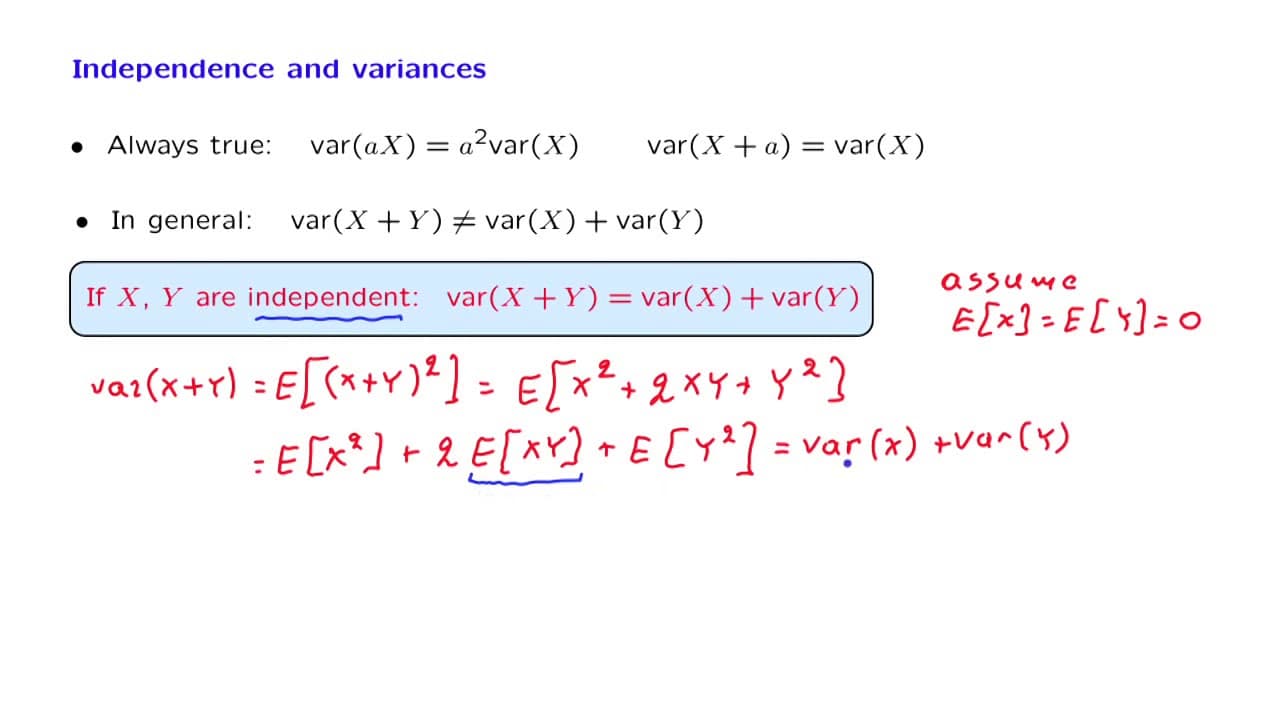
When two random variables are independent, the variance of their sum is equal to the sum of their variances.
Transcript
Let us now revisit the variance and see what happens in the case of independence. Variances have some general properties that we have already seen. However, since we often add random variables, we would like to be able to say something about the variance of the sum of two random variables. Unfortunately, the situation is not so simple, and in gener... Read More
Key Insights
- 🍹 The variance of the sum of two random variables is not always equal to the sum of their variances.
- 🍹 When random variables are independent, the variance of their sum follows the rule of the sum of variances.
- 🍹 The interrelation between random variables determines the variance of their sum.
- 🍹 Knowing the variance of each individual random variable is not enough to determine the variance of their sum.
Install to Summarize YouTube Videos and Get Transcripts
Explore YouTube Video Summarizer or Get YouTube Transcript Extractor
Questions & Answers
Q: What happens to the variance of the sum of two random variables that are not independent?
The variance of the sum is not necessarily equal to the sum of the variances. It depends on the relationship between the two random variables.
Q: How does independence affect the variance of the sum of two random variables?
When two random variables are independent, the variance of their sum is equal to the sum of their variances.
Q: What happens to the variance of the sum when two random variables are the same?
If two random variables are the same, the variance of their sum is equal to 4 times the variance of one of the variables.
Q: What happens to the variance of the sum when one random variable is the negative of the other?
When one random variable is the negative of the other, the variance of their sum is equal to 0.
Summary & Key Takeaways
-
Variances have general properties, but the variance of the sum of two random variables is not always the same as the sum of their variances.
-
When X and Y are independent, the variance of their sum is equal to the sum of their variances.
-
Examples are given to illustrate how the interrelation between random variables affects the variance of their sum.
Read in Other Languages (beta)
Share This Summary 📚
Summarize YouTube Videos and Get Video Transcripts with 1-Click
Try YouTube Summary with ChatGPT & Claude or YouTube Transcript Generator
Explore More Summaries from MIT OpenCourseWare 📚



Summarize YouTube Videos and Get Video Transcripts with 1-Click
Try YouTube Summary with ChatGPT & Claude or YouTube Transcript Generator