L3.5 Feynman Calculus: Divergency
TL;DR
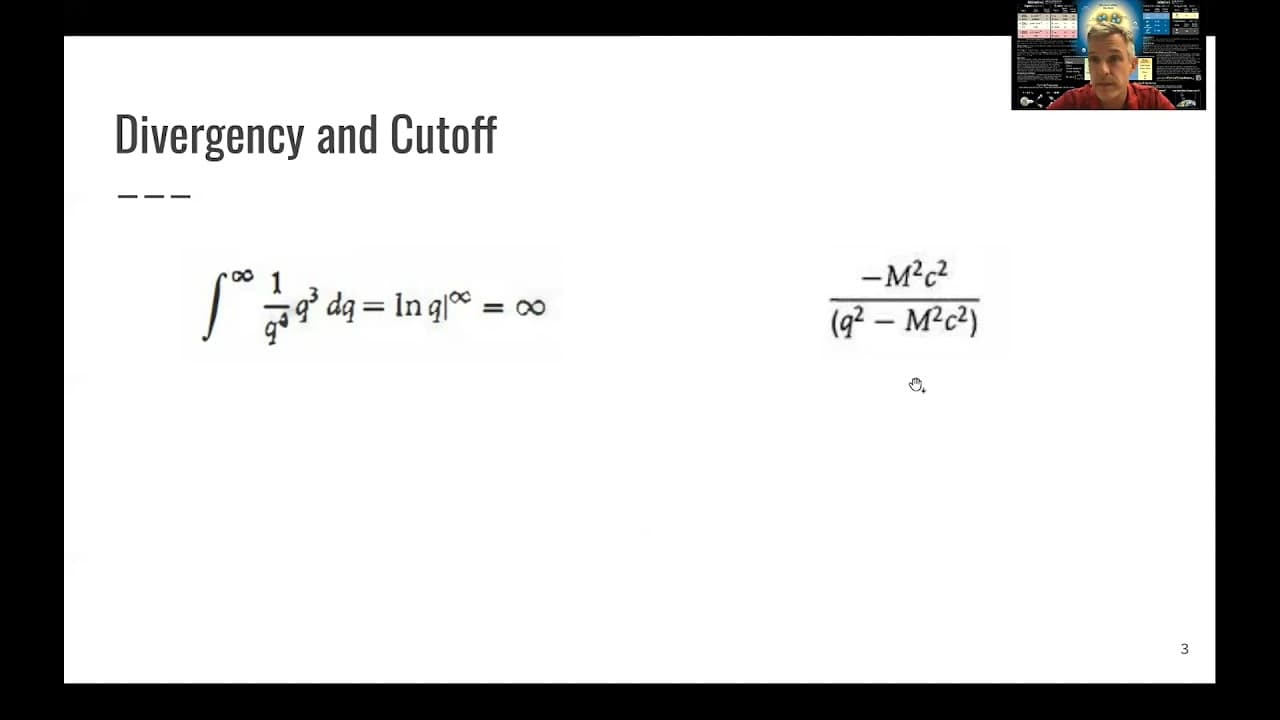
Higher-order corrections in particle physics introduce infinite terms to calculations, but can be managed through the introduction of a cutoff scale and re-normalization.
Transcript
MARKUS KLUTE: Let's come back to 8.701. So in the previous video, we talked about higher-order diagrams and we looked at how we can classify those contributions to the total matrix element. We didn't do any of the calculations, or we didn't calculate the Feynman diagram itself. And I'm not actually planning to do this in the lecture. What we want t... Read More
Key Insights
- 🥺 Higher-order corrections in particle physics involve self-energy corrections to the propagator, leading to divergent integrals.
- ⚖️ The introduction of a cutoff scale and re-scaling or re-normalizing physical objects allows for manageable calculations of infinite terms.
- 🫡 The running of couplings and masses with respect to energy scales can be influenced by the introduction of new particles.
- 🥺 Introducing new particles along the energy scale may lead to a unified theory that encompasses electromagnetic, weak, and strong interactions.
Install to Summarize YouTube Videos and Get Transcripts
Explore YouTube Video Summarizer or Get YouTube Transcript Extractor
Questions & Answers
Q: What is the problem with higher-order corrections in particle physics calculations?
Higher-order corrections can result in infinite terms in calculations, which is problematic as physical quantities like cross-sections and lifetimes should not be infinite.
Q: How is the issue of infinite terms in calculations solved?
The introduction of a cutoff scale allows for calculations to be performed up to a certain scale, and then an additional term is evaluated from the cutoff scale to infinity.
Q: What is the significance of re-scaling or re-normalizing physical objects in calculations?
Re-scaling or re-normalizing allows for the inclusion of corrections to masses and coupling constants, making the calculations consistent with experimental results.
Q: How does the behavior of couplings change with the introduction of new particles along the energy scale?
Introducing new particles can alter the running behavior of couplings, as they contribute to the overall running of the couplings at different energy scales.
Summary & Key Takeaways
-
Higher-order corrections in particle physics involve self-energy corrections to the propagator, resulting in loops in Feynman diagrams.
-
The integration of these corrections can lead to divergent results, but this issue can be solved by introducing a cutoff scale.
-
By re-scaling or re-normalizing physical objects in calculations, infinite terms can be accounted for and compared to experimental results.
Read in Other Languages (beta)
Share This Summary 📚
Summarize YouTube Videos and Get Video Transcripts with 1-Click
Try YouTube Summary with ChatGPT & Claude or YouTube Transcript Generator
Explore More Summaries from MIT OpenCourseWare 📚


Summarize YouTube Videos and Get Video Transcripts with 1-Click
Try YouTube Summary with ChatGPT & Claude or YouTube Transcript Generator