8. Radioactive Decay — Modes, Energetics, and Trends
TL;DR
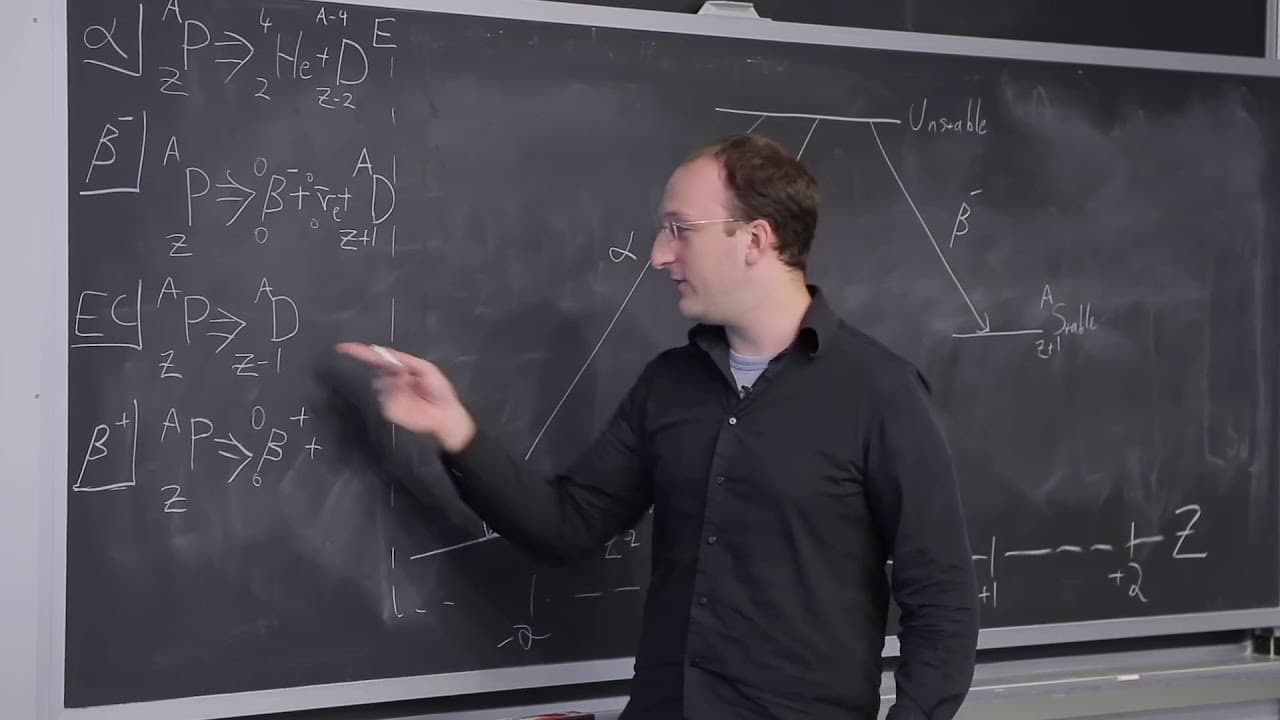
This content provides an overview of radioactive decay, including alpha decay, beta decay, and positron decay. It also discusses the use of positron annihilation spectroscopy to study defects in materials.
Transcript
The following content is provided under a Creative Commons license. Your support will help MIT OpenCourseWare continue to offer high quality educational resources for free. To make a donation or to view additional materials from hundreds of MIT courses, visit MIT OpenCourseWare at ocw.mit.edu. MICHAEL SHORT: Today we launch into radioactive decay. ... Read More
Key Insights
- 🥺 Different types of radioactive decay, such as alpha decay, beta decay, and electron capture, have specific characteristics and can lead to the emission of various particles.
- 🆘 Decay diagrams are used to represent these decay processes and can help determine the final state of the decayed nucleus and the emitted particles.
- 🫀 Positron annihilation spectroscopy is a technique to study defects in materials by measuring the lifetime of positrons before they annihilate with electrons, providing information about atomic defects.
Install to Summarize YouTube Videos and Get Transcripts
Explore YouTube Video Summarizer or Get YouTube Transcript Extractor
Questions & Answers
Q: What is alpha decay?
Alpha decay is a type of radioactive decay where an unstable nucleus emits an alpha particle, which consists of two protons and two neutrons. This causes the atomic number and mass number of the parent nucleus to decrease.
Q: How is beta decay different from alpha decay?
Beta decay involves the emission of a beta particle, which can be an electron (beta minus decay) or a positron (beta plus decay). Unlike alpha decay, beta decay does not involve a significant change in atomic mass, but it does change the atomic number of the nucleus.
Q: What is positron decay?
Positron decay occurs when a proton in the nucleus is converted into a neutron, releasing a positron and a neutrino. This decay process is accompanied by the emission of gamma rays.
Q: How is positron annihilation spectroscopy used in materials science?
Positron annihilation spectroscopy is used to study defects in materials by measuring the lifetime of positrons before they annihilate with electrons. It can provide information about the distribution and size of atomic defects, such as vacancies, in crystalline materials.
Q: Which type of decay is most dangerous to humans?
The most dangerous type of decay depends on the specific circumstances. Alpha particles, for example, can be highly damaging if ingested or inhaled, as they can cause damage to living cells. However, neutrons are also highly damaging as they can penetrate deeply into the body and cause nuclear reactions that release large amounts of energy.
Summary & Key Takeaways
-
The content discusses different types of radioactive decay, including alpha decay, beta decay, electron capture, and positron decay.
-
It explains the process of decay using generalized decay diagrams and provides examples of specific decay reactions.
-
The content also introduces the concept of positron annihilation spectroscopy, which is used to study defects in materials by measuring positron lifetimes.
Read in Other Languages (beta)
Share This Summary 📚
Summarize YouTube Videos and Get Video Transcripts with 1-Click
Try YouTube Summary with ChatGPT & Claude or YouTube Transcript Generator
Explore More Summaries from MIT OpenCourseWare 📚



Summarize YouTube Videos and Get Video Transcripts with 1-Click
Try YouTube Summary with ChatGPT & Claude or YouTube Transcript Generator