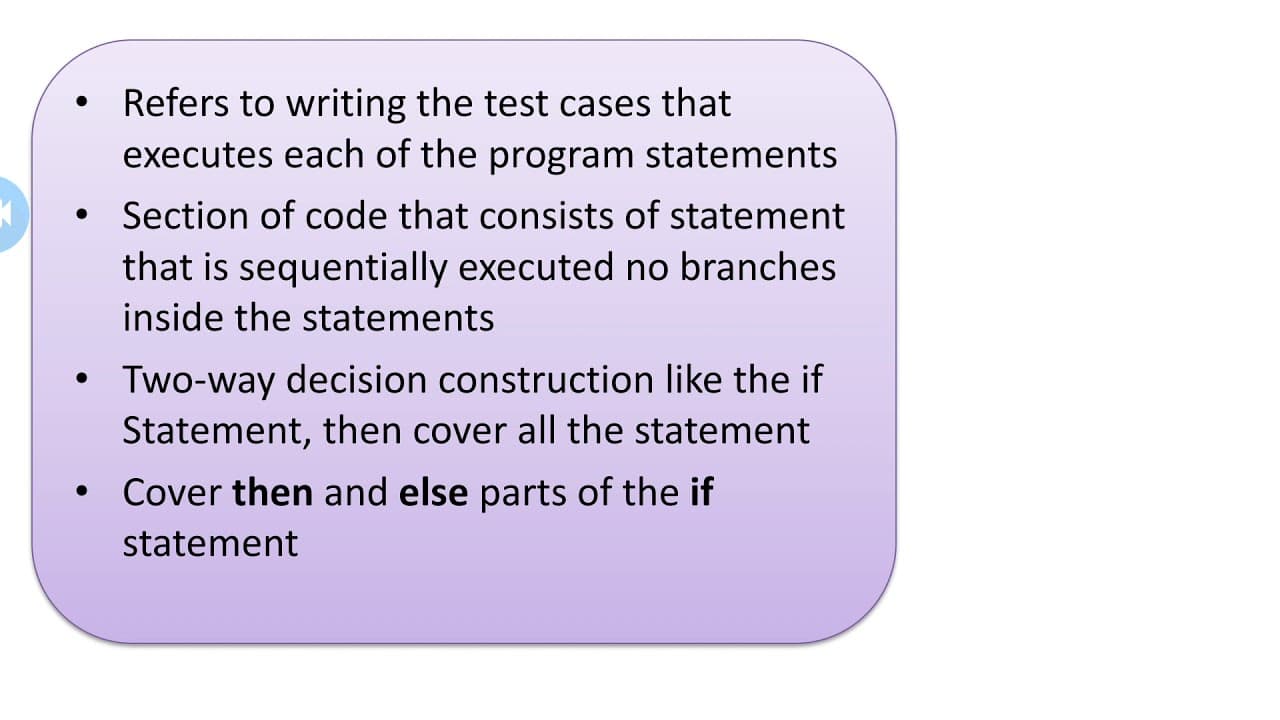
Statements coverage - Testing Techniques - Software Testing and Quality Assurance
TL;DR
This content discusses different testing techniques, including black box testing, white box testing, and structural unit testing.
Transcript
chapter 2 testing technique we have already seen black box testing based on your requirements the things are tested requirements are tested and we have seen the technique of black box testing the first was requirement based testing second was boundary value analysis third was decision tables fourth was equivalence partition or you can say equivalen... Read More
Key Insights
- 🚰 Black box testing techniques include boundary value analysis, decision tables, equivalence partition, and state or graph space transition tables.
- 🍱 White box testing focuses on the internal structure and patterns of the software.
- 👨💻 Structural unit testing involves functionality testing, code coverage testing, and code complexity analysis.
Install to Summarize YouTube Videos and Get Transcripts
Explore YouTube Video Summarizer or Get YouTube Transcript Extractor
Questions & Answers
Q: What is black box testing?
Black box testing is a technique that tests software based on its requirements, employing methods like boundary value analysis, decision tables, equivalence partitioning, and state or graph space transition tables.
Q: What is white box testing?
White box testing is a testing method that focuses on the internal structure of the software. It involves static testing techniques and follows certain patterns to ensure code quality.
Q: What is structural unit testing?
Structural unit testing is based on three aspects: functionality testing, code coverage testing, and code complexity analysis. It aims to assess the functionality of the software, measure the extent of code coverage, and analyze the complexity of the code.
Q: What is code coverage testing?
Code coverage testing involves designing and executing test cases to measure the percentage of code that is being tested. It employs techniques like statement coverage, path coverage, condition coverage, and function coverage.
Summary & Key Takeaways
-
The content covers black box testing, which focuses on testing requirements and includes techniques like boundary value analysis, decision tables, equivalence partition, and state or graph space transition tables.
-
White box testing is discussed, highlighting static testing and its patterns.
-
Structural unit testing is explained, focusing on functionality testing, code coverage testing, and code complexity.
Read in Other Languages (beta)
Share This Summary 📚
Summarize YouTube Videos and Get Video Transcripts with 1-Click
Try YouTube Summary with ChatGPT & Claude or YouTube Transcript Generator
Explore More Summaries from Ekeeda 📚


Summarize YouTube Videos and Get Video Transcripts with 1-Click
Try YouTube Summary with ChatGPT & Claude or YouTube Transcript Generator