26.1 Momentum in Collisions
TL;DR
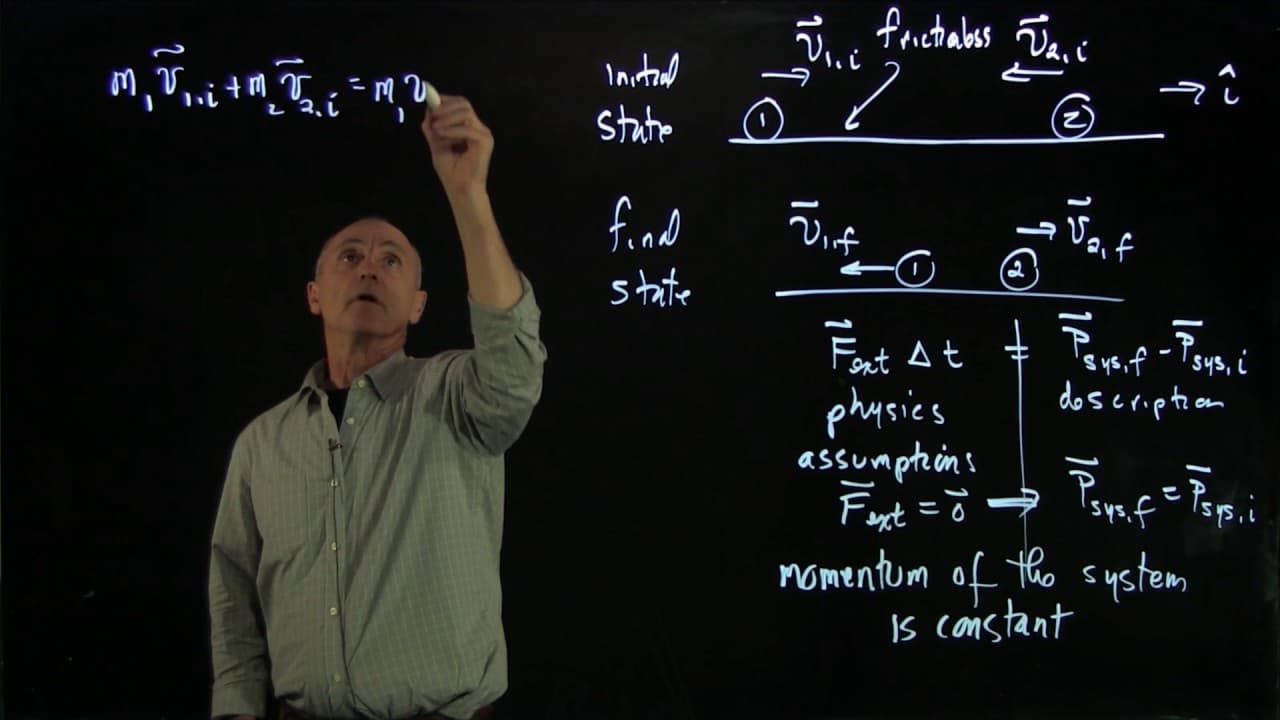
In a one-dimensional collision, if there are no external forces, the momentum of the system remains constant.
Transcript
Let's consider our one-dimensional collision again, object 1 moving with velocity V1 initial, and object 2 moving with V2 initial. Let's call this or i hat direction. And this is our initial state. And our final state after the collision, we have object 1. We'll say it's moving this, V1 final, and object 2 moving that way, V2 final. Now recall our ... Read More
Key Insights
- 🥹 Conservation of momentum holds true in a one-dimensional collision without external forces.
- 💥 Friction and air resistance are often neglected in collision analysis.
- 😑 Momentum can be expressed as vector expressions or component equations.
Install to Summarize YouTube Videos and Get Transcripts
Explore YouTube Video Summarizer or Get YouTube Transcript Extractor
Questions & Answers
Q: What is the principle of impulse and momentum?
The principle of impulse and momentum states that the change in momentum of a system is equal to the external forces acting on the system during a collision.
Q: Why do we assume no external forces in a one-dimensional collision?
By assuming no external forces, such as friction and air resistance, we can simplify the analysis and focus on the conservation of momentum in the system.
Q: How do we express the conservation of momentum in vector expressions?
We express the conservation of momentum in vector expressions by equating the initial momentum of the system to the final momentum of the system, taking into account the masses and velocities of the objects involved.
Q: How can we represent the equations in terms of components?
The equations can be represented in terms of components by expressing the momentum as the product of mass and velocity in specific directions (e.g., x-direction), which allows us to analyze the conservation of momentum for each component separately.
Summary & Key Takeaways
-
In a one-dimensional collision, the initial and final states of two objects moving with different velocities are considered.
-
According to the principle of impulse and momentum, the change in momentum is equal to the external forces acting on the system.
-
By assuming no external forces, such as friction and air resistance, the momentum of the system remains constant.
Read in Other Languages (beta)
Share This Summary 📚
Summarize YouTube Videos and Get Video Transcripts with 1-Click
Try YouTube Summary with ChatGPT & Claude or YouTube Transcript Generator
Explore More Summaries from MIT OpenCourseWare 📚



Summarize YouTube Videos and Get Video Transcripts with 1-Click
Try YouTube Summary with ChatGPT & Claude or YouTube Transcript Generator