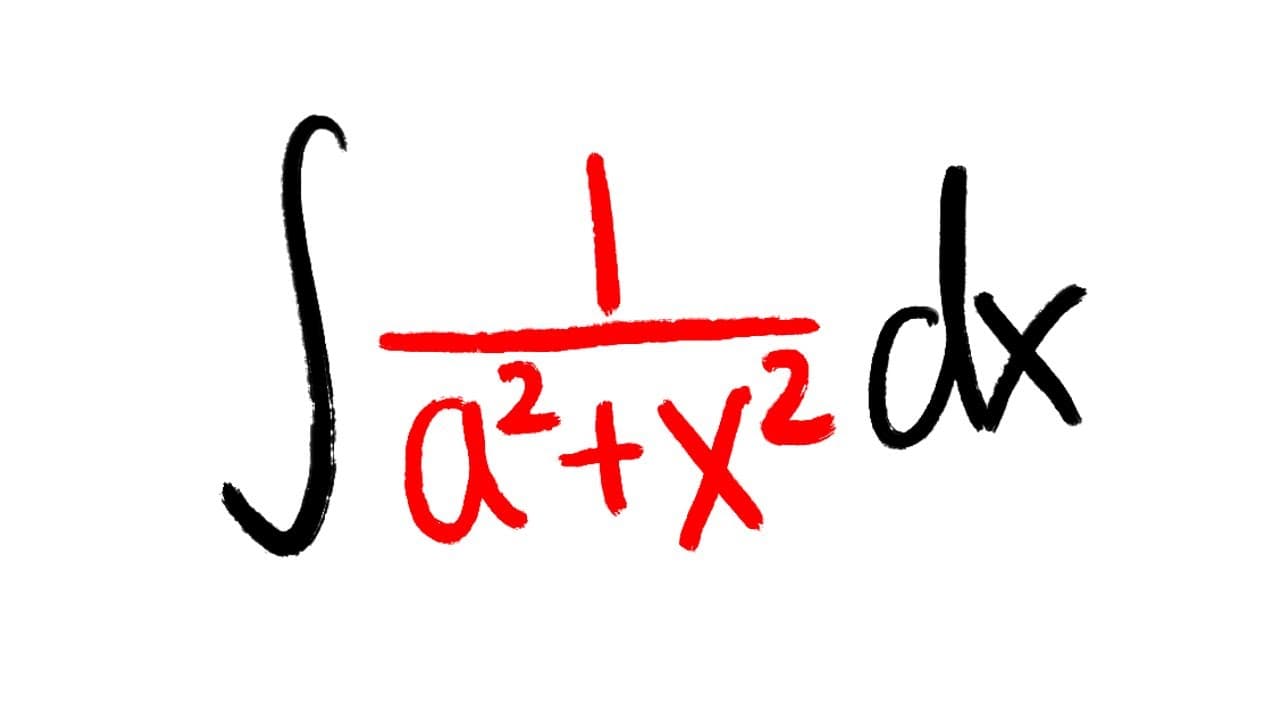
integral of 1/(a^2+x^2), trig sub vs u sub, calculus 2 tutorial
TL;DR
Learn how to compose the formula for the integral of 1/(a^2+x^2) using two different methods.
Transcript
okay sweetie I'll show us how to compose the formula for the integral of 1 over a square plus x squared and of course because you're just adding these two things you can switch to water as well in my opinion this points more comment I think and in fact in this video I'll show you guys two ways to come with the formula the first ways to do tricks up... Read More
Key Insights
- ❓ Different methods can be used to derive the formula for the integral of 1/(a^2+x^2).
- 🍉 Trigonometric substitutions are useful for simplifying integrals with squared terms.
- ❓ The derivative of inverse tangent can be directly used to evaluate certain integrals.
- 🍉 Including the DX or D(theta) term is essential for accurate integration calculations.
- ☺️ The formula for the integral of 1/(a^2+x^2) is given as the inverse tangent of x/a.
- ❓ Both methods provide the same result, but the preference may depend on individual preferences and familiarity.
- ❓ The derived formula is useful for integrating rational functions with irreducible quadratic denominators.
Install to Summarize YouTube Videos and Get Transcripts
Explore YouTube Video Summarizer or Get YouTube Transcript Extractor
Questions & Answers
Q: How is the trigonometric substitution used to simplify the integral?
The trigonometric substitution is applied by setting x = a*tan(theta), which allows us to express the integral in terms of theta. After differentiation and simplification, the integral becomes 1/a * theta.
Q: What is the role of the derivative of inverse tangent in the second method?
The derivative of inverse tangent is used to evaluate the integral directly. By recognizing that the derivative of inverse tangent x is 1/(1+x^2), the integral of 1/(a^2+x^2) can be written as the inverse tangent of x/a.
Q: Why is it important to include the DX or D(theta) term when integrating?
Including the DX or D(theta) term is crucial when integrating to ensure accurate calculations. Neglecting to include it would be an error similar to not wearing a seatbelt while driving.
Q: How are the two methods different, and which one is preferable?
The first method involves a trigonometric substitution, while the second method utilizes the derivative of inverse tangent. The preference between the two methods may vary for individuals based on familiarity and personal preference.
Summary & Key Takeaways
-
The content explains how to derive the formula for the integral of 1/(a^2+x^2) using two different approaches.
-
The first method involves using a trigonometric substitution by setting x = a*tan(theta) to simplify the integral.
-
The second method utilizes the derivative of inverse tangent to directly find the integral.
Read in Other Languages (beta)
Share This Summary 📚
Summarize YouTube Videos and Get Video Transcripts with 1-Click
Try YouTube Summary with ChatGPT & Claude or YouTube Transcript Generator
Explore More Summaries from blackpenredpen 📚


Summarize YouTube Videos and Get Video Transcripts with 1-Click
Try YouTube Summary with ChatGPT & Claude or YouTube Transcript Generator