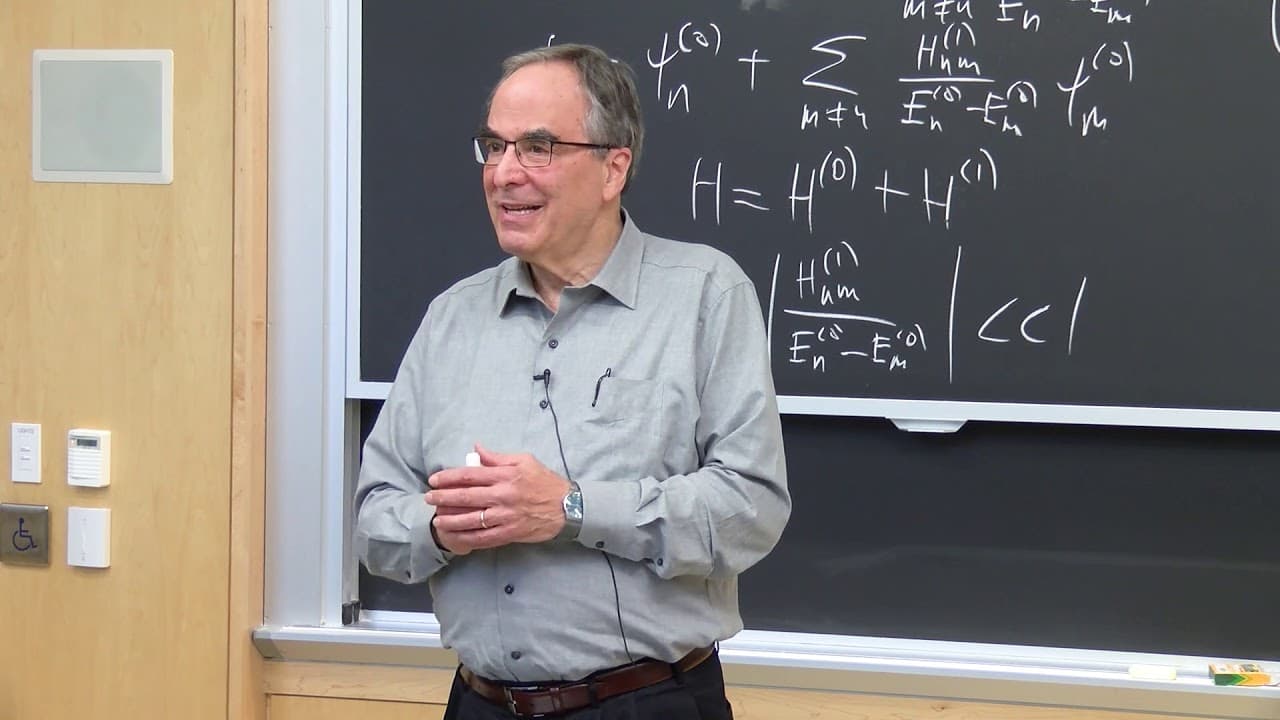
16. Non-Degenerate Perturbation Theory II: HO using a,a†
TL;DR
Perturbation theory is a powerful tool in spectroscopy, allowing for the analysis of energy levels, wave functions, and transition probabilities.
Transcript
The following content is provided under a Creative Commons license. Your support will help MIT OpenCourseWare continue to offer high-quality educational resources for free. To make a donation or to view additional materials from hundreds of MIT courses, visit MIT OpenCourseWare at ocw.mit.edu. ROBERT FIELD: Today, I'm going to go over a lot of mate... Read More
Key Insights
- 👻 Perturbation theory is a valuable tool in spectroscopy, allowing for the analysis of energy levels, wave functions, and transition probabilities.
- 🤩 By using operator or matrix notation, perturbation theory simplifies calculations and enables the determination of key molecular parameters.
- 👻 Understanding the selection rules in perturbation theory helps in predicting allowed transitions between energy levels.
Install to Summarize YouTube Videos and Get Transcripts
Explore YouTube Video Summarizer or Get YouTube Transcript Extractor
Questions & Answers
Q: How does perturbation theory help in analyzing energy levels in molecules?
Perturbation theory allows for the calculation of energy levels and wave functions in molecules, providing insights into the structure and behavior of molecules.
Q: What selection rule exists in perturbation theory?
In perturbation theory, the selection rule involves counting the number of a's and a daggers to determine the allowed transitions between energy levels.
Q: How can perturbation theory be applied to spectroscopy?
Perturbation theory can be used in spectroscopy to understand the relationship between experimental measurements, such as energy levels and transition probabilities, and molecular parameters, such as force constants and anharmonicity constants.
Q: What are some advantages of using perturbation theory in spectroscopy?
Perturbation theory allows for the analysis of multiple parameters simultaneously, providing a comprehensive understanding of molecular spectra. It also enables the calculation of transition probabilities and the characterization of superposition states.
Summary & Key Takeaways
-
Perturbation theory allows for the analysis of molecules through spectroscopy, by calculating energy levels and wave functions.
-
The method involves using an operator or matrix notation to simplify the calculations.
-
Key parameters such as force constants, reduced mass, and anharmonicity constants can be obtained through perturbation theory.
Read in Other Languages (beta)
Share This Summary 📚
Summarize YouTube Videos and Get Video Transcripts with 1-Click
Try YouTube Summary with ChatGPT & Claude or YouTube Transcript Generator
Explore More Summaries from MIT OpenCourseWare 📚


Summarize YouTube Videos and Get Video Transcripts with 1-Click
Try YouTube Summary with ChatGPT & Claude or YouTube Transcript Generator