Does Group Farming Empower Rural Women? India’s Experience with Bina Agarwal
TL;DR
Group farming initiatives in India, particularly in Kerala and Telangana, have empowered women by providing economic opportunities, increasing productivity and profits, and improving access to resources and markets.
Transcript
SPEAKER 1: Welcome to the Women and Public Policy Program's Seminar Series podcast at the Harvard Kennedy school. SPEAKER 2: I'm going to go ahead and get us started because we have a very exciting speaker today, and I don't want us to miss out on any time that we get to interact with her. I'm Hannah Riley Bowles, codirector here at the Women and P... Read More
Key Insights
- 👍 Group farming initiatives have proven successful in empowering women in India by providing economic opportunities and improving productivity and profits.
- 🧑🌾 The success of group farms is attributed to state commitment, institutional support, and the pooling of resources and labor.
- 👥 Heterogeneity within groups and the autonomy of neighborhood groups play important roles in the success of group farming initiatives.
- 🛀 Kerala's model, with its multi-level structure of governance and state support, has shown particularly positive results, while Telangana's model, with limited support, has yielded mixed results.
- ♿ Access to land and resources, technical training, and market access are critical components for the success of group farming initiatives.
Install to Summarize YouTube Videos and Get Transcripts
Explore YouTube Video Summarizer or Get YouTube Transcript Extractor
Questions & Answers
Q: What are the main advantages of group farming for women in India?
Group farming allows women to overcome resource constraints, such as limited access to land, capital, and technology. It enhances their economic well-being by increasing productivity and profits, while also providing opportunities for societal and political empowerment.
Q: How do Kerala and Telangana differ in terms of their approaches to group farming?
In Kerala, group farming initiatives were implemented through a multi-level structure of governance, involving state support, the autonomy of neighborhood groups, and collaboration with village councils. In Telangana, group farming was launched under a UNDP and government of India initiative, but the support was limited and the projects were not sustained after initial funding.
Q: How do group farms compare to individual family farms in terms of productivity and profitability?
Group farms, particularly in Kerala, have been found to outperform individual family farms in terms of productivity and profitability. The value of output per hectare is higher for group farms, and their average net returns are significantly greater than those of individual farms.
Summary & Key Takeaways
-
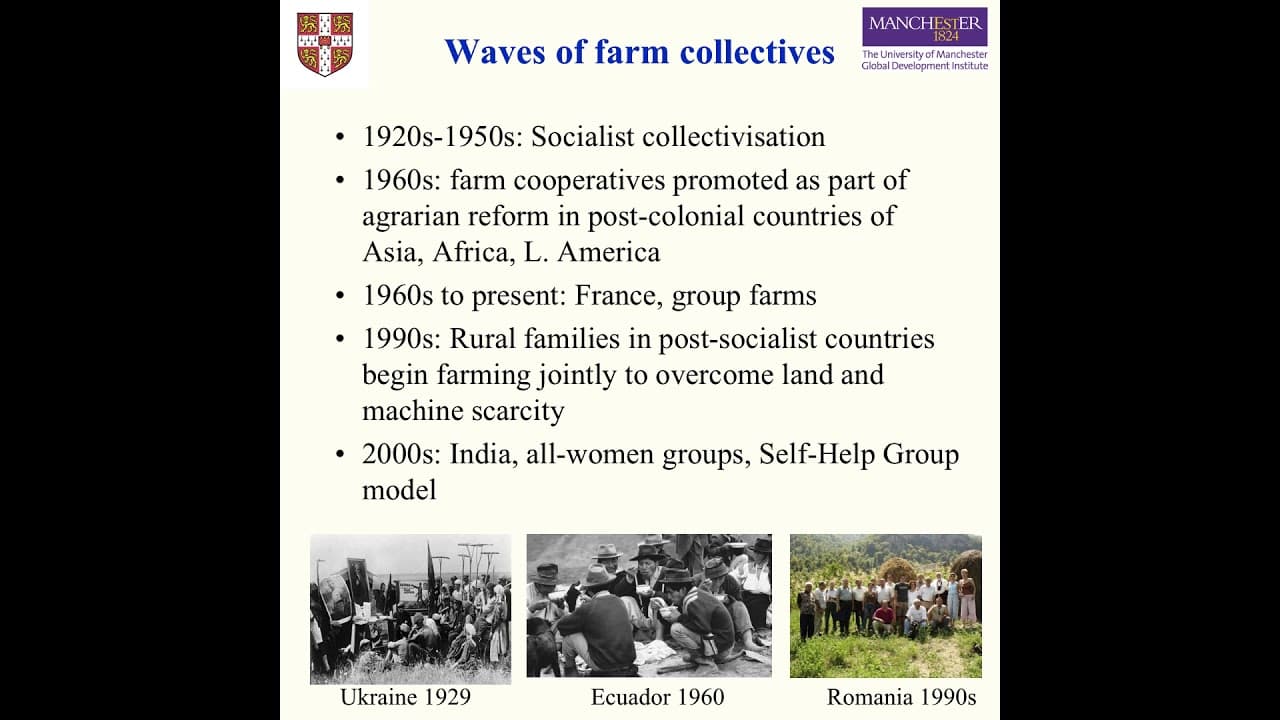
In India, rural women make up a significant portion of the informal farming sector, yet efforts to economically empower women rarely focus on farming.
-
Two state-level experiments in Kerala and Telangana have implemented group farming initiatives, promoting the collective leasing of land and pooling of labor and capital among rural women.
-
Research shows that these group farms perform significantly better than small individual family farms, both in terms of productivity and profits.
Read in Other Languages (beta)
Share This Summary 📚
Summarize YouTube Videos and Get Video Transcripts with 1-Click
Try YouTube Summary with ChatGPT & Claude or YouTube Transcript Generator
Explore More Summaries from Harvard University 📚






Summarize YouTube Videos and Get Video Transcripts with 1-Click
Try YouTube Summary with ChatGPT & Claude or YouTube Transcript Generator