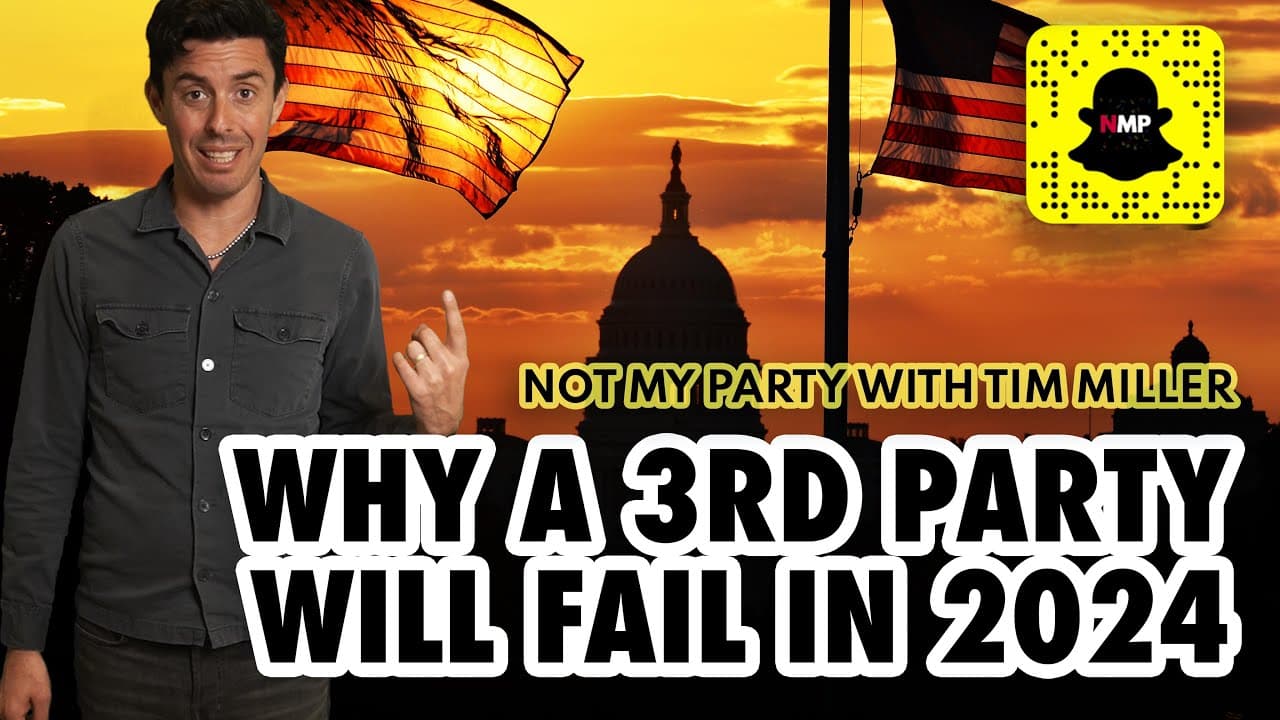
Why a 3rd Party Will Fail in 2024 | Not My Party with Tim Miller
TL;DR
No Labels is funding a nationwide effort to introduce another option on the ballot for the 2024 election, but the current political landscape makes it unlikely for a third-party candidate to succeed due to extreme negative partisanship and the wide gap between the two major parties.
Transcript
can a third-party Outsider disrupt the 2024 election would that be something this is not my party brought to you by the bulwark last week I laid out what the odds were for the 2024 election and left just a 5 chance for someone totally unexpected that is a small chance given that the two leading contenders are so old that they were alive for the Neg... Read More
Key Insights
- 🥳 Extreme negative partisanship reduces the willingness of voters to support a third-party candidate.
- 🥳 The wide gap between the two major parties makes it difficult for a third-party candidate to gather enough support from both sides.
- 🥳 No Labels' effort to introduce a third-party candidate for the 2024 election faces significant challenges.
- 🥳 The success of Ross Perot in 1992 was due to the perception that the two major candidates were similar, making voters more willing to support a third-party candidate.
- 🥳 Changes in the political landscape, such as the death of Donald Trump or the emergence of a charismatic figure, could potentially increase the chances of a third-party candidate's success.
- 🥳 Andrew Yang, Kristen Cinema, Joe Manchin, Mark Cube, and Liz Cheney are often discussed as potential third-party candidates.
Install to Summarize YouTube Videos and Get Transcripts
Explore YouTube Video Summarizer or Get YouTube Transcript Extractor
Questions & Answers
Q: What is No Labels and what are they trying to accomplish?
No Labels is a group funding an effort to introduce a third-party option in the 2024 election, aiming to provide voters with more choices beyond the major parties.
Q: Why is it unlikely for a third-party candidate to succeed in the current political landscape?
Extreme negative partisanship makes voters more inclined to vote for their preferred major party candidate, even if they don't fully support them. The wide gap between the two major parties also makes it challenging for a third-party candidate to gather enough support from both sides of the political spectrum.
Q: Who are some potential names that could be considered as third-party candidates?
Andrew Yang, Kristen Cinema, Joe Manchin, Mark Cube, and Liz Cheney are often brought up in discussions about potential third-party candidates. However, uniting both sides of the political spectrum would be a difficult task for any of them.
Q: What potential events could change the game and increase the chances of a third-party candidate's success?
The death of Donald Trump, the discovery of remarkable evidence, or the emergence of an exceptionally charismatic person or AI could potentially shift public opinion and unite supporters of both major parties behind a third-party candidate.
Summary & Key Takeaways
-
No Labels is funding an effort to introduce a third-party candidate for the 2024 election.
-
Extreme negative partisanship makes it less likely for voters to risk wasting their vote on a third-party candidate.
-
The wide gap between the two major parties also decreases the chances of a third-party candidate winning.
Read in Other Languages (beta)
Share This Summary 📚
Summarize YouTube Videos and Get Video Transcripts with 1-Click
Try YouTube Summary with ChatGPT & Claude or YouTube Transcript Generator
Explore More Summaries from The Bulwark 📚
Summarize YouTube Videos and Get Video Transcripts with 1-Click
Try YouTube Summary with ChatGPT & Claude or YouTube Transcript Generator