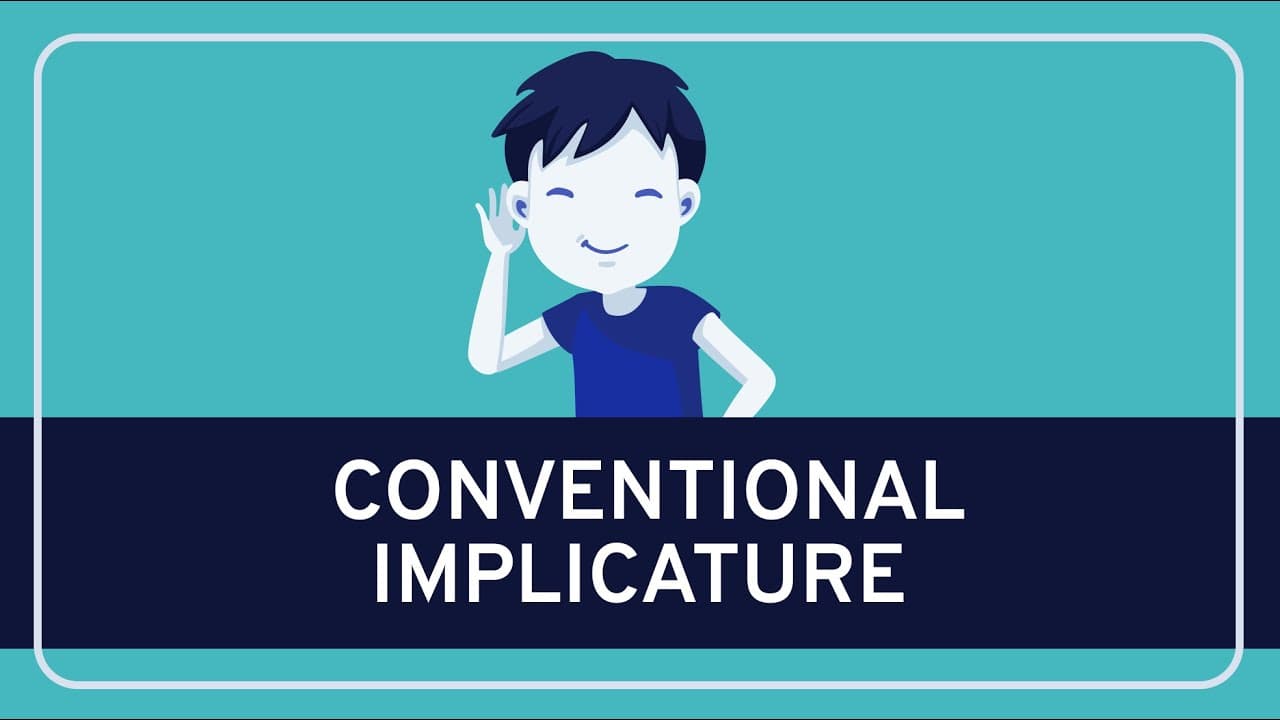
PHILOSOPHY - Language: Conventional Implicature [HD]
TL;DR
Explains conventional and conversational implicatures in language.
Transcript
(intro music) My name is Will Salmon, and I'm an assistant[br]professor of linguistics at the University of Minnesota Duluth. Today I'm going to talk to you about different kinds of linguistic meanings, specifically about[br]conventional implicature and conversational implicature, one way of dividing up linguistic meaning that's been very influenti... Read More
Key Insights
- Conventional implicature refers to meanings that are part of the literal meaning of words but are not truth-conditional, such as the contrast conveyed by the word 'but'.
- Conversational implicature involves implied meanings that go beyond the literal words spoken, relying on context and speaker intentions.
- Truth-conditional meaning is the literal meaning of a sentence, determining its truth value based solely on the sentence's content.
- The distinction between what is said and what is meant is crucial in understanding linguistic communication.
- Grice's theories on implicature have significantly influenced the study of linguistic meaning over the past 40 years.
- Conventional implicatures are embedded in the language and do not vary with context, unlike conversational implicatures.
- Words like 'frankly' or 'darn' convey speaker attitudes without affecting the truth conditions of a statement.
- Understanding these linguistic distinctions is essential in fields like philosophy, linguistics, and communication studies.
Install to Summarize YouTube Videos and Get Transcripts
Explore YouTube Video Summarizer or Get YouTube Transcript Extractor
Questions & Answers
Q: What is conventional implicature?
Conventional implicature refers to meanings that are part of the literal meaning of words but are not truth-conditional. An example is the word 'but,' which implies a contrast between two statements. This contrast is conventional because it is inherent in the word's meaning, regardless of context.
Q: How does conversational implicature differ from conventional implicature?
Conversational implicature involves meanings implied by a speaker that go beyond the literal words spoken, relying heavily on context and the speaker's intentions. Unlike conventional implicature, which is embedded in the language, conversational implicature is not fixed and can vary depending on the situation.
Q: What role does truth-conditional meaning play in language?
Truth-conditional meaning is the literal meaning of a sentence, determining whether it is true or false based solely on the content of the sentence. It does not account for implied meanings or speaker intentions, focusing strictly on the factual correctness of the statement.
Q: Why is the distinction between what is said and what is meant important?
The distinction between what is said and what is meant is crucial for understanding linguistic communication. It highlights how speakers often convey additional meanings beyond their literal words, relying on context and shared knowledge to communicate effectively. This understanding is vital for interpreting language accurately.
Q: What influence has Paul Grice had on the study of linguistic meaning?
Paul Grice's work on implicature has significantly influenced the study of linguistic meaning over the past 40 years. His theories on conversational and conventional implicature have shaped how linguists and philosophers understand the relationship between language, meaning, and communication, providing a framework for analyzing implied meanings in speech.
Q: How do words like 'frankly' or 'darn' function in language?
Words like 'frankly' or 'darn' convey the speaker's attitudes or emotions without affecting the truth conditions of a statement. These words are examples of conventional implicature, as they add an additional layer of meaning related to the speaker's perspective, which is not part of the sentence's truth value.
Q: What is the significance of understanding linguistic distinctions?
Understanding linguistic distinctions is essential in fields like philosophy, linguistics, and communication studies. It allows for a deeper comprehension of how language functions in conveying not just factual information but also implied meanings, speaker intentions, and emotional nuances, which are crucial for effective communication.
Q: How do examples in the video illustrate different meanings in language?
The video uses examples like 'I'm tired' and 'John is short, but he is strong' to illustrate how different meanings are conveyed through language. These examples show how literal meanings, implied meanings, and conventional contrasts are used to communicate beyond the surface level, emphasizing the role of context and speaker intention in interpretation.
Summary & Key Takeaways
-
William Salmon discusses the distinctions in linguistic meanings, focusing on conventional and conversational implicatures. Conventional implicatures are part of literal meanings but not truth-conditional, like the word 'but' indicating contrast. Conversational implicatures rely on context and speaker intentions to convey meanings beyond the literal words.
-
The video introduces three dimensions of meaning: conventional truth-conditional, non-conventional implied, and conventional non-truth-conditional. These distinctions help in understanding how language is used to communicate beyond literal meanings, emphasizing the importance of context and speaker intentions.
-
Salmon highlights the influence of philosopher Paul Grice's work on implicature, which has shaped linguistic studies. The discussion includes examples illustrating how different meanings are conveyed through language, emphasizing the role of context in interpreting conversational implicatures.
Read in Other Languages (beta)
Share This Summary 📚
Summarize YouTube Videos and Get Video Transcripts with 1-Click
Try YouTube Summary with ChatGPT & Claude or YouTube Transcript Generator
Explore More Summaries from Wireless Philosophy 📚
Summarize YouTube Videos and Get Video Transcripts with 1-Click
Try YouTube Summary with ChatGPT & Claude or YouTube Transcript Generator