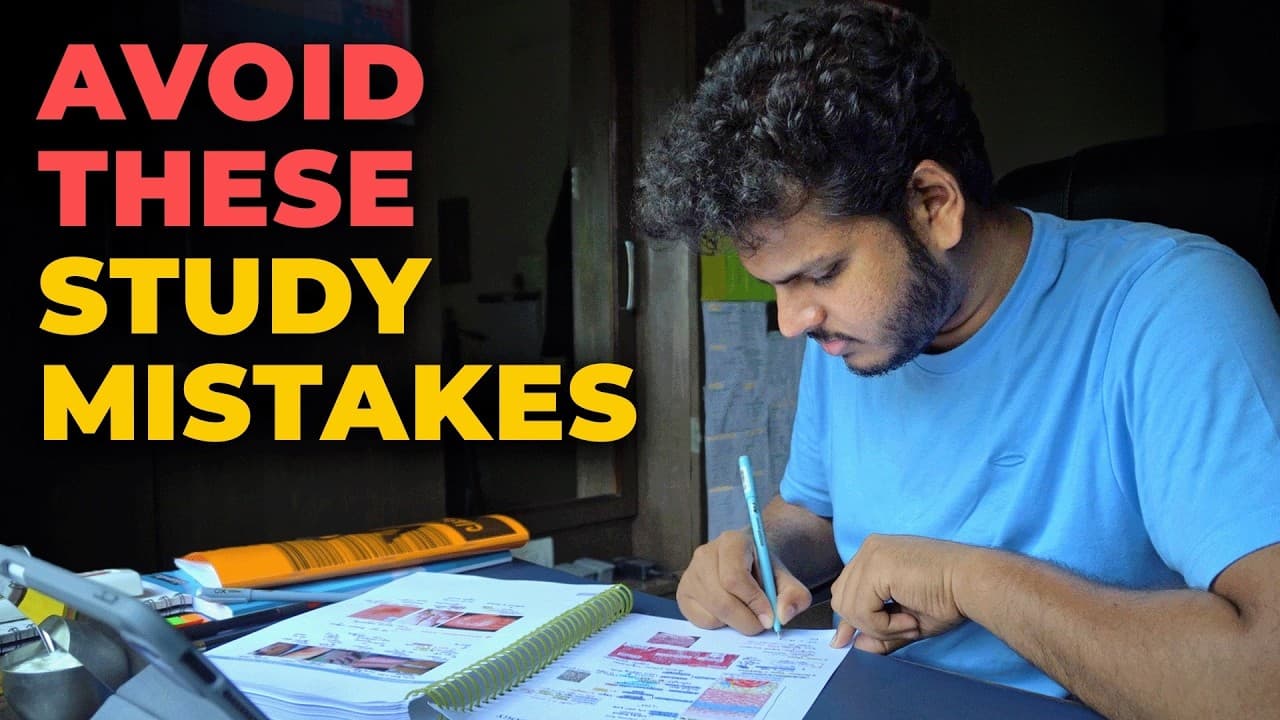
9 Study Mistakes Killing Your Progress : Stop Now! - A Senior's Guidance | Dr Anuj Pachhel
TL;DR
Avoid these nine common study mistakes for better productivity.
Transcript
are you trying to study every day but you're not seeing the results despite your efforts well then you've clicked on the Right video because in this video I'll be telling you exactly nine things that are destroying your academic comeback nine of the common study mistakes that you can make and the things which are decreasing ... Read More
Key Insights
- Creating a study plan is crucial for efficient learning. Without a plan, students waste time and lack direction, negatively impacting productivity and long-term success.
- Multitasking is counterproductive. Focusing on one task at a time increases efficiency and helps retain information better than juggling multiple activities simultaneously.
- Passive learning, such as only highlighting text, is ineffective. Active learning techniques like active recall and practice questions are more beneficial for retaining information.
- Regular breaks are essential to maintain focus and energy. Techniques like the Pomodoro method can help sustain concentration and prevent burnout.
- Prioritizing high-yield topics is critical, especially in vast subjects like medicine. Focusing on exam-relevant content ensures better preparation and performance.
- Reviewing previously studied material prevents knowledge decay. Regular revision helps retain information and reduces pre-exam anxiety.
- Studying in a cluttered environment can hinder concentration. A clean, organized space enhances mental clarity and improves study efficiency.
- Seeking help when needed is vital. Students should overcome hesitation and ask questions to clarify doubts, using resources like teachers, peers, and online tools.
Install to Summarize YouTube Videos and Get Transcripts
Explore YouTube Video Summarizer or Get YouTube Transcript Extractor
Questions & Answers
Q: What is the main focus of Dr. Anuj Pachhel's video?
The video focuses on identifying and addressing nine common study mistakes that hinder students' academic progress. Dr. Anuj provides practical strategies to avoid these pitfalls, emphasizing the importance of planning, focused work, active learning, and effective resource management.
Q: Why is multitasking considered ineffective for studying?
Multitasking is ineffective because it divides attention and reduces efficiency by up to 40%. The brain is not designed for multitasking, and focusing on one task at a time leads to better retention and understanding of the material, as supported by research and expert advice from authors like Carl Newport.
Q: How does Dr. Anuj suggest students handle passive learning?
Dr. Anuj advises against passive learning methods like merely highlighting texts. Instead, he recommends active learning techniques such as active recall, solving practice questions, and using mind maps or flowcharts. These methods engage the brain more effectively, leading to better comprehension and retention of information.
Q: What role do breaks play in effective studying according to the video?
Breaks are crucial for maintaining focus and preventing mental fatigue. Dr. Anuj suggests using the Pomodoro technique, which involves studying for 35-40 minutes followed by a 5-10 minute break. This method helps sustain concentration and can be gradually adjusted to increase focus duration over time.
Q: Why is prioritizing high-yield topics important in studying?
Prioritizing high-yield topics ensures that students focus on the most exam-relevant material, which is crucial for subjects with extensive content like medicine. This strategy helps in efficient time management and maximizes the chances of performing well in exams by concentrating on critical areas.
Q: What is the significance of reviewing previously studied material?
Reviewing material is essential to reinforce knowledge and prevent forgetting. Dr. Anuj emphasizes that regular revision helps transfer information from short-term to long-term memory, reducing the risk of forgetting and alleviating last-minute exam stress.
Q: How does the study environment affect learning according to Dr. Anuj?
A cluttered study environment can negatively impact focus and information retention. Dr. Anuj suggests maintaining a clean and organized study space to enhance mental clarity and improve study efficiency, as the physical environment often reflects and influences mental states.
Q: What advice does Dr. Anuj give about using study resources?
Dr. Anuj advises against overloading with too many study resources, as it can lead to confusion and inefficiency. He stresses that success depends more on the student's application of knowledge rather than the quantity of resources, and suggests choosing a few reliable resources and using them effectively.
Summary & Key Takeaways
-
Dr. Anuj Pachhel highlights nine common study mistakes that hinder student progress. He emphasizes the importance of planning, focused work, and active learning techniques to enhance productivity and exam success.
-
The video advises against multitasking, passive learning, and studying without breaks. Dr. Anuj suggests using the Pomodoro method and prioritizing high-yield topics for effective study sessions.
-
Creating a conducive study environment, regularly reviewing material, and seeking help when necessary are key strategies discussed to improve academic performance and reduce exam stress.
Read in Other Languages (beta)
Share This Summary 📚
Summarize YouTube Videos and Get Video Transcripts with 1-Click
Try YouTube Summary with ChatGPT & Claude or YouTube Transcript Generator
Explore More Summaries from Dr. Anuj Pachhel 📚






Summarize YouTube Videos and Get Video Transcripts with 1-Click
Try YouTube Summary with ChatGPT & Claude or YouTube Transcript Generator