What Is an SR Latch Circuit Using NAND Gates?
TL;DR
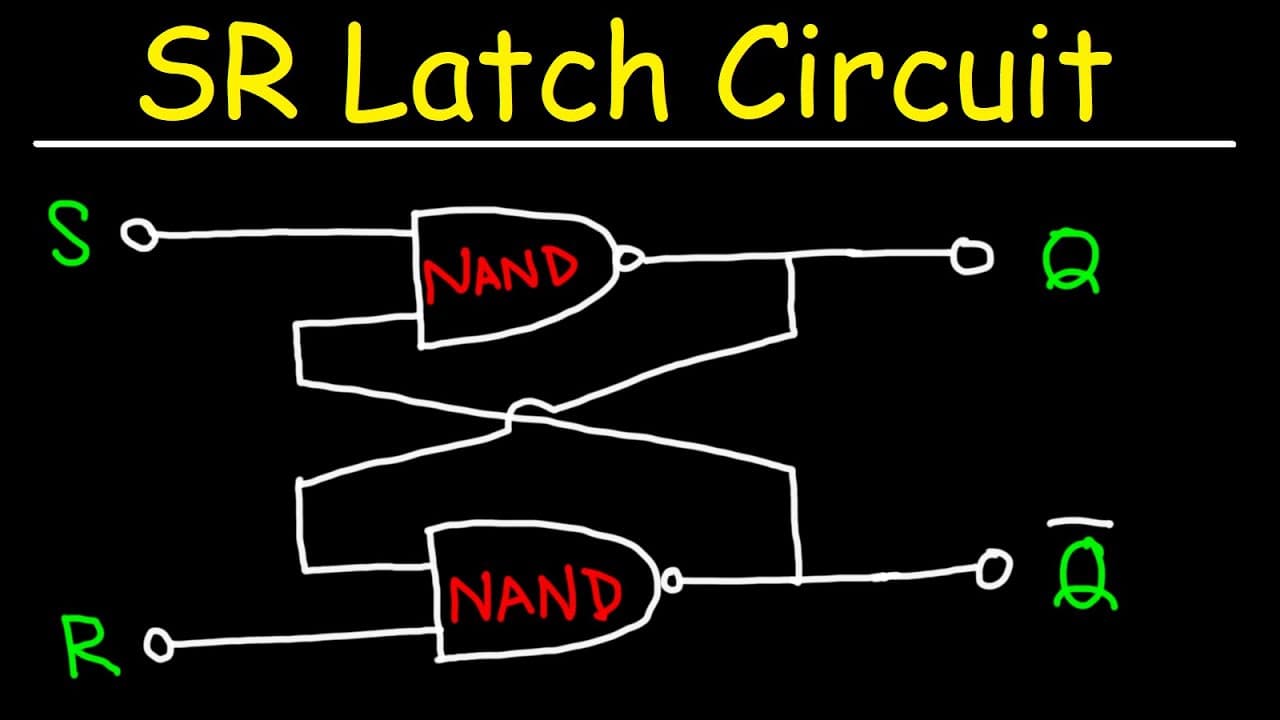
An SR latch circuit using NAND gates is a type of memory device that retains its output state based on two inputs, S (set) and R (reset). When S is activated, Q is set to 0 and Q bar to 1; when R is activated, Q is reset to 1 and Q bar to 0. An invalid condition arises when both inputs are 0, as it leads to both outputs being 1, which contradicts the definition of a latch.
Transcript
in this video we're going to focus on the sr latch circuit but particularly the one using nand gates i have another video where i talked about the sr latch circuit using nor gates but let's begin with the truth table for nand gate so let's say we have the inputs a b and the output c now the way i like to remember it is the truth table for an and ga... Read More
Key Insights
- 🔬 The truth table for a NAND gate is the opposite of an AND gate, with the output off when both inputs are on.
- 🇭🇰 The SR latch circuit using NAND gates has an invalid condition when both S and R inputs are zero.
- 🉐 The set button sets Q bar to 1 and Q to 0, while the reset button resets Q bar to 0.
- 🇭🇰 The circuit shows memory when both S and R inputs are 1, retaining its previous output.
Install to Summarize YouTube Videos and Get Transcripts
Explore YouTube Video Summarizer or Get YouTube Transcript Extractor
Questions & Answers
Q: What is the difference between the truth table for an AND gate and a NAND gate?
The truth table for an AND gate shows that the output is only on when both inputs are on. In contrast, the truth table for a NAND gate shows that the output is off when both inputs are on, and in all other cases, the output is on.
Q: Why is the condition when S and R are both zero considered invalid?
When both S and R are zero, the outputs Q and Q bar will be both one. This contradicts the requirement that Q should always be opposite to Q bar. Therefore, this condition is defined as invalid.
Q: What happens when the set button is pressed in the SR latch circuit?
Pressing the set button sets Q bar to 1, which means Q is set to 0. This state is maintained until any other input condition changes.
Q: How does the SR latch circuit retain its previous output in the memory state?
When both S and R inputs are set to 1, the circuit goes into a memory state, retaining its previous output. Changing the inputs does not alter the outputs until a different condition is applied.
Summary & Key Takeaways
-
The video discusses the truth table for a NAND gate and the truth table for an SR latch circuit using NAND gates.
-
It explains the invalid condition and the valid conditions for the inputs S and R in the SR latch circuit.
-
The video demonstrates the state changes in the circuit when different input conditions are applied, including set and reset operations.
-
It emphasizes the importance of understanding the correct placement of Q and Q bar in the circuit to determine the truth table.
Read in Other Languages (beta)
Share This Summary 📚
Summarize YouTube Videos and Get Video Transcripts with 1-Click
Try YouTube Summary with ChatGPT & Claude or YouTube Transcript Generator
Explore More Summaries from The Organic Chemistry Tutor 📚




Summarize YouTube Videos and Get Video Transcripts with 1-Click
Try YouTube Summary with ChatGPT & Claude or YouTube Transcript Generator