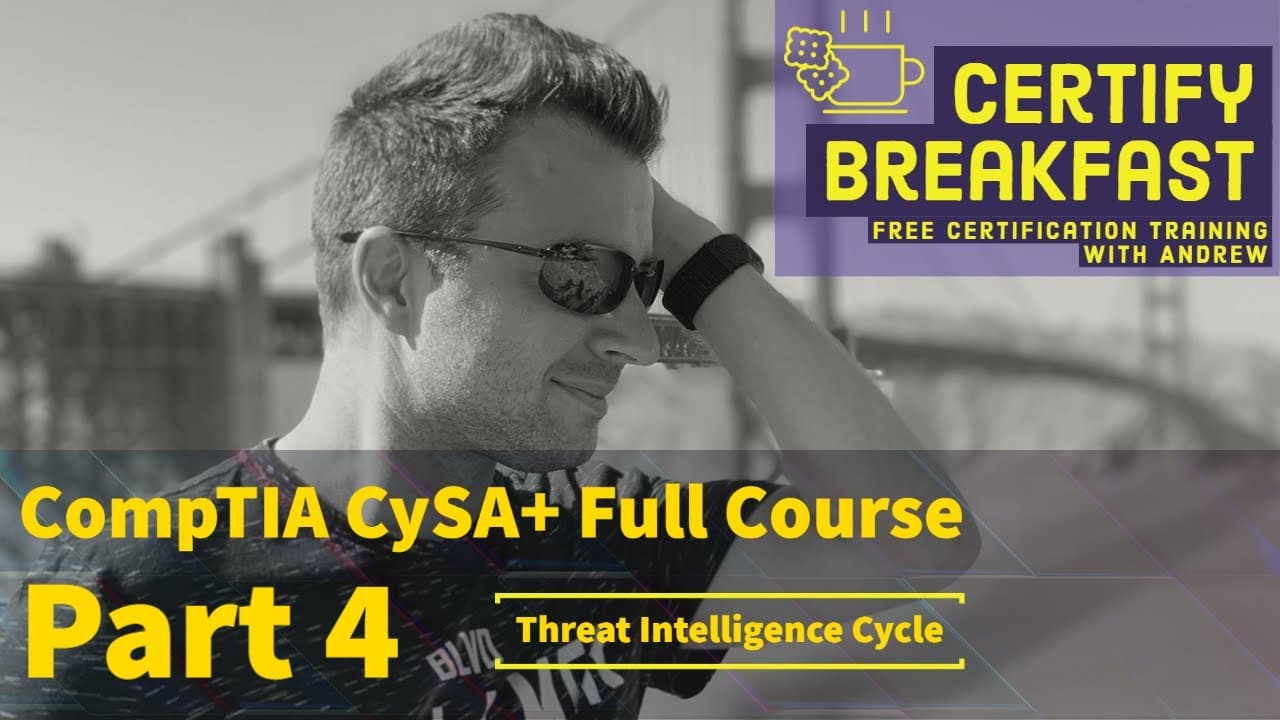
CompTIA CySA+ Full Course Part 04: Threat Intelligence Cycle
TL;DR
Explains the threat intelligence cycle for cybersecurity preparedness.
Transcript
It's always difficult to begin talking about something completely new You have to be very careful where you begin, because things have to start making sense as soon as possible Otherwise, I risk losing you, my audience, and I don't want that So, I actually thought about this for a while and I thought that there is one thing ... Read More
Key Insights
- The threat intelligence cycle is crucial for making informed security decisions by filling knowledge gaps and structuring information.
- Planning and requirements phase focuses on aligning security efforts with business goals and legal obligations to ensure relevance.
- Collection and processing phase involves gathering raw data consistently and processing it for normalization to make it usable.
- Automated tools and SIEM products are essential for handling large volumes of data and performing event correlation.
- Dissemination phase communicates findings to various stakeholders, requiring tailored reports for different audiences.
- Intelligence dissemination occurs at three levels: strategic, operational, and tactical, each addressing different priorities.
- Feedback phase involves reviewing and improving the cycle by analyzing what went right or wrong and identifying new threats.
- Continuous improvement of the threat intelligence cycle is key, with a focus on constructive responsibilities and avoiding blame.
Install to Summarize YouTube Videos and Get Transcripts
Explore YouTube Video Summarizer or Get YouTube Transcript Extractor
Questions & Answers
Q: What is the purpose of the threat intelligence cycle?
The threat intelligence cycle aims to fill knowledge gaps and structure information to make informed security decisions. It helps identify vulnerabilities, assess threats, and guide strategic planning for cybersecurity measures, ensuring that security efforts align with business goals and legal obligations.
Q: Why is the planning and requirements phase important?
The planning and requirements phase is crucial as it ensures that security efforts are relevant to business objectives and comply with legal obligations. It sets the foundation by identifying potential threats, assessing risks, and aligning security strategies with organizational goals, thus preventing unnecessary efforts.
Q: How does the collection and processing phase work?
The collection and processing phase involves gathering raw data from various sources and normalizing it for analysis. This phase requires an organized approach, often utilizing automated tools and SIEM products, to handle large data volumes and ensure consistency, making the information usable for decision-making.
Q: What role do automated tools play in threat intelligence?
Automated tools are essential in threat intelligence for handling large data volumes, performing event correlation, and identifying patterns. They reduce the manual workload, enhance efficiency, and improve accuracy in detecting potential threats, allowing cybersecurity professionals to focus on strategic decision-making.
Q: What is the focus of the dissemination phase?
The dissemination phase focuses on communicating findings from the analysis phase to various stakeholders within the organization. It requires tailoring reports to different audiences, such as technical staff and upper management, ensuring that each group receives relevant information to address their specific objectives and priorities.
Q: How is intelligence dissemination structured?
Intelligence dissemination is structured at three levels: strategic, operational, and tactical. Strategic intelligence addresses long-term goals, operational intelligence focuses on day-to-day priorities, and tactical intelligence involves real-time actions, particularly in incident response procedures, ensuring that each level receives appropriate information.
Q: What is the purpose of the feedback phase?
The feedback phase aims to continuously improve the threat intelligence cycle by analyzing what went right or wrong, identifying new threats, and learning lessons from previous steps. It involves feeding new information back into the cycle and assigning constructive responsibilities to enhance future processes.
Q: Why is continuous improvement important in threat intelligence?
Continuous improvement is vital in threat intelligence to adapt to evolving threats and enhance the effectiveness of security measures. By analyzing past performance, learning from mistakes, and implementing improvements, organizations can better protect themselves against cyber threats and ensure their security strategies remain relevant and effective.
Summary & Key Takeaways
-
The video explains the threat intelligence cycle, emphasizing its importance in cybersecurity for making informed decisions. It details the phases, starting with planning and requirements, which align security efforts with business goals and legal obligations.
-
The collection and processing phase gathers and normalizes data from various sources, utilizing automated tools and SIEM products for event correlation. Dissemination involves communicating findings to different stakeholders, requiring tailored reports.
-
The feedback phase focuses on continuous improvement by analyzing successes and failures, identifying new threats, and assigning constructive responsibilities. The video stresses understanding each phase for exam preparation and practical application.
Read in Other Languages (beta)
Share This Summary 📚
Summarize YouTube Videos and Get Video Transcripts with 1-Click
Try YouTube Summary with ChatGPT & Claude or YouTube Transcript Generator
Explore More Summaries from Certify Breakfast 📚

Summarize YouTube Videos and Get Video Transcripts with 1-Click
Try YouTube Summary with ChatGPT & Claude or YouTube Transcript Generator