What is Blockchain? (Explainer) | The Big Story | Real Vision™
TL;DR
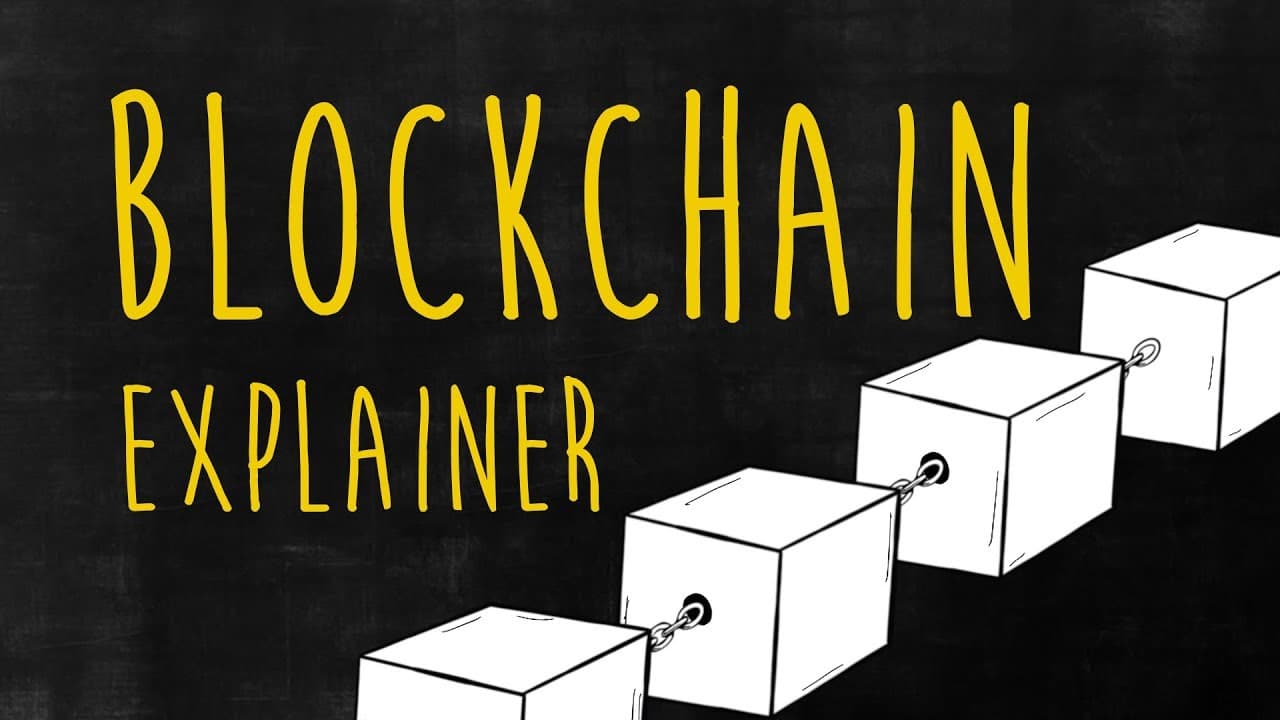
Blockchain is a distributed database that stores information in blocks, forming a chain. It ensures data security and trust through cryptographic hashes and consensus mechanisms.
Transcript
So what exactly is a blockchain? Blockchain is a distributed database that stores information in blocks, what you can think of as a kind of virtual container for data. As new data gets added, additional blocks are created. The blocks are then linked together chronologically to form a sequence of blocks called a chain. As new information gets added,... Read More
Key Insights
- 😒 Blockchain is a distributed database that uses blocks and chains to store and organize information.
- ❓ Peer-to-peer networks, like those that powered Napster, are integral to blockchain functionality.
- ❓ Consensus mechanisms ensure network agreement by solving math problems and validating data.
- #️⃣ Blockchain's decentralized nature and cryptographic hashes make data tampering difficult.
- 💨 Blockchain provides a secure and trustful way to store and verify data in a distributed network.
- 🚄 Blockchain has solved the Byzantine General's Problem using high-speed computer networks and massive computation power.
- ❓ Various consensus mechanisms exist for maintaining agreement and validating data on a blockchain.
Install to Summarize YouTube Videos and Get Transcripts
Explore YouTube Video Summarizer or Get YouTube Transcript Extractor
Questions & Answers
Q: What is blockchain and how does it work?
Blockchain is a distributed database that organizes data in blocks linked together chronologically. It ensures data security and immutability through cryptographic hashes and non-destructive data storage.
Q: What makes blockchain powerful?
Blockchain's distributed nature, where data is stored across a network of computers, makes it powerful. It eliminates the need for centralized control and enables global networking.
Q: What are peer-to-peer networks and how are they related to blockchain?
Peer-to-peer networks are a recent invention that power blockchain. Each node in the network can share data with others without central coordination, making it similar to an orchestra without a conductor.
Q: How does blockchain ensure the accuracy of information?
Blockchain uses consensus mechanisms to maintain network agreement. Participants solve math problems simultaneously, validating data authenticity. Blockchain's full records and non-destructive storage enable tamper-proof data verification.
Summary & Key Takeaways
-
Blockchain is a distributed database that stores information in blocks, forming a chain.
-
Each new block contains a cryptographic hash, ensuring data tampering is extremely difficult.
-
Consensus mechanisms, solved through math problems, validate the data and maintain network agreement.
Read in Other Languages (beta)
Share This Summary 📚
Summarize YouTube Videos and Get Video Transcripts with 1-Click
Try YouTube Summary with ChatGPT & Claude or YouTube Transcript Generator
Explore More Summaries from Real Vision 📚



Summarize YouTube Videos and Get Video Transcripts with 1-Click
Try YouTube Summary with ChatGPT & Claude or YouTube Transcript Generator