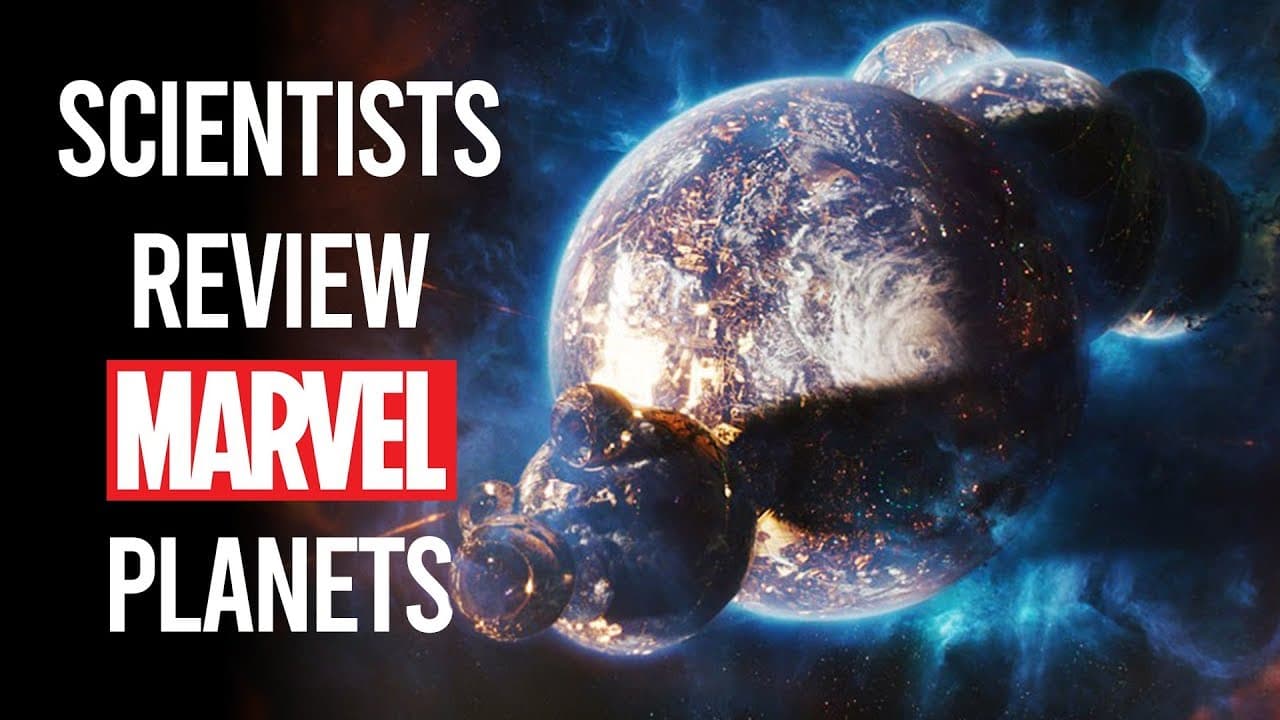
Which MCU Planets Could Really Exist?
TL;DR
Planetary scientists and a physicist examine the plausibility of various planets in the Marvel Cinematic Universe based on scientific principles.
Transcript
this video was sponsored by brilliant org to learn more about the natural world through solving problems go to brilliant org forward slash Simon Clark the Marvel Cinematic Universe or MCU is an unprecedented achievement of franchise filmmaking across 22 films and 11 TV shows the MCU ties together hundreds of characters and plot lines weaving a huge... Read More
Key Insights
- 🪐 Most planets in the MCU adhere to scientific principles, while others require additional explanations or rely heavily on fictional elements.
- 🪐 Planets like Earth, Asgard, and Vanaheim have similarities to known planetary bodies and could potentially exist.
- 🚴 Some planets, like Jotunheim and Sekar, showcase features observed in icy and trash-collecting bodies in our solar system.
- 🖤 Certain planets, such as the quantum asteroid field and Vermeer, lack sufficient information to determine their feasibility.
- 🫷 Planets with unique properties, like Hell and the garden on Titan, push the boundaries of what is known about planetary science.
- 🪐 There are countless possibilities for new and intriguing planets in science fiction, such as tidally locked planets and exotic atmospheres.
Install to Summarize YouTube Videos and Get Transcripts
Explore YouTube Video Summarizer or Get YouTube Transcript Extractor
Questions & Answers
Q: Could Asgard from the MCU really exist as shown in the films?
Asgard, a flat disc rather than a spheroid, would require extremely low density and fast spinning to maintain its shape. Additionally, the seemingly infinite water supply on Asgard defies scientific principles.
Q: Is Jotunheim, the frozen planet in Thor, plausible based on known planetary bodies?
Jotunheim, with its ice features and cryovolcanism, resembles other bodies in our solar system like Pluto and Miranda. While extremely cold, Jotunheim's indestructibility allows for the possibility of its existence.
Q: Could Sanctuary, the asteroid-like planet in Guardians of the Galaxy, be a feasible geological structure?
Sanctuary's rings and asteroid-looking features are reminiscent of structures found in our solar system. However, the planet's high density and surface gravity make it unlikely for an asteroid and its atmosphere to exist as shown.
Q: Is Muspelheim, the fiery planet in Thor: Ragnarok, consistent with scientific principles?
Muspelheim, resembling volcanic regions on Earth, could potentially exist as a geologically active planet. However, the physiological requirements for inhabitants and the planet's specific properties would need further explanation.
Summary & Key Takeaways
-
The Marvel Cinematic Universe (MCU) features a wide range of planets, some similar to Earth and others incredibly alien.
-
Using scientific principles, the video examines the physical and biological feasibility of each planet in the MCU.
-
While some planets align with our current understanding of planetary science, others stretch the boundaries of possibility.
Read in Other Languages (beta)
Share This Summary 📚
Summarize YouTube Videos and Get Video Transcripts with 1-Click
Try YouTube Summary with ChatGPT & Claude or YouTube Transcript Generator
Explore More Summaries from Simon Clark 📚




Summarize YouTube Videos and Get Video Transcripts with 1-Click
Try YouTube Summary with ChatGPT & Claude or YouTube Transcript Generator