What Are the Best Moving Averages for Day Trading?
TL;DR
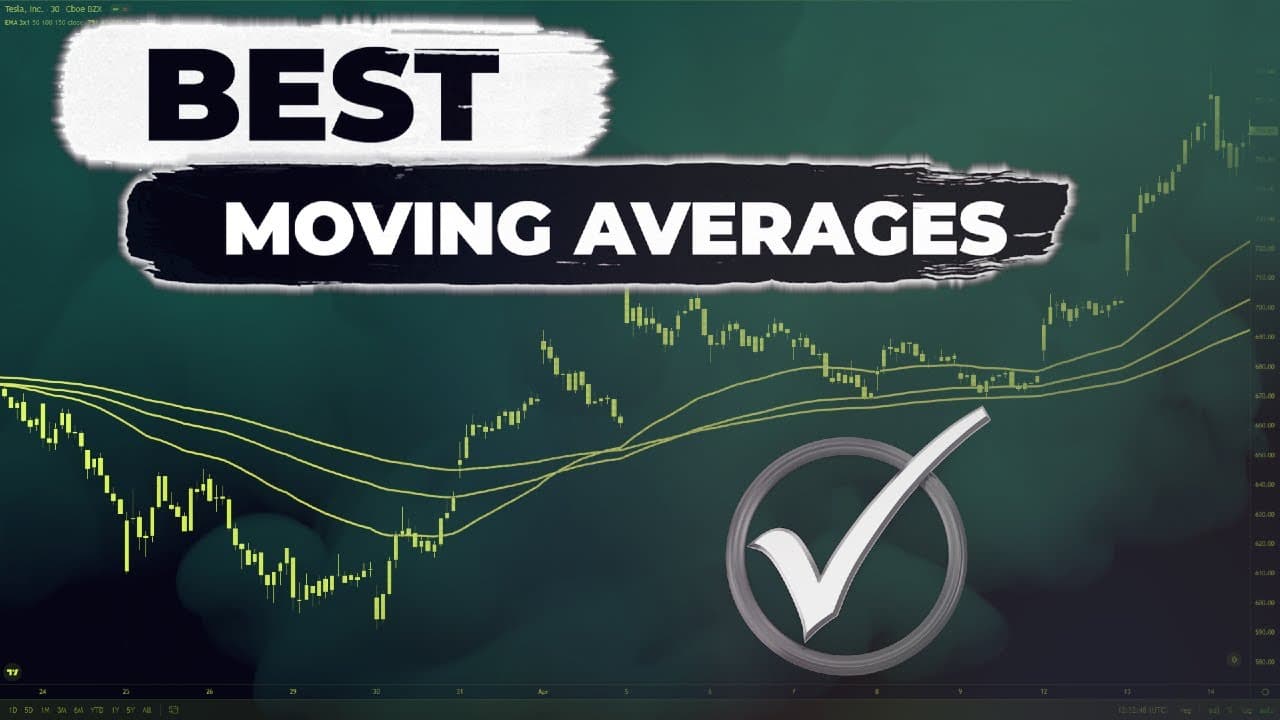
The best moving averages for day trading include the Simple Moving Average (SMA), Exponential Moving Average (EMA), and Hull Moving Average (HMA). Each type serves different purposes: SMA is stable, EMA is responsive to recent price changes, and HMA reduces lag while maintaining smoothness. Shorter moving averages are ideal for short-term trades, while longer ones suit long-term investments.
Transcript
Hey guys, let me ask you a quick question. Take a look at this chart with a 200 exponential moving average and try to find out what determined the price to reverse right in this area and was unable to move higher? What hides there and what is so important in that area that made the price reverse and go the other way? You could say that this is an a... Read More
Key Insights
- 📈 Moving averages are widely used indicators in technical analysis, capturing trends effectively.
- 🅰️ Different types of moving averages include SMA, EMA, TEMA, AMA, HMA, WMA, and JMA.
- 🍉 Shorter moving averages are preferred for short-term trading, while longer-term moving averages are used for longer-term trends.
- ⚾ Fibonacci-based moving averages, derived from the Fibonacci sequence, are also utilized by some traders.
Install to Summarize YouTube Videos and Get Transcripts
Explore YouTube Video Summarizer or Get YouTube Transcript Extractor
Questions & Answers
Q: What is the difference between simple moving average (SMA) and exponential moving average (EMA)?
SMA calculates the average closing price over a specific period, while EMA gives more weight to recent prices, making it more responsive to current price dynamics.
Q: How does the triple exponential moving average (TEMA) differ from other moving averages?
TEMA triples the weighting of recent prices, reducing lag and responding to market movements quicker than SMA or EMA.
Q: What is the adaptive moving average (AMA) and how does it differ from other moving averages?
AMA multiplies the weighting of EMA by a volatility factor, adapting quickly to changing market conditions and filtering out noise in the trend.
Q: How does the Hull moving average (HMA) differ from other moving averages?
HMA, developed by Alan Hull, is a fast moving average with reduced lag. It combines several weighted averages to reduce market lag and increase smoothness.
Q: What is the importance of using different settings of moving averages?
Traders use different moving average settings based on their objectives. Shorter moving averages are preferred for short-term trading, while longer-term moving averages are used by long-term investors.
Q: What are the most common moving average settings for different trading styles?
Common settings include 200 EMA for long-term trends, 50 EMA for medium-term movements, and 10/20 EMA for short-term momentum trading.
Q: Are there any Fibonacci-based moving averages?
Yes, some traders use input values for EMAs from the Fibonacci sequence, such as 5EMA, 8EMA, 21EMA, 55EMA, and 144EMA.
Q: How should traders choose the right moving average type?
The choice of moving average depends on the trader's style and objectives. SMA responds slowly, while EMA or WMA provide more trading signals, which may include false signals.
Summary & Key Takeaways
-
Moving averages are popular indicators used in technical analysis to identify trends in price movements.
-
The video explains different types of moving averages such as simple moving average (SMA) and exponential moving average (EMA).
-
It also covers triple exponential moving average (TEMA), adaptive moving average (AMA), Hull moving average (HMA), weighted moving average (WMA), and Jurik moving average (JMA).
Read in Other Languages (beta)
Share This Summary 📚
Summarize YouTube Videos and Get Video Transcripts with 1-Click
Try YouTube Summary with ChatGPT & Claude or YouTube Transcript Generator
Explore More Summaries from The Secret Mindset 📚




Summarize YouTube Videos and Get Video Transcripts with 1-Click
Try YouTube Summary with ChatGPT & Claude or YouTube Transcript Generator