S05.1 Supplement: Functions
TL;DR
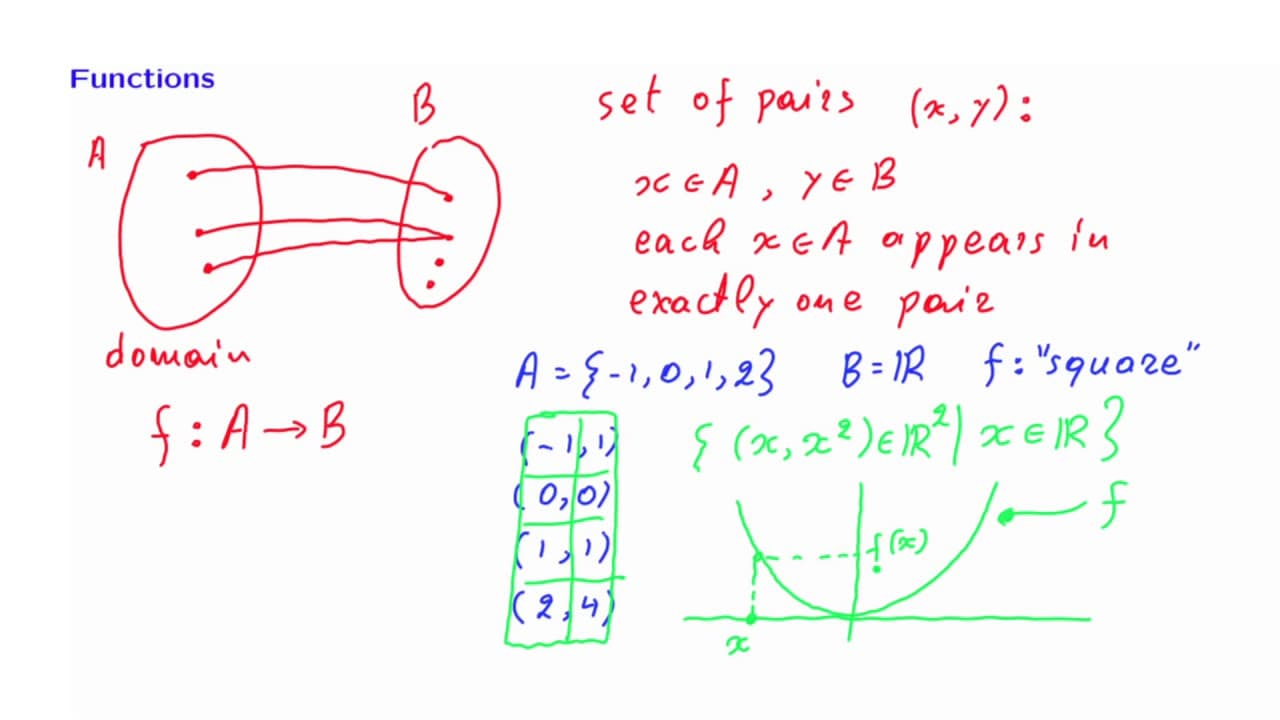
Functions are real valued functions on a sample space, defined as a rule that maps elements of a domain set to elements of a range set.
Transcript
We are defining a random variable as a real valued function on the sample space. So this is a good occasion to make sure that we understand what a function is. To define a function, we start with two sets. One set-- call it A-- is the domain of the function. And we have our second set. Then a function is a rule that for any element of A associates ... Read More
Key Insights
- 😫 Functions are real valued functions on a sample space, mapping elements from a domain set to a range set.
- 😫 A function is a rule that assigns points in the domain set to points in the range set, with each element in the domain set mapped to exactly one element in the range set.
- 🪈 Functions can be represented by ordered pairs or tables, with the entire plot representing the function itself.
- 😒 Informal language may lead to confusion, so it's important to use precise notation when describing functions.
- ❎ The function x squared and the function z squared are the same function, as they involve the same sets and follow the same rule.
- ☺️ The notation "f of x" is not technically correct since "f of x" represents the value of the function at a specific input, rather than the function itself.
Install to Summarize YouTube Videos and Get Transcripts
Explore YouTube Video Summarizer or Get YouTube Transcript Extractor
Questions & Answers
Q: What is a function?
A function is a rule that maps elements of a domain set to elements of a range set. It assigns points in the domain set to points in the range set.
Q: Can two elements from the domain set be mapped to the same element in the range set?
Yes, two elements in the domain set can be mapped to the same element in the range set. However, each element in the domain set should be mapped to exactly one element in the range set.
Q: How can a function be represented?
A function can be represented by ordered pairs or tables. Ordered pairs consist of an element from the domain set and its corresponding element from the range set. Tables show the input-output relationship of the function.
Q: What is the difference between a function and its specific value at a given input?
A function refers to the entire plot or mapping of the input-output relationship, while the specific value of a function at a given input is a single point on the plot.
Summary & Key Takeaways
-
Functions are defined as real valued functions on a sample space, mapping elements of a domain set to elements of a range set.
-
A function is a rule that assigns points from the domain set to points in the range set.
-
Functions can be represented by ordered pairs or tables, and the entire plot represents the function itself.
Read in Other Languages (beta)
Share This Summary 📚
Summarize YouTube Videos and Get Video Transcripts with 1-Click
Try YouTube Summary with ChatGPT & Claude or YouTube Transcript Generator
Explore More Summaries from MIT OpenCourseWare 📚


Summarize YouTube Videos and Get Video Transcripts with 1-Click
Try YouTube Summary with ChatGPT & Claude or YouTube Transcript Generator