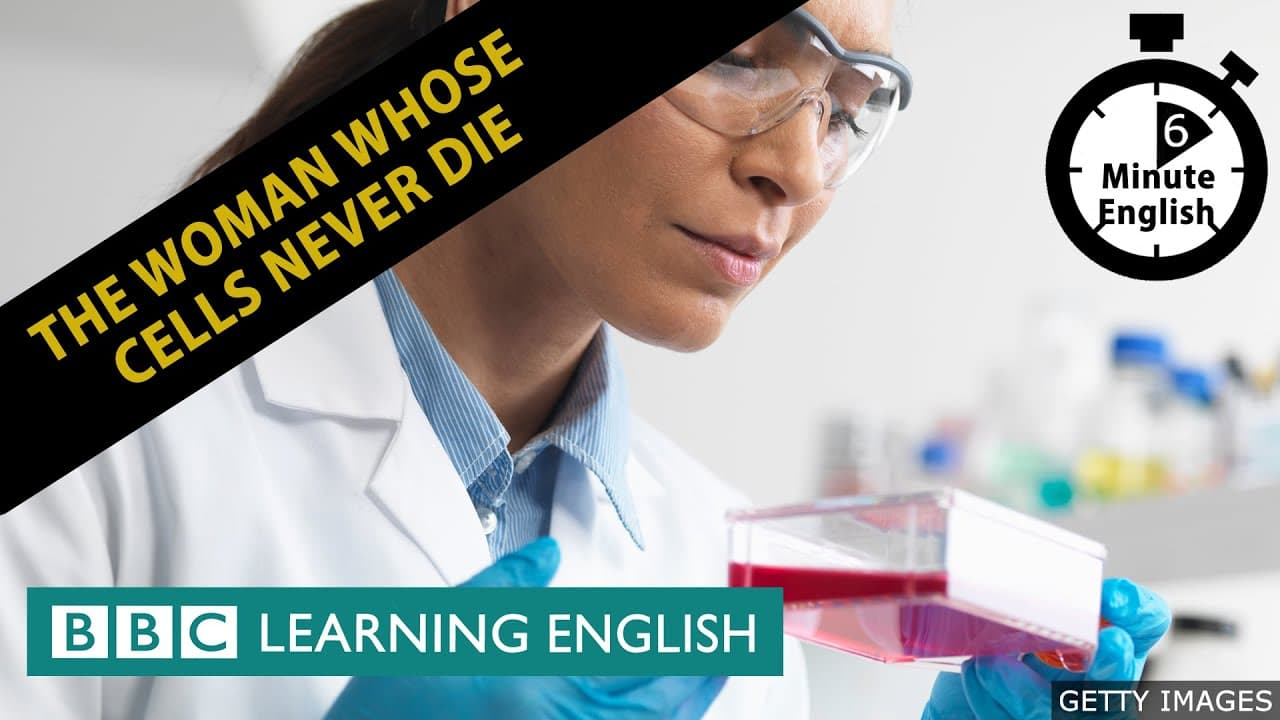
The woman whose cells never die - 6 Minute English
TL;DR
Henrietta Lacks' cells revolutionized medical research and treatments.
Transcript
Hello. This is 6 Minute English from BBC Learning English. I’m Rob. And I’m Georgina. What do Vincent Van Gogh and Galileo Galilei have in common, Georgina? Hmm… their first name and last names both start with the same letter? Well, that’s true… but another similarity is their amazing contributions – to art and science - were only recognised after ... Read More
Key Insights
- Henrietta Lacks' cells, known as HeLa cells, were discovered to have the extraordinary ability to reproduce endlessly, which has been pivotal in medical research.
- HeLa cells have contributed to numerous medical breakthroughs, including the development of the polio vaccine, cancer drugs, and treatments for HIV and infertility.
- Henrietta Lacks was an African American woman whose cells were taken without her consent in 1951, highlighting ethical issues in medical research.
- Her story gained public attention through a biography by Rebecca Skloot, which emphasized the significance of Lacks' contributions to science.
- HeLa cells have been instrumental in understanding cell reproduction and division, leading to advancements in IVF and other fertility treatments.
- Henrietta's cells have been described as a 'workhorse' due to their extensive use in scientific research and medical discoveries.
- The centenary of Henrietta Lacks' birth was marked by the eradication of polio in Africa, symbolizing her unknowing impact on global health.
- The discovery of insulin in 1921 is another significant medical breakthrough, occurring around the same time as Henrietta's birth.
Install to Summarize YouTube Videos and Get Transcripts
Explore YouTube Video Summarizer or Get YouTube Transcript Extractor
Questions & Answers
Q: Who was Henrietta Lacks and why is she significant?
Henrietta Lacks was an African American woman whose cells were taken without her consent in 1951. Her cells, known as HeLa cells, have the unique ability to reproduce endlessly, which has made them invaluable to medical research. They have contributed to numerous breakthroughs, including the polio vaccine, cancer drugs, and treatments for HIV and infertility.
Q: What are HeLa cells and how have they impacted medical research?
HeLa cells are a line of human cells derived from Henrietta Lacks that have the extraordinary ability to reproduce indefinitely. These cells have been instrumental in medical research, leading to significant advancements such as the development of the polio vaccine, cancer treatments, and understanding of cell reproduction, which has furthered fertility treatments like IVF.
Q: How did Henrietta Lacks' story gain public attention?
Henrietta Lacks' story gained public attention through a biography written by Rebecca Skloot. The book highlighted the significance of Lacks' contributions to science and brought to light the ethical issues surrounding the use of her cells without consent. It emphasized the importance of her HeLa cells in numerous medical breakthroughs.
Q: What ethical concerns are raised by Henrietta Lacks' story?
Henrietta Lacks' story raises ethical concerns about consent in medical research. Her cells were taken and used for research without her knowledge or permission, highlighting issues of exploitation and lack of informed consent, particularly in the context of racial and socio-economic disparities in the medical field.
Q: How have HeLa cells contributed to the fight against diseases?
HeLa cells have been crucial in the fight against various diseases. They have been used to develop vaccines, such as the polio vaccine, and treatments for cancer and HIV. Their ability to replicate endlessly allows scientists to conduct extensive research on cell reproduction and disease mechanisms, leading to numerous medical advancements.
Q: What is the significance of the centenary of Henrietta Lacks' birth?
The centenary of Henrietta Lacks' birth is significant as it coincides with the eradication of polio in Africa, a disease against which her cells helped develop a vaccine. This milestone symbolizes her unknowing yet profound impact on global health and highlights the importance of recognizing her contributions to medical science.
Q: What medical breakthrough occurred in 1921, and why is it significant?
In 1921, the discovery of insulin by Canadian doctor Frederick Banting occurred, which is significant because it revolutionized the treatment of diabetes. This breakthrough has saved the lives of millions of diabetics worldwide, marking a pivotal moment in medical history and coinciding with the era of Henrietta Lacks' birth.
Q: How are HeLa cells described in terms of their role in research?
HeLa cells are often described as a 'workhorse' in the realm of scientific research. This term reflects their extensive use and contribution to numerous medical discoveries. Their ability to endlessly reproduce has allowed scientists to conduct vital research, leading to significant advancements in understanding and treating various diseases.
Summary & Key Takeaways
-
Henrietta Lacks, an African American woman, unknowingly contributed to medical science when her cells were taken without consent in 1951. Her HeLa cells have been vital in numerous medical breakthroughs, including the polio vaccine and cancer treatments, highlighting both her legacy and ethical concerns in medical research.
-
The story of Henrietta Lacks gained widespread attention through a biography by Rebecca Skloot, which underscored the importance of her cells in scientific advancements. HeLa cells have been described as a 'workhorse' in medical research, contributing to understanding cell reproduction and aiding in treatments for various diseases.
-
The centenary of Henrietta Lacks' birth coincided with the eradication of polio in Africa, a testament to her cells' impact on global health. Her story raises ethical questions about consent in medical research, as her cells were used without her knowledge, leading to significant medical discoveries.
Read in Other Languages (beta)
Share This Summary 📚
Summarize YouTube Videos and Get Video Transcripts with 1-Click
Try YouTube Summary with ChatGPT & Claude or YouTube Transcript Generator
Explore More Summaries from BBC Learning English 📚

Summarize YouTube Videos and Get Video Transcripts with 1-Click
Try YouTube Summary with ChatGPT & Claude or YouTube Transcript Generator