I Failed a Right-Wing Philosophy Class
TL;DR
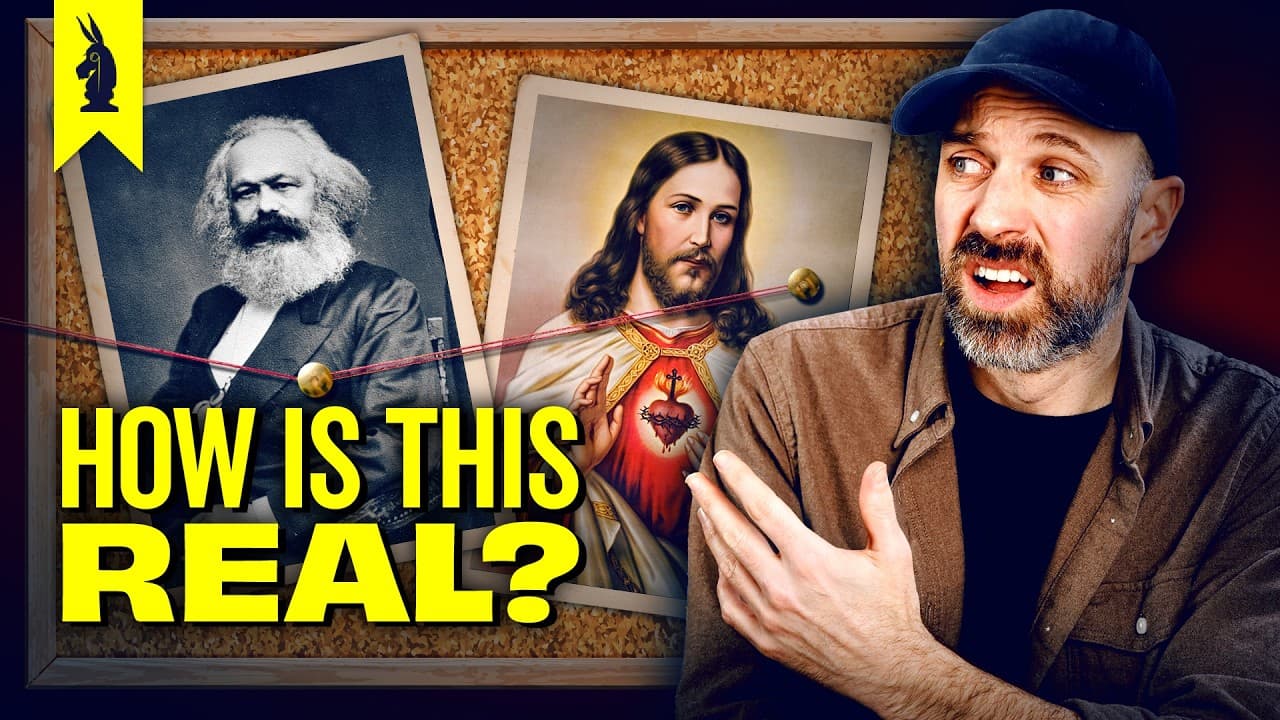
The speaker critiques Hillsdale College's course on Marxism, deeming it misleading and ideologically driven.
Transcript
I have a PhD in philosophy and used to teach college courses on Marxism and I just failed a quiz in an online class on Marxism socialism and communism at Hillsdale College so either I've gotten Dumber or this course is pedagogically designed not to teach or inform but to indoctrinate people into a very specific right-wing ideology one which ultimat... Read More
Key Insights
- 🎑 The critique emphasizes the course's failure to provide a balanced view of Marxism, instead promoting a right-wing agenda.
- 🎁 It highlights the disconnect between Marx's actual teachings and the distorted interpretations presented in the course material.
- 😥 The analysis points to the problematic implications of equating Marxism with historical figures associated with authoritarian regimes, undermining broader discussions about wealth and class.
- 🤔 It illustrates the importance of dialectical thinking in understanding socio-political ideologies and the interplay between individual and collective freedoms.
- 🌍 The speaker argues that equating moral and religious homogeneity with national stability is a dangerous oversimplification of complex societal dynamics.
- 🤨 The content raises awareness of how educational platforms can serve ideological purposes, potentially misguiding learners.
- 💀 It underscores the necessity for critical engagement with course materials and the dangers of ideological indoctrination in academic settings.
Install to Summarize YouTube Videos and Get Transcripts
Explore YouTube Video Summarizer or Get YouTube Transcript Extractor
Questions & Answers
Q: What are the main criticisms the speaker has about the course?
The speaker criticizes the course for presenting a one-sided narrative that misrepresents Marxism and promotes right-wing ideology. They argue that the course overlooks crucial aspects of Marx's theories, such as human flourishing and dialectical thinking, thus rendering it more of a propaganda tool than an educational resource.
Q: How does the speaker interpret Marx's views on religion and the family?
The speaker explains that Marx critiques religion as a response to socio-economic oppression rather than outright condemnation. They argue that Marx does not advocate for the abolition of family per se but critiques the bourgeois family structure that serves as a vehicle for wealth transfer and oppression, contrasting this with the community-oriented ideals Marx espouses.
Q: What is the significance of the term "white Christian nationalism" in this context?
The term "white Christian nationalism" refers to a belief system presented in the course, suggesting that a nation must be rooted in a common ethnicity, language, and religion. The speaker argues that this oversimplification draws dangerously incorrect parallels with historical ideologies associated with discrimination and exclusion.
Q: How does the speaker relate the course content to contemporary issues?
The speaker connects the course's portrayal of Marxism to ongoing socio-political debates, particularly around wealth inequality and exploitation in capitalism. They argue that the course fails to address these relevant issues adequately and instead focuses on creating a narrative that fosters division and misunderstanding.
Q: What does the speaker mean by "dialectical thinking"?
The speaker describes dialectical thinking as an approach that considers ideas and concepts in relation to their social, historical, and material contexts. This method acknowledges the complexity of human experiences and relationships, allowing for a more nuanced understanding of philosophical theories, particularly Marxism.
Q: Why does the speaker find the course's conclusions problematic?
The speaker finds the course's conclusions, particularly its framing of Marxism as a threat to Western civilization, problematic because it lacks substantial evidence and oversimplifies complex theories. They argue this creates a distorted perspective that misguides students rather than encouraging critical thought.
Q: How does the course attempt to relate Marxism to modern education?
The course asserts that Marxism has infiltrated educational institutions, framing educators and curriculum with leftist ideology. The speaker challenges this perspective, arguing that academia's focus on Marxist thought is more about understanding historical significance and relevance, not ideological warfare.
Q: What is the speaker's overall perspective on the importance of educational content?
The speaker believes educational content should prioritize accuracy, critical engagement, and intellectual freedom. They criticize the course for its propagandistic approach, arguing that it detracts from genuine scholarship and prevents students from forming informed opinions on important ideological discussions.
Summary & Key Takeaways
-
The content critiques Hillsdale College's online course on Marxism, suggesting it promotes a specific right-wing ideology while misrepresenting Marxist principles, leading to ideological indoctrination.
-
The speaker highlights inconsistencies in the course and discusses how it fails to accurately represent Marx's ideas, instead framing them within a reactionary narrative that culminates in a call for white Christian nationalism.
-
The analysis emphasizes the importance of dialectical thinking and the need for education to present a nuanced understanding of ideologies, arguing that the course oversimplifies and distorts Marxism to promote propaganda.
Read in Other Languages (beta)
Share This Summary 📚
Summarize YouTube Videos and Get Video Transcripts with 1-Click
Try YouTube Summary with ChatGPT & Claude or YouTube Transcript Generator