L26.4 A Numerical Example - Part III
TL;DR
This content discusses the calculation of steady-state probabilities and the approximation techniques used in a two-state Markov chain.
Transcript
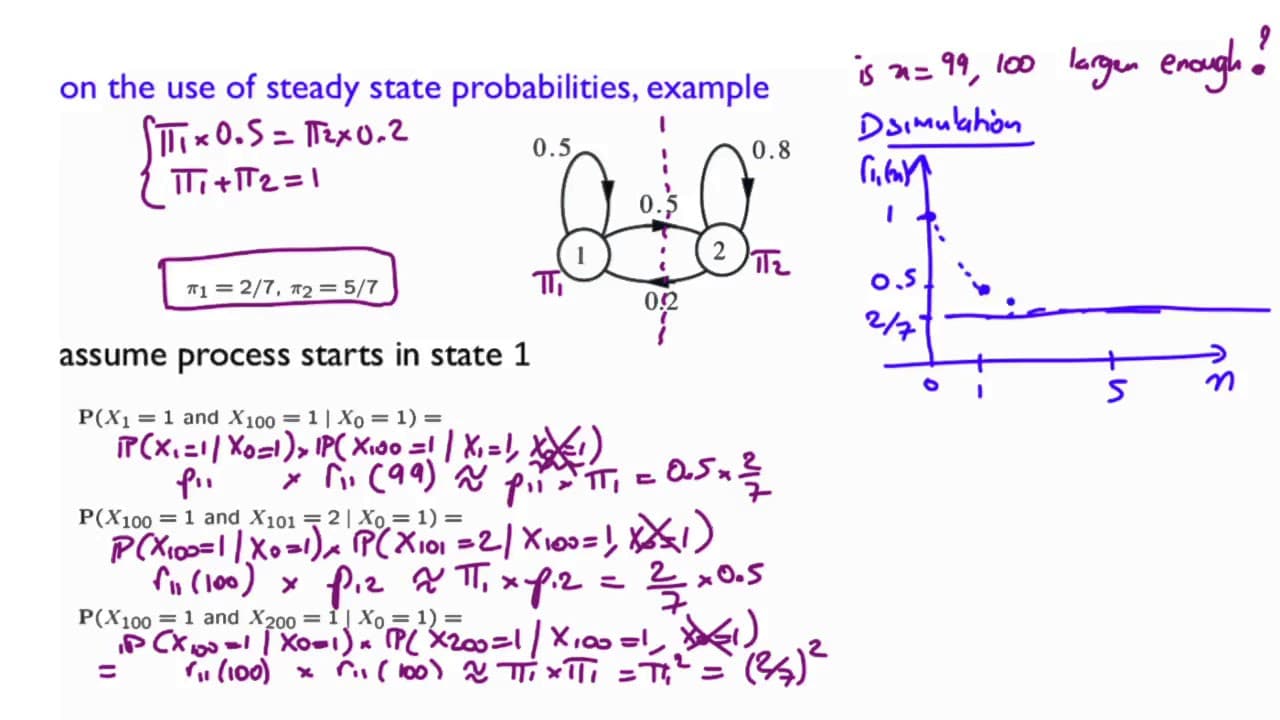
As a warm-up, just to see how to use steady-state probabilities, let us look at our familiar example. This is a two-state Markov chain, and we did write down the complete balance equations for this chain, and found the steady-state probabilities before. Notice that we can find these by using the trick which we introduced for birth and death process... Read More
Key Insights
- ⛓️ The steady-state probabilities in a two-state Markov chain can be found by comparing transition frequencies and solving equations.
- ❓ Conditional probabilities for specific transitions can be approximated using steady-state probabilities and transition probabilities.
- 🥡 The accuracy of the approximation depends on the number of steps taken in the chain.
- ⌛ The mixing time scale indicates how quickly the chain reaches a steady state and determines the number of iterations required for the initial states to be forgotten.
Install to Summarize YouTube Videos and Get Transcripts
Explore YouTube Video Summarizer or Get YouTube Transcript Extractor
Questions & Answers
Q: How can steady-state probabilities be found in a two-state Markov chain?
In a two-state Markov chain, the steady-state probabilities can be found by equating the frequency of transition from one state to itself with the frequency of transition from one state to the other state and solving the resulting equations.
Q: What is the conditional probability of staying in state 1 after 100 steps, given that state 1 is the starting point?
The conditional probability of staying in state 1 after 100 steps, given that state 1 is the starting point, can be approximated using the steady-state probability of state 1 multiplied by the transition probability from state 1 to state 1. This approximation is valid when the number of steps is sufficiently large.
Q: How can the probability of transitioning from state 1 to state 2 after 100 steps be calculated?
The probability of transitioning from state 1 to state 2 after 100 steps can be approximated by multiplying the steady-state probability of state 1 with the transition probability from state 1 to state 2. This approximation is valid when the number of steps is large enough.
Q: What determines how long it takes for the initial states to be forgotten in a Markov chain?
The mixing time scale determines how long it takes for the initial states to be forgotten in a Markov chain. It reflects the rate at which the chain converges to a steady state and depends on the transition probabilities between states.
Summary & Key Takeaways
-
The content explains the method of finding steady-state probabilities in a two-state Markov chain using the trick of cutting the chain and comparing transition frequencies.
-
It demonstrates the calculation of conditional probabilities for staying in state 1 after 100 steps, transitioning from state 1 to state 2 after 100 steps, and staying in state 1 after 200 steps.
-
The concept of mixing time scale is introduced, which determines the number of iterations required for the initial states to be forgotten and the chain to reach a steady state.
Read in Other Languages (beta)
Share This Summary 📚
Summarize YouTube Videos and Get Video Transcripts with 1-Click
Try YouTube Summary with ChatGPT & Claude or YouTube Transcript Generator
Explore More Summaries from MIT OpenCourseWare 📚



Summarize YouTube Videos and Get Video Transcripts with 1-Click
Try YouTube Summary with ChatGPT & Claude or YouTube Transcript Generator