Pulse Doppler radar | MTI | Principle | Radar Systems | Lec-31
TL;DR
The video discusses two radar systems: MTA radar for moving targets and Pulse Doppler radar combining range and velocity measurements.
Transcript
hi everyone in this video I am going to introduce two radar systems those are MTA radar and pulse Doppler radar till now we have seen three more different radar systems like pulse radar letter we have gone through CW radar and later we have also seen fmcw radar okay when you are studying different types of radar resistance you should know what is t... Read More
Key Insights
- 🎯 MTA radar specifically filters out stationary targets, improving the detection of objects in motion.
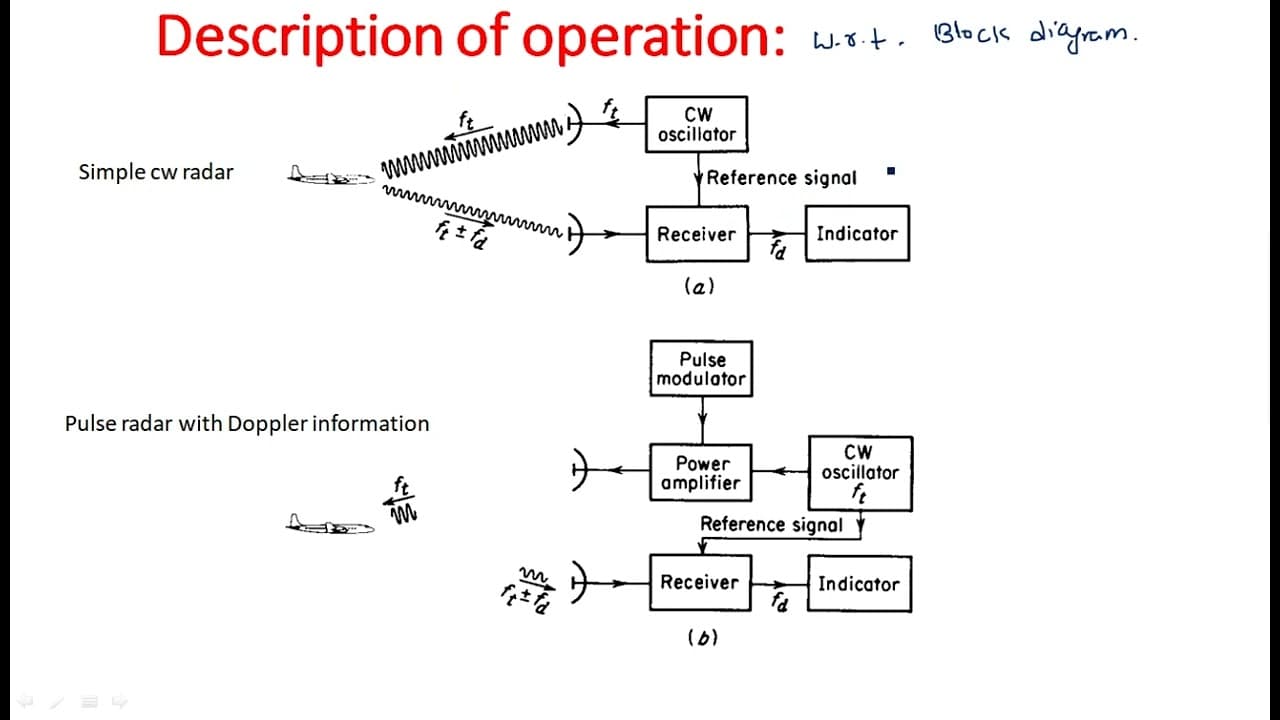
- 💗 Pulse Doppler radar merges techniques from both pulse and CW radar systems to measure both range and velocity.
- 💁 Doppler information is crucial for tracking and identifying moving targets effectively.
- ⁉️ The evolution of radar systems illustrates the ongoing quest to overcome limitations of predecessors through technological advancements.
- 💐 The design and operation of radar systems depend heavily on defined block diagrams that illustrate the signal flow and processing.
- 🅰️ Understanding radar systems involves recognizing the specific applications and contexts in which each type excels.
- 🚨 Different radar types have emerged as responses to the limitations of earlier models, demonstrating innovation in radar technology.
Install to Summarize YouTube Videos and Get Transcripts
Explore YouTube Video Summarizer or Get YouTube Transcript Extractor
Questions & Answers
Q: What is the main function of MTA radar?
MTA radar stands for Moving Target Indicator radar and its main function is to detect moving targets while filtering out stationary ones. This capability is essential for applications such as surveillance and tracking in a variety of terrains, enhancing situational awareness and target identification.
Q: How does Pulse Doppler radar differ from Pulse radar?
While Pulse radar is designed to measure range, it lacks the capability to determine velocity, which is a key limitation. Pulse Doppler radar integrates Doppler information into its operation, enabling it to calculate both range and velocity simultaneously, effectively addressing the shortcomings of the Pulse radar system.
Q: What are the advantages of incorporating Doppler information into radar systems?
Adding Doppler information allows radar systems to measure the speed of moving targets, thereby providing critical data for applications such as air traffic control, weather monitoring, and military operations. This enhances the radar's functionality and accuracy in detecting and tracking dynamic objects.
Q: What are the drawbacks of CW radar that FMCW radar addresses?
CW radar, while effective at measuring the velocity of targets, cannot measure range. FMCW radar improves upon this by transmitting frequency-modulated signals, thereby allowing for the measurement of both range and velocity—a significant advancement in radar capabilities.
Summary & Key Takeaways
-
The video introduces MTA and Pulse Doppler radar systems, explaining their functions and how they differ from previously discussed radar types.
-
MTA radar specifically identifies moving targets by filtering out stationary ones, enhancing target detection in various environments.
-
Pulse Doppler radar builds on pulse radar technology by incorporating Doppler information, allowing simultaneous measurement of range and velocity for moving targets.
Read in Other Languages (beta)
Share This Summary 📚
Summarize YouTube Videos and Get Video Transcripts with 1-Click
Try YouTube Summary with ChatGPT & Claude or YouTube Transcript Generator