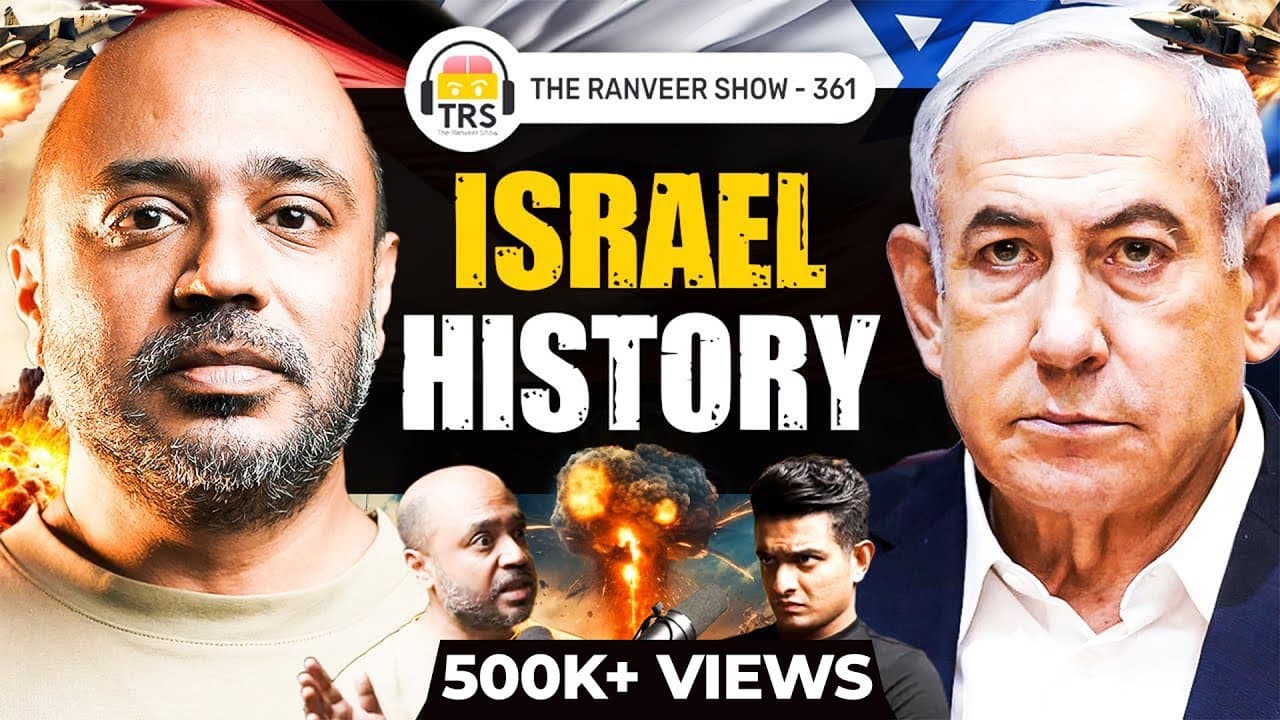
Current Situation: Israel - Hamas - Gaza & The Gulf Conflict: Abhijit I Mitra: UNTOLD Truth| TRS 361
TL;DR
The conversation delves into the historical complexities of the Israel-Palestine conflict.
Transcript
killing torturing raping people is a wrong period who was behind this Palestinian identity was it the rest of the Arab world saying that hey you guys there fight with the local Jew it was the same Colonial project that created Palestine that also accepted the right of the Jews to return either both are illegal or both are legal who do we call Israe... Read More
Key Insights
- 🙃 The Israel-Palestine conflict is deeply rooted in historical narratives that date back thousands of years, necessitating an understanding of both sides’ histories.
- 🏝️ Both Israeli and Palestinian identities have been shaped by colonial histories, significantly influencing contemporary claims to the land.
- ✌️ Violence perpetuates a cycle of conflict that complicates peace efforts, urging a shift towards non-violent dialogues for resolution.
- 💠 Historical grievances and narratives play a crucial role in shaping current geopolitical discussions and strategies on both sides.
- ✌️ Palestinian leadership often struggles between moderates seeking peace and hardline factions like Hamas that emphasize violence.
- 📈 Demographic trends among Palestinians highlight political challenges and underscore the urgency for a viable two-state solution.
- 💞 The significance of international perspectives and policies in shaping the evolving dynamics of the Israel-Palestine conflict cannot be underestimated.
Install to Summarize YouTube Videos and Get Transcripts
Explore YouTube Video Summarizer or Get YouTube Transcript Extractor
Questions & Answers
Q: How does the historical context shape the current Israel-Palestine conflict?
Historical context is vital as it illuminates how both Israeli and Palestinian identities have evolved over centuries due to colonialism, wars, and political negotiations. Recognizing these deep-seated histories helps to understand the motivations and claims from both sides regarding the land.
Q: What role does the perception of Israel as a colonial construct play in the discourse about the conflict?
Viewing Israel as a colonial construct brings up complex questions about legality and legitimacy. It argues that if Israel's establishment is deemed colonial, then one must also consider the colonial history of Palestine itself, raising deeper issues of historical grievances and rights to the land.
Q: Why are both sides unable to reach a lasting peace agreement?
The inability to reach a lasting peace agreement stems from continuous violence, failed negotiations, and deeply entrenched narratives that foster mistrust. Both sides have leaders whose actions often contradict their stated intentions of peace, complicating the path to resolution.
Q: What insights can we gain from the Palestinian and Israeli narratives?
Both narratives reveal the complexities of identity, historical grievances, and the impact of violence on civilian life. Understanding each perspective is crucial for fostering empathy and promoting dialogues that may lead to peace.
Q: How does the concept of non-violence relate to achieving peace in this context?
Non-violence, exemplified by leaders like Gandhi, is seen as a powerful weapon for change. The conversation suggests that peace achieved through civil disobedience can force the oppressor to reconsider their stance, highlighting the moral high ground of peaceful resistance.
Q: What is the relationship between Hamas and the broader Palestinian movement?
Hamas, as a significant faction within the Palestinian movement, complicates the struggle for statehood. Its violent tactics and governance style create challenges for moderates seeking peace and recognition, often polarizing opinions both locally and globally.
Q: How do demographics impact the Israel-Palestine conflict?
Demographics play a crucial role, particularly with a growing Palestinian population. The discussion details that demographic trends can influence political strategies, breeding grounds for conflict, and aspirations for statehood, highlighting the urgency for a political resolution.
Q: What is the significance of the two-state solution in the current discourse?
The two-state solution represents a potential resolution to the conflict, envisioning both Israeli and Palestinian states living peacefully side-by-side. However, growing skepticism regarding its feasibility reflects the complicated realities on the ground, driven by settlement activities and mutual distrust.
Summary & Key Takeaways
-
The discussion explores the deep historical roots of the Israel-Palestine conflict, suggesting that understanding history is crucial in comprehending the current situation, which has evolved over centuries.
-
It emphasizes that both Israeli and Palestinian identities have been shaped significantly by the legacies of colonialism and political struggles, with both sides having legal claims to the land.
-
The importance of civilian-led peace initiatives and the rejection of violence is underscored, advising that violence perpetuates suffering and reinforces the cycle of conflict.
Read in Other Languages (beta)
Share This Summary 📚
Summarize YouTube Videos and Get Video Transcripts with 1-Click
Try YouTube Summary with ChatGPT & Claude or YouTube Transcript Generator
Explore More Summaries from History - The Ranveer Show 📚

Summarize YouTube Videos and Get Video Transcripts with 1-Click
Try YouTube Summary with ChatGPT & Claude or YouTube Transcript Generator