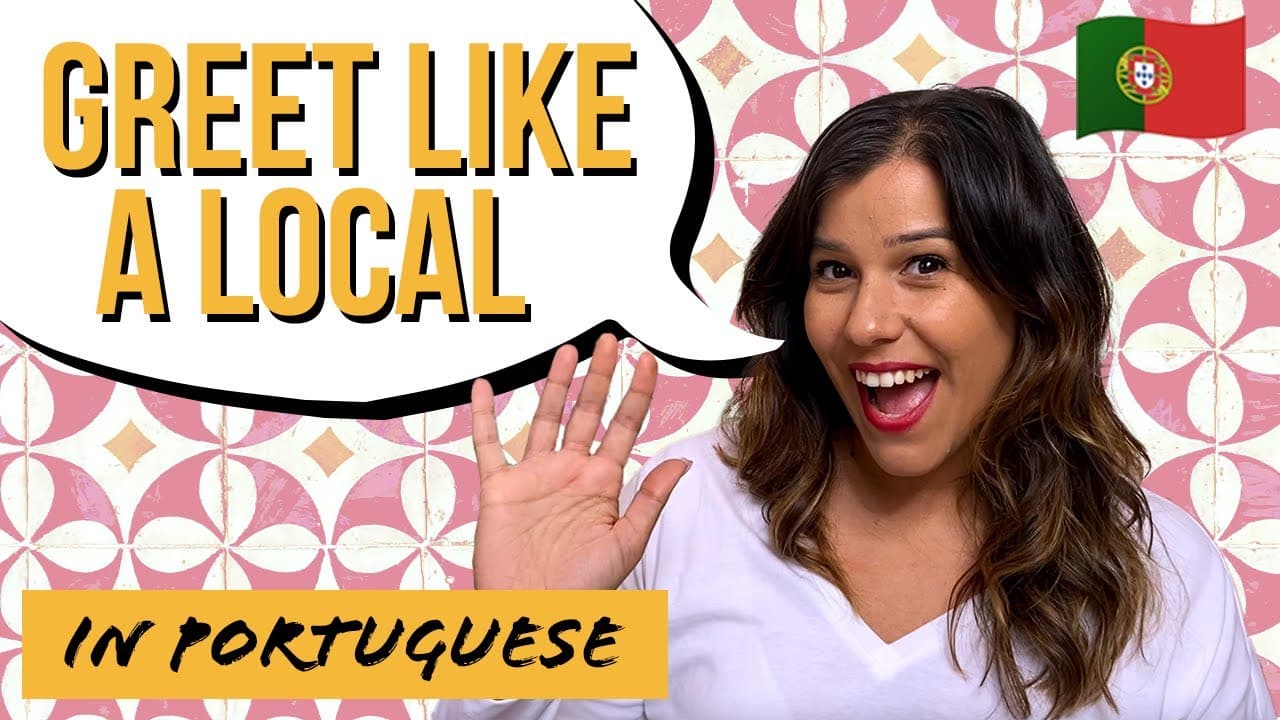
European Portuguese | How to Greet like a Local [Quick, Easy Greetings Phrases]
TL;DR
Learn formal and informal Portuguese greetings for natural conversations.
Transcript
greeting someone in Portuguese is quite literally the first thing you are going to do when you see those people in your life whether it's your neighbors or your extended family so we might as well learn to do it with perfect pronunciation and the type of words and phrases that native speakers will use themselves I mean there's nothing worse than ha... Read More
Key Insights
- Greeting someone in Portuguese is essential and can help you sound more like a native speaker. It's important to use appropriate phrases based on the context, whether formal or informal.
- Using 'Olá' is straightforward, but there are other informal greetings like 'Alô' and 'Então' that can be used to sound more natural and friendly.
- 'Bom dia,' 'Boa tarde,' and 'Boa noite' are preferred by Portuguese speakers over 'Olá' as they are considered more polite and culturally appropriate.
- Pronunciation is crucial in Portuguese. The nasal sounds in words like 'Bom' and the closed 'e' in 'tarde' require special attention for accurate pronunciation.
- The transition from afternoon to night ('tarde' to 'noite') in greetings can vary, often depending on cultural norms such as dinner times.
- The phrase 'Tudo bem?' is commonly used to ask how someone is, and the response can be a simple 'Tudo bem' with a change in intonation.
- Saying goodbye in Portuguese can be done with 'Tchau' or using 'Até' to create various phrases like 'Até logo' or 'Até amanhã.'
- Cultural nuances, such as using 'Beijinhos' for goodbye, show the importance of understanding local customs to communicate effectively.
Install to Summarize YouTube Videos and Get Transcripts
Explore YouTube Video Summarizer or Get YouTube Transcript Extractor
Questions & Answers
Q: What is the importance of learning greetings in Portuguese?
Learning greetings in Portuguese is crucial because it is often the first interaction you have with someone. Using the correct greetings helps you sound more like a native speaker and shows respect for cultural norms. It sets the tone for the conversation and can boost your confidence in speaking Portuguese.
Q: What are some informal greetings mentioned in the video?
Some informal greetings mentioned in the video include 'Alô,' which is similar to the English 'hello,' and 'Então,' which translates to 'hey' or 'so.' These greetings can make interactions feel more casual and friendly, helping you connect better with native speakers in informal settings.
Q: Why are 'Bom dia,' 'Boa tarde,' and 'Boa noite' preferred over 'Olá'?
'Bom dia,' 'Boa tarde,' and 'Boa noite' are preferred over 'Olá' because they are considered more polite and culturally appropriate. Portuguese speakers often use these greetings to show respect and politeness, especially in formal settings. They reflect the time of day, adding a personal touch to the interaction.
Q: How can pronunciation affect your ability to greet in Portuguese?
Pronunciation is crucial when greeting in Portuguese because it ensures you are understood correctly and sound more like a native speaker. Mispronouncing words, particularly nasal sounds or closed vowels, can lead to misunderstandings or reveal you as a beginner. Proper pronunciation helps convey respect and competence in the language.
Q: What is a common question to ask someone in Portuguese and its response?
A common question to ask someone in Portuguese is 'Tudo bem?' which means 'How are you?' The typical response is 'Tudo bem,' with a change in intonation to indicate it is an answer rather than a question. This exchange is a simple yet effective way to engage in small talk.
Q: What are some ways to say goodbye in Portuguese?
Some ways to say goodbye in Portuguese include 'Tchau,' which is similar to 'bye,' and using 'Até' to form phrases like 'Até logo' (see you later) or 'Até amanhã' (see you tomorrow). These phrases are versatile and can be used in various contexts to end a conversation politely.
Q: How does cultural understanding enhance your greeting skills in Portuguese?
Cultural understanding enhances your greeting skills in Portuguese by allowing you to use appropriate phrases and gestures that resonate with native speakers. It helps you avoid cultural faux pas and shows respect for local customs, making your interactions more meaningful and effective.
Q: What resources does Liz Sharma offer for improving Portuguese pronunciation?
Liz Sharma offers a free pronunciation guide for beginners, which includes seven tips to instantly improve European Portuguese pronunciation. This resource helps learners master nasal sounds and closed vowels, crucial for accurate pronunciation. Additionally, she provides free lessons and other educational content to boost language skills.
Summary & Key Takeaways
-
The video provides a comprehensive guide on how to greet people in European Portuguese using both formal and informal phrases. It emphasizes the importance of pronunciation and cultural nuances in greeting someone appropriately.
-
Liz Sharma explains various greetings such as 'Olá,' 'Alô,' 'Então,' and formal greetings like 'Bom dia,' 'Boa tarde,' and 'Boa noite.' She also highlights the significance of using polite greetings in Portuguese culture.
-
The video also covers how to say goodbye using phrases like 'Tchau' and 'Até,' and discusses common questions and responses like 'Tudo bem?' to help learners sound more natural in conversations.
Read in Other Languages (beta)
Share This Summary 📚
Summarize YouTube Videos and Get Video Transcripts with 1-Click
Try YouTube Summary with ChatGPT & Claude or YouTube Transcript Generator
Explore More Summaries from Talk the Streets 📚



![Practice Portuguese with Mixologist Fábio Guerreiro! [English & Portuguese Subtitles] thumbnail](/_next/image?url=https%3A%2F%2Fi.ytimg.com%2Fvi%2F1-T2PNWuiWY%2Fhqdefault.jpg&w=750&q=75)
Summarize YouTube Videos and Get Video Transcripts with 1-Click
Try YouTube Summary with ChatGPT & Claude or YouTube Transcript Generator