What Is a Depletion Type MOSFET and How Does It Work?
TL;DR
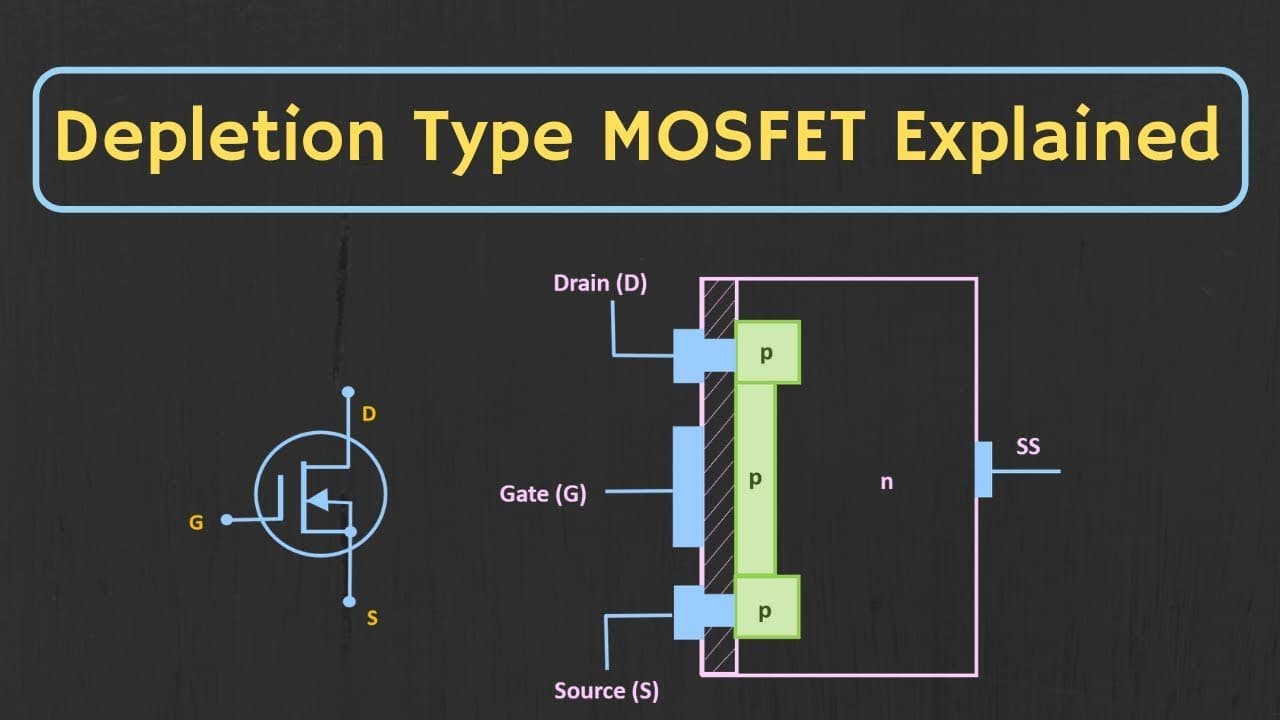
A depletion type MOSFET is an insulated gate field effect transistor (IGFET) that uses an insulating layer to isolate the gate from the channel, resulting in high input impedance. In an n-channel MOSFET, a positive voltage increases current until saturation, while negative voltage reduces current until it reaches zero at the pinch-off voltage. The p-channel variant operates similarly but with reversed voltage polarities.
Transcript
Hey friends, welcome to the YouTube channel ALL ABOUT ELECTRONICS. In the earlier video of the field effect transistor, we have briefly discussed about the different types of FET. And in detail we have already discussed about the JFET. So in this video let us see the second type of FET, which is known as IGFET and here this IGFET stands for insulat... Read More
Key Insights
- 🅰️ Depletion type MOSFETs are a type of IGFET where the gate terminal is isolated from the channel using an insulating layer.
- 🅰️ The n-channel depletion type MOSFET has an n-type channel and a p-type substrate, while the p-channel depletion type MOSFET has a p-type channel and an n-type substrate.
- 🔡 Depletion type MOSFETs have high input impedance due to the insulating layer, making them suitable for applications where low power consumption is required.
- ⚡ The drain current in a depletion type MOSFET increases with increasing positive gate-source voltage until it reaches a saturation current.
- ⚡ Negative gate-source voltage in a depletion type MOSFET reduces the drain current due to the recombination of electrons and holes in the channel. The drain current becomes zero at the pinch-off voltage.
- 🤬 Depletion type MOSFETs can be represented by symbols indicating the direction of the current flow when the PN junction formed by the channel and the substrate is forward biased.
Install to Summarize YouTube Videos and Get Transcripts
Explore YouTube Video Summarizer or Get YouTube Transcript Extractor
Questions & Answers
Q: What is the difference between an n-channel and p-channel depletion type MOSFET?
The n-channel depletion type MOSFET has an n-type channel and a p-type substrate, while the p-channel depletion type MOSFET has a p-type channel and an n-type substrate. This difference in doping determines the polarity of the applied voltages for these MOSFETs.
Q: How does the input impedance of a depletion type MOSFET compare to that of a JFET?
Depletion type MOSFETs have a higher input impedance than JFETs. This is due to the insulating layer that isolates the gate terminal from the channel, preventing any current flow through the gate terminal.
Q: What is the purpose of the insulating layer in a depletion type MOSFET?
The insulating layer in a depletion type MOSFET acts as a barrier between the gate terminal and the channel, ensuring that there is no direct connection. This isolation allows for high input impedance and lower power consumption.
Q: What is the pinch-off voltage in a depletion type MOSFET?
The pinch-off voltage is the negative voltage at which the drain current in a depletion type MOSFET becomes zero. This voltage causes the recombination of electrons in the channel with the holes in the substrate, reducing the flow of current.
Key Insights:
- Depletion type MOSFETs are a type of IGFET where the gate terminal is isolated from the channel using an insulating layer.
- The n-channel depletion type MOSFET has an n-type channel and a p-type substrate, while the p-channel depletion type MOSFET has a p-type channel and an n-type substrate.
- Depletion type MOSFETs have high input impedance due to the insulating layer, making them suitable for applications where low power consumption is required.
- The drain current in a depletion type MOSFET increases with increasing positive gate-source voltage until it reaches a saturation current.
- Negative gate-source voltage in a depletion type MOSFET reduces the drain current due to the recombination of electrons and holes in the channel. The drain current becomes zero at the pinch-off voltage.
- Depletion type MOSFETs can be represented by symbols indicating the direction of the current flow when the PN junction formed by the channel and the substrate is forward biased.
- The transfer characteristic of a depletion type MOSFET shows the relationship between the drain current and the gate-source voltage, similar to JFETs.
Summary & Key Takeaways
-
Depletion type MOSFETs are a type of insulated gate field effect transistor (IGFET) where the gate terminal is isolated from the channel using an insulating layer.
-
The n-channel depletion type MOSFET has an n-type channel and a p-type substrate, while the p-channel depletion type MOSFET has a p-type channel and an n-type substrate.
-
When a positive voltage is applied between the drain and source terminals, current flows through the channel, but as the voltage increases, the current ultimately becomes constant. The relationship between drain current and gate-source voltage is similar to that of JFETs.
-
When a negative voltage is applied to the gate terminal, the electrons in the channel recombine with the holes in the substrate, reducing the flow of current. The drain current decreases as the negative gate-source voltage increases, ultimately reaching zero at the pinch-off voltage.
Read in Other Languages (beta)
Share This Summary 📚
Summarize YouTube Videos and Get Video Transcripts with 1-Click
Try YouTube Summary with ChatGPT & Claude or YouTube Transcript Generator
Explore More Summaries from ALL ABOUT ELECTRONICS 📚
Summarize YouTube Videos and Get Video Transcripts with 1-Click
Try YouTube Summary with ChatGPT & Claude or YouTube Transcript Generator