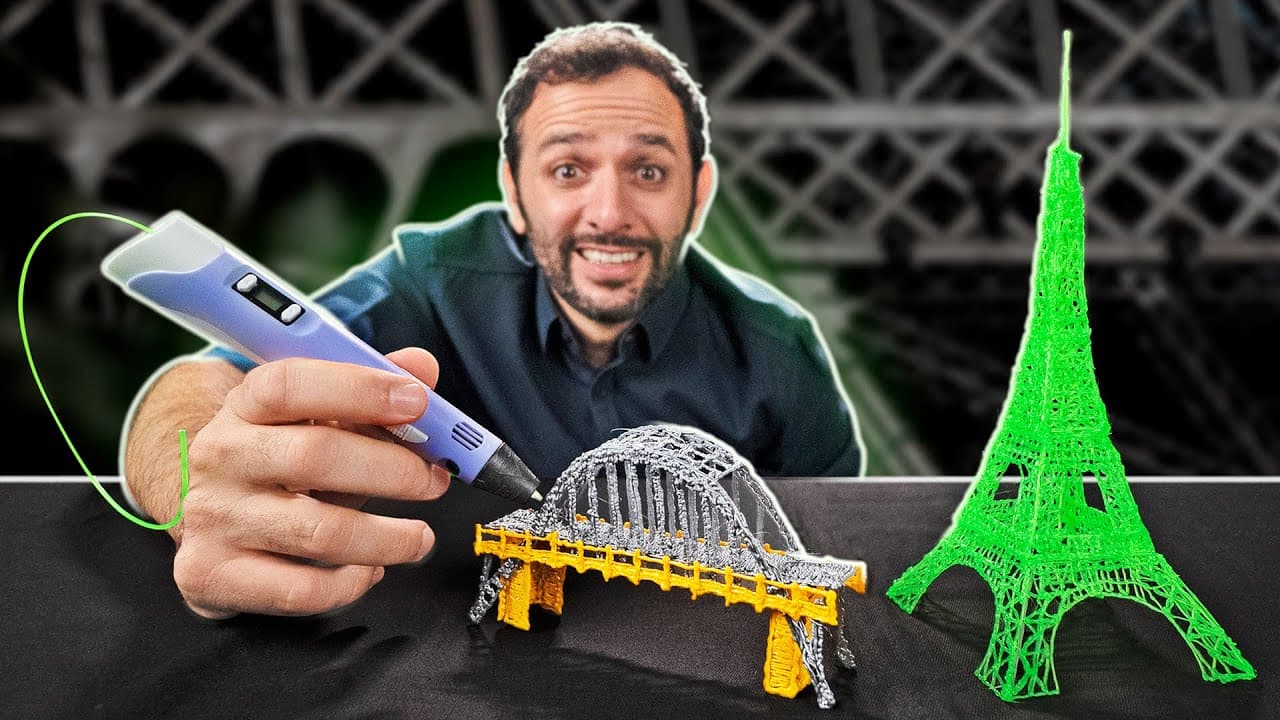
Testamos a CANETA 3D!
TL;DR
Exploring a 3D pen's capabilities and limitations.
Transcript
Do you know what just arrived? A 3D pen! It's a pen that works like a 3D printer. So, today let's see and explore this pen that I've wanted to test for years. Ah, let me tell you that we bought one of the cheapest ones they had, but I think it will work well. Look at this pen. It looks like a stove lighter. Let's find out how it works. First, it ... Read More
Key Insights
- The 3D pen functions similarly to a 3D printer but requires manual operation, offering creative freedom without computerized control.
- Two types of plastic filaments, ABS and PLA, can be used with the pen, each requiring different temperature settings for optimal results.
- The pen must be plugged in during use, which limits mobility and can affect the user's agility while creating objects.
- Creating 3D objects with the pen involves a learning curve, as controlling the speed and temperature is crucial for achieving desired results.
- Using drawing molds or pre-planned designs can simplify the process of creating 3D objects and improve the final outcome.
- The pen releases heated plastic, similar to a hot glue gun, but with more precise control over the extrusion process.
- Safety concerns exist regarding the pen's temperature, suggesting it may not be suitable for young children without supervision.
- Despite its limitations compared to a 3D printer, the 3D pen offers a fun and engaging way to experiment with 3D creation.
Install to Summarize YouTube Videos and Get Transcripts
Explore YouTube Video Summarizer or Get YouTube Transcript Extractor
Questions & Answers
Q: What are the main differences between a 3D pen and a 3D printer?
A 3D pen operates manually, allowing users to create objects freehand, whereas a 3D printer is computer-controlled, following precise digital designs. The pen requires constant manual input for shaping objects, while the printer automates the process. Additionally, the pen offers more creative freedom but less precision and complexity compared to a 3D printer.
Q: What types of plastic filaments can be used with the 3D pen?
The 3D pen can use two types of plastic filaments: ABS and PLA. ABS is a petroleum-based plastic that requires higher temperatures to melt and is typically used in enclosed 3D printers. PLA, on the other hand, is plant-based, derived from sources like corn and sugar cane, and melts at lower temperatures, making it more suitable for open environments.
Q: How does the 3D pen's temperature control affect its use?
The 3D pen's temperature control is crucial for melting different types of plastic filaments properly. Users must adjust the temperature based on the filament type (ABS or PLA) to ensure smooth extrusion and prevent issues like bubbling or improper adhesion. Incorrect temperature settings can lead to poor quality creations and difficulty in handling the pen effectively.
Q: What safety concerns are associated with using a 3D pen?
Safety concerns with a 3D pen include the risk of burns from the heated tip and melted plastic. While the plastic cools quickly and is less likely to cause burns, the pen's tip remains hot and can cause injury if touched. This makes the pen potentially unsuitable for young children without supervision, requiring careful handling to avoid accidents.
Q: What are the advantages of using drawing molds with a 3D pen?
Using drawing molds with a 3D pen simplifies the creation process by providing predefined shapes to follow, reducing the complexity of freehand drawing. Molds help users achieve more precise and consistent results, especially for beginners. They allow for the creation of detailed 2D components that can be assembled into 3D objects, enhancing the pen's versatility.
Q: How does the 3D pen compare to a hot glue gun?
The 3D pen is similar to a hot glue gun in that both release heated material through a nozzle. However, the pen offers more control over the extrusion process, including adjustable speed and temperature settings. Unlike a glue gun, which requires manual pressure to release glue, the pen uses a motor to extrude plastic, providing more precision for detailed work.
Q: What challenges did the creator face while using the 3D pen?
The creator faced challenges such as controlling the pen's speed and temperature to prevent issues like bubbling and poor adhesion. Creating complex shapes required practice and patience, as the pen's manual operation demands steady hands and precise movements. Additionally, the need to keep the pen plugged in limited mobility, complicating the creation process.
Q: What potential does the 3D pen have as a creative tool?
The 3D pen has significant potential as a creative tool, offering users the ability to experiment with 3D design and creation in a hands-on manner. It encourages creativity and innovation, allowing for the creation of custom objects and artistic expressions. Despite its limitations compared to a 3D printer, the pen provides an accessible entry point into the world of 3D creation, making it a valuable educational and artistic tool.
Summary & Key Takeaways
-
The video explores the use of a 3D pen, highlighting its similarities to a 3D printer and hot glue gun. The pen requires manual operation and offers creative freedom, but involves a learning curve to master the controls effectively.
-
Two types of plastic filaments, ABS and PLA, are compatible with the pen, each requiring specific temperature settings. The pen's need to be plugged in limits its mobility, affecting the user's ability to create complex designs easily.
-
The 3D pen is a fun and engaging tool for experimenting with 3D creation, despite its limitations compared to a 3D printer. Safety concerns exist due to the pen's high temperature, making it potentially unsuitable for young children.
Read in Other Languages (beta)
Share This Summary 📚
Summarize YouTube Videos and Get Video Transcripts with 1-Click
Try YouTube Summary with ChatGPT & Claude or YouTube Transcript Generator
Explore More Summaries from Manual do Mundo 📚
Summarize YouTube Videos and Get Video Transcripts with 1-Click
Try YouTube Summary with ChatGPT & Claude or YouTube Transcript Generator