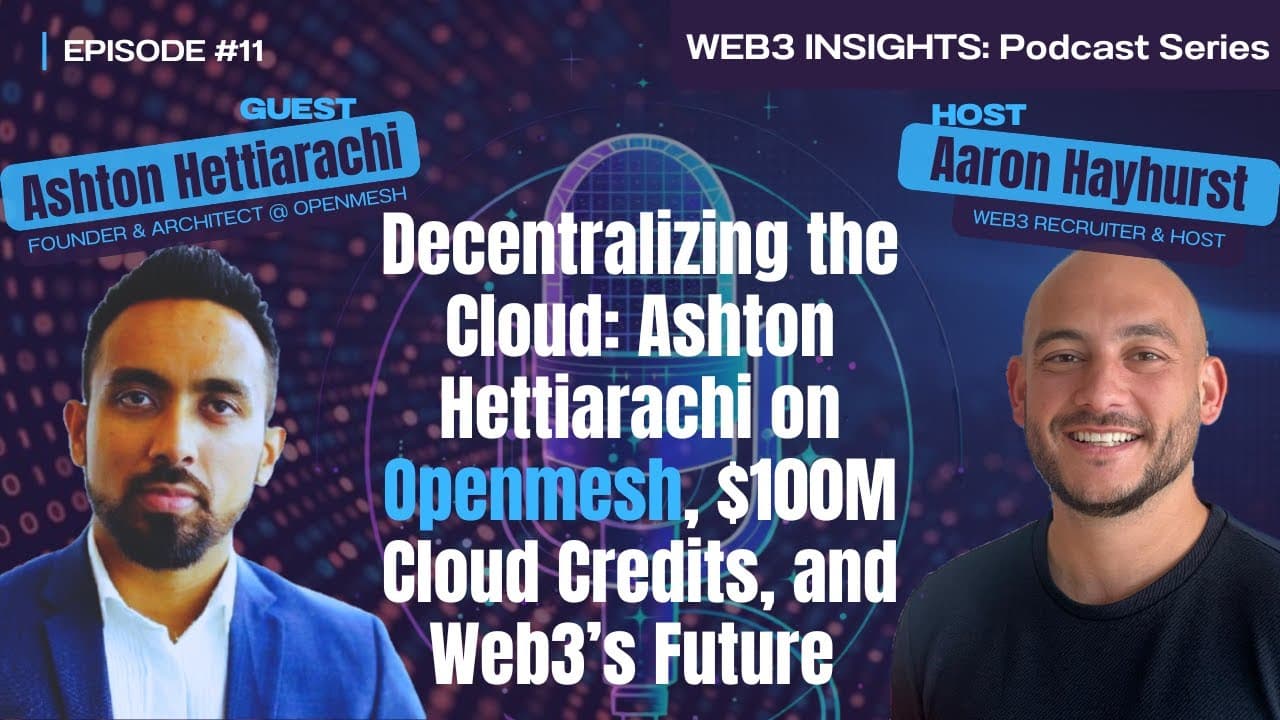
Decentralizing the Cloud: Ashton Hettiarachi on Openmesh, $100M Cloud Credits, and Web3’s Future
TL;DR
Exploring decentralization's impact on Web3 with Openmesh's Ashton.
Transcript
so hello and welcome back to another episode of web free insights I'm your host Aaron heurst and today we're diving into a critical discussion on the future of the centralization in web 3 joining me is Ashton um who is the founder and product architect of open mesh um in the first part of our conversation we're going to be e... Read More
Key Insights
- Centralization remains a structural issue across various sectors, leading to monopolies and concentrated power in a few corporations, which is a significant concern.
- Decentralized governance, while a solution to central control, faces its own challenges in decision-making and maintaining a distributed network.
- The economic viability of node validators is crucial for decentralized networks, requiring incentives to ensure long-term sustainability and participation.
- Openmesh offers a decentralized alternative to traditional cloud services, aiming to provide infrastructure that is user-friendly and accessible, akin to Lego blocks.
- The $100 million cloud credits initiative by Openmesh is aimed at empowering developers rather than simply handing out cash, promoting the usage of decentralized infrastructure.
- Building a distributed network involves overcoming significant hurdles, including scalability, security, and network reliability challenges.
- The future of Web3 is expected to be a multi-chain ecosystem, with interoperability and composability between different chains playing a crucial role.
- Partnerships and integrations are essential for the growth of decentralized infrastructure, with Openmesh focusing on community-based fundraising and collaborations.
Install to Summarize YouTube Videos and Get Transcripts
Explore YouTube Video Summarizer or Get YouTube Transcript Extractor
Questions & Answers
Q: What are the main concerns associated with centralization?
Centralization leads to monopolies and concentrated power, posing significant concerns as a few corporations control critical infrastructure, data, and AI capabilities. This concentration of power can influence distribution and data collection, potentially leading to misuse and lack of transparency, as regulatory oversight is limited.
Q: How does decentralized governance address central control?
Decentralized governance aims to distribute decision-making power across a network, reducing central control. However, it faces challenges such as maintaining incentives for network participants and ensuring effective decision-making without a centralized authority, which can slow down processes and hinder ecosystem growth.
Q: What role does Openmesh play in decentralized infrastructure?
Openmesh provides a decentralized alternative to traditional cloud services, offering infrastructure that combines the best of cloud technology and blockchain. It focuses on creating a user-friendly and accessible ecosystem, empowering developers to build decentralized applications with ease and promoting the use of decentralized networks.
Q: What is the purpose of the $100 million cloud credits initiative?
The $100 million cloud credits initiative by Openmesh aims to support developers by providing access to decentralized cloud infrastructure. This initiative is not about giving away cash but rather encouraging the use of Openmesh's services, thereby promoting the adoption and growth of decentralized networks in the Web3 space.
Q: What challenges does Openmesh face in building decentralized infrastructure?
Openmesh encounters challenges such as scalability, security, and network reliability when building decentralized infrastructure. Additionally, finding and collaborating with the right partners and ecosystems is crucial for showcasing their technology and achieving widespread adoption in the Web3 landscape.
Q: How does Openmesh differ from centralized cloud providers?
Unlike centralized cloud providers, Openmesh operates without a centralized company or foundation, relying on a decentralized network of node operators. This approach ensures that resources are community-driven, offering a more democratic and transparent alternative to traditional cloud services dominated by major corporations.
Q: What future developments are expected in the Web3 ecosystem?
The Web3 ecosystem is expected to evolve into a multi-chain environment, emphasizing interoperability and composability between different blockchains. Innovations like Chainlink's CCIP are anticipated to play a significant role, enabling cross-chain communication and asset transfers without relying on traditional bridges.
Q: What upcoming initiatives does Openmesh have planned?
Openmesh plans to focus on Chainlink integration and participate in major conferences such as Smartcon and Devcon. They are also conducting a community-based fundraising initiative and exploring partnerships with companies like Nvidia and large data centers to enhance their decentralized infrastructure offerings.
Summary & Key Takeaways
-
In this episode, Aaron Hayhurst interviews Ashton Hettiarachi, discussing the future of decentralization in Web3, highlighting the differences between centralization and decentralization and the economic viability of node validators.
-
Ashton introduces Openmesh's mission to provide decentralized cloud infrastructure, detailing their $100 million cloud credits giveaway aimed at empowering developers and encouraging the use of decentralized networks.
-
The conversation covers the challenges of decentralized governance, the importance of partnerships, and the future direction of Openmesh in the evolving landscape of decentralized technology.
Read in Other Languages (beta)
Share This Summary 📚
Summarize YouTube Videos and Get Video Transcripts with 1-Click
Try YouTube Summary with ChatGPT & Claude or YouTube Transcript Generator