Why Do Devis Exist In Hinduism - Dr Vineet Agarwal Explains
TL;DR
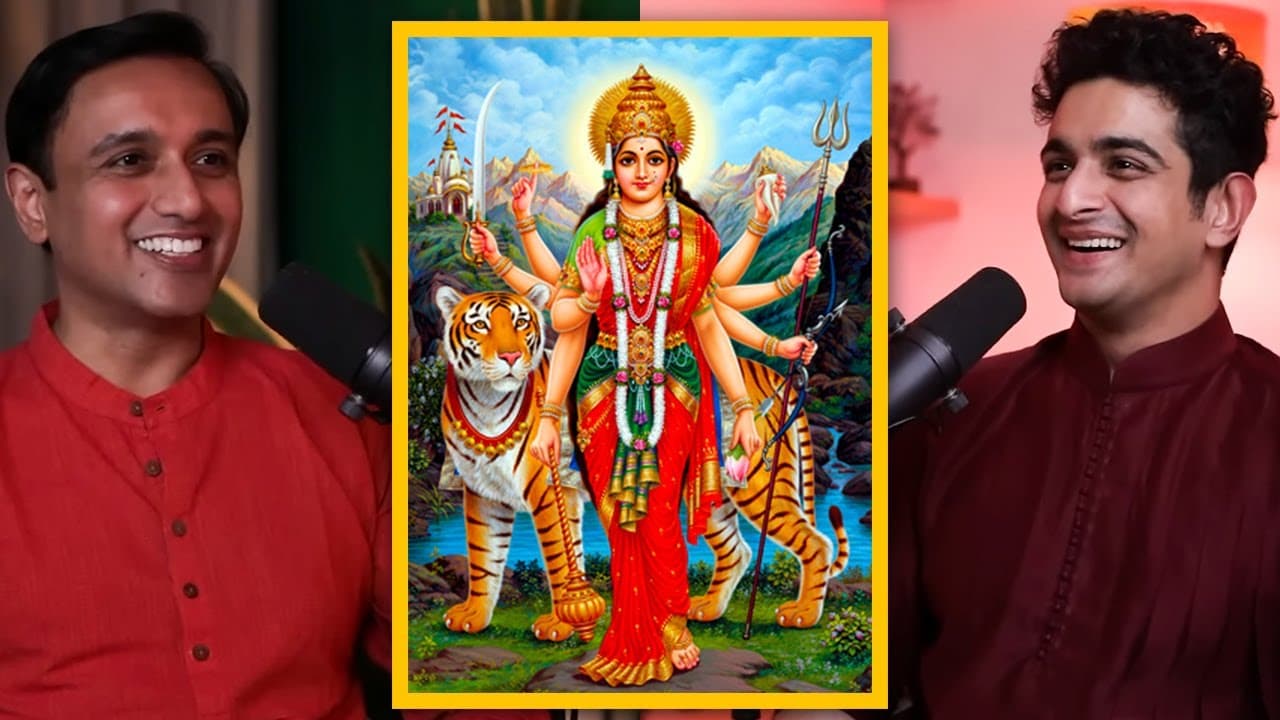
The content explores the significance of Brahma and the evolution of divine feminine energy in Hindu mythology.
Transcript
happiness through Curiosity on the ranveer show Welcome to TRS Clips each of the purans they um tell the stories or they narrate the incidents that happened in one day of Brahma so Brahma we know is a Creator God right and Brahma has a lifespan of 100 years each of his ears has about 360 days and each of these days is known as a kulpa so the differ... Read More
Key Insights
- 🏍️ Brahma's life cycle illustrates the profound differences between divine and human temporal existence, inviting contemplation on the nature of time.
- ❓ The narrative confirms Devi as the primordial energy responsible for creation within the Hindu pantheon, reinforcing the sacred feminine.
- 👾 Vishnu's representation of space connects to his role in maintaining universal harmony, corresponding to the expansive nature of existence.
- 👾 The balance of time and space is embodied in the relationship between Vishnu and Shiva, highlighting their significance in the cosmic order.
- 🛟 Shakti as energy emphasizes the necessity of movement and life, reflecting a fundamental understanding of nature's forces.
- 🧭 The Saptarishis are crucial in passing wisdom through storytelling, preserving complex knowledge for future generations.
- ❓ The universal concept of the sacred feminine transcends cultures, suggesting a shared understanding of vital nurturing energies in mythologies worldwide.
Install to Summarize YouTube Videos and Get Transcripts
Explore YouTube Video Summarizer or Get YouTube Transcript Extractor
Questions & Answers
Q: What is the significance of Brahma's lifespan in cosmic mythology?
Brahma, the Creator God in Hindu mythology, has a lifespan of 100 years, divided into Kalpas. Each Kalpa represents a day in Brahma's life, emphasizing a vast difference from human time, which, according to calculations, is around 155 trillion years in Brahma's current 51st year, showcasing the immense scale of cosmic timelines.
Q: How do the Puranas characterize the divine feminine?
The Puranas often depict Devi, or the divine feminine, as the first manifestation of God, highlighting her essential role in the emergence of the Trimurti—Brahma, Vishnu, and Shiva. This characterization illustrates a deep-rooted recognition of feminine energy as the source of creation and sustenance in the universe.
Q: What does Vishnu symbolize in Hindu cosmology?
Vishnu symbolizes space within Hindu cosmology, represented by his blue color akin to the sky or dark space. As the preserver of the universe, Vishnu's essence embodies the vastness of existence and the interconnectedness of all creation, emphasizing his role in maintaining balance within the cosmos.
Q: How does the concept of Shakti relate to energy in the universe?
Shakti represents energy in the universe, necessary for all forms of movement and life. In Hindu philosophy, energy is often personified as feminine, underpinning the continuity of life and civilization, echoing the nurturing roles traditionally associated with women in society and the connection between all beings.
Q: What role do the Saptarishis play in the transmission of knowledge?
The Saptarishis, or seven great sages, are believed to convey the pure wisdom of the universe to humanity. They translate complex, esoteric knowledge into stories and Puranas, making them accessible and relatable for human understanding, thus preserving ancient insights across generations.
Q: How does the sacred feminine manifest across different cultures?
Various ancient cultures worldwide have recognized a sacred feminine aspect, from goddesses in Mesopotamia and Greek mythology to the divine feminine in Hinduism. This universal archetype often embodies life-giving and nurturing qualities, reflecting a fundamental aspect of existence pervasive throughout human history.
Q: What is the relationship between energy, creation, and the divine in this context?
In this narrative, energy is viewed as the driving force behind creation and existence. The interplay between Shakti (energy), Brahma (material creation), Vishnu (space), and Shiva (time) illustrates a cosmic balance, suggesting that understanding these relationships provides deeper insight into life and the universe.
Q: How do stories in the Puranas help in understanding complex philosophical ideas?
Stories in the Puranas serve as metaphors that encapsulate complex philosophical concepts, making them digestible for human comprehension. By weaving narratives around deities and cosmic principles, these ancient texts facilitate a deeper recognition of the interconnectedness of life, energy, and the divine amidst human experience.
Summary & Key Takeaways
-
The content delves into the lifespan of Brahma and the concept of Kalpas, illustrating the differences between divine and human timelines, emphasizing the complexity of cosmic time.
-
It discusses the representation of deities in Hinduism, specifically focusing on the roles of Vishnu, Shiva, and the energy of Shakti, highlighting their interconnectivity in the universe.
-
The ancient knowledge conveyed through Puranas is preserved by sages, reflecting how narratives encapsulate profound wisdom about life, energy, and the sacred feminine across cultures.
Read in Other Languages (beta)
Share This Summary 📚
Summarize YouTube Videos and Get Video Transcripts with 1-Click
Try YouTube Summary with ChatGPT & Claude or YouTube Transcript Generator
Explore More Summaries from TRS Clips 📚



Summarize YouTube Videos and Get Video Transcripts with 1-Click
Try YouTube Summary with ChatGPT & Claude or YouTube Transcript Generator