Lecture 4.2: Shimon Ullman - Atoms of Recognition
TL;DR
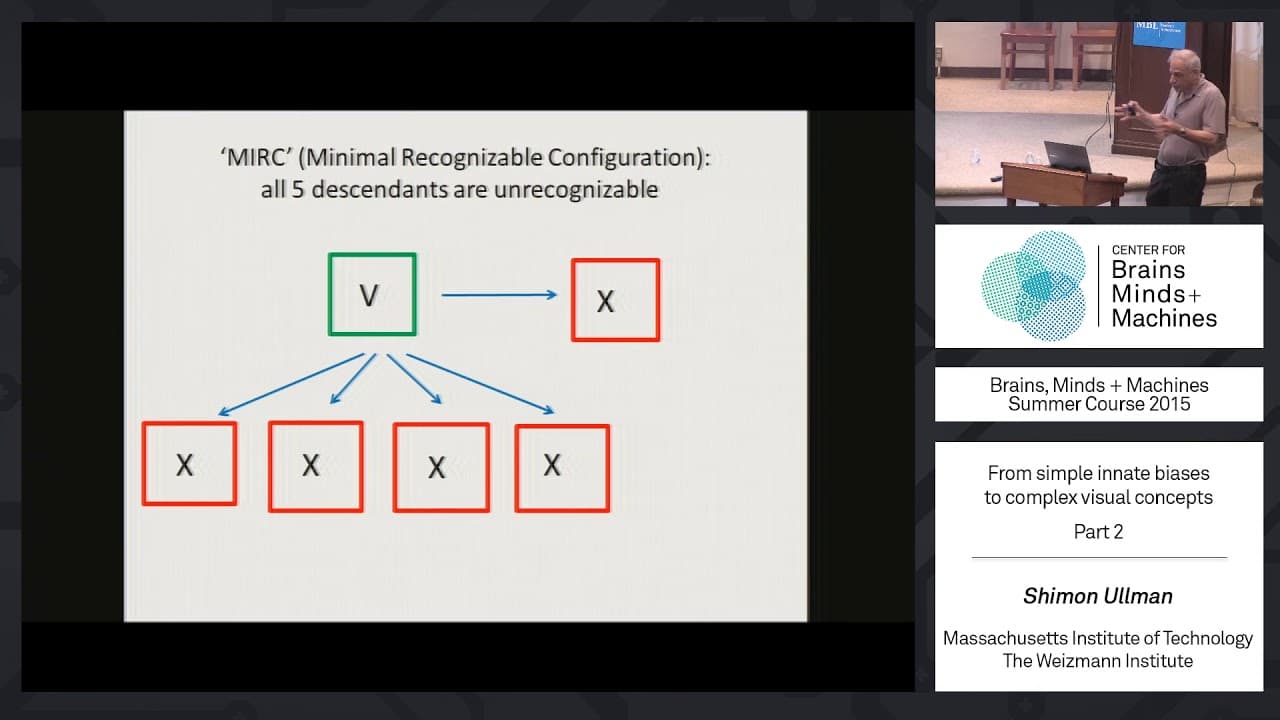
Humans can recognize and interpret minimal images, while current computational models struggle due to a lack of top-down processing.
Transcript
The following content is provided under a Creative Commons license. Your support will help MIT OpenCourseWare continue to offer high-quality educational resources for free. To make a donation or view additional materials from hundreds of MIT courses, visit MIT OpenCourseWare at ocw.mit.edu. SHIMON ULLMAN: Now for a different, entirely different typ... Read More
Key Insights
- 😒 Humans can recognize and interpret minimal images due to their ability to use top-down processing and internal interpretation.
- 🖤 Current computational models, including deep networks, struggle to recognize minimal images and lack the ability to interpret fine details.
- 🖐️ Top-down processing and internal interpretation play a crucial role in human visual recognition.
- 💨 Minimal images provide a way to compare representations and understand the relevant features and structures for recognition.
- ❓ The combination of bottom-up and top-down processing is essential for accurate and detailed interpretation of visual images.
- 👻 Top-down processing allows for the recognition of specific structures and details within minimal images.
- ❓ MEG studies provide evidence of top-down processing in the human visual system during recognition of minimal images.
- 🎑 Fine interpretation of details is essential for accurate recognition and understanding of visual scenes.
- ⚾ Visualization-based tasks, such as understanding social interactions, require precise interpretation of fine details.
Install to Summarize YouTube Videos and Get Transcripts
Explore YouTube Video Summarizer or Get YouTube Transcript Extractor
Questions & Answers
Q: Why do humans excel at recognizing and interpreting minimal images?
Humans have the ability to use top-down processing and internal interpretation, which allows them to recognize meaningful details and make fine distinctions.
Q: How do computational models differ from humans in recognizing minimal images?
Current computational models, such as deep networks, do not have the ability to interpret fine details and rely solely on bottom-up processing, resulting in lower accuracy in recognizing minimal images.
Q: What is the significance of the gap between recognizable and unrecognizable images?
The gap highlights the importance of top-down processing and internal interpretation in recognizing and interpreting minimal images, which current computational models struggle to replicate.
Q: How can this research benefit the field of computer vision?
This research suggests the need for incorporating top-down processing and internal interpretation in computational models to improve recognition accuracy and understanding of visual images.
Summary & Key Takeaways
-
Humans have the ability to recognize and interpret minimal images, even with limited information.
-
Computational models, including deep networks, struggle to recognize minimal images and lack the ability to interpret fine details.
-
Top-down processing and internal interpretation play a crucial role in human visual recognition.
Read in Other Languages (beta)
Share This Summary 📚
Summarize YouTube Videos and Get Video Transcripts with 1-Click
Try YouTube Summary with ChatGPT & Claude or YouTube Transcript Generator
Explore More Summaries from MIT OpenCourseWare 📚



Summarize YouTube Videos and Get Video Transcripts with 1-Click
Try YouTube Summary with ChatGPT & Claude or YouTube Transcript Generator