Mindbending Facts About Our Solar System Explained By A Scientist-10th Planet? Bordering Black Hole?
TL;DR
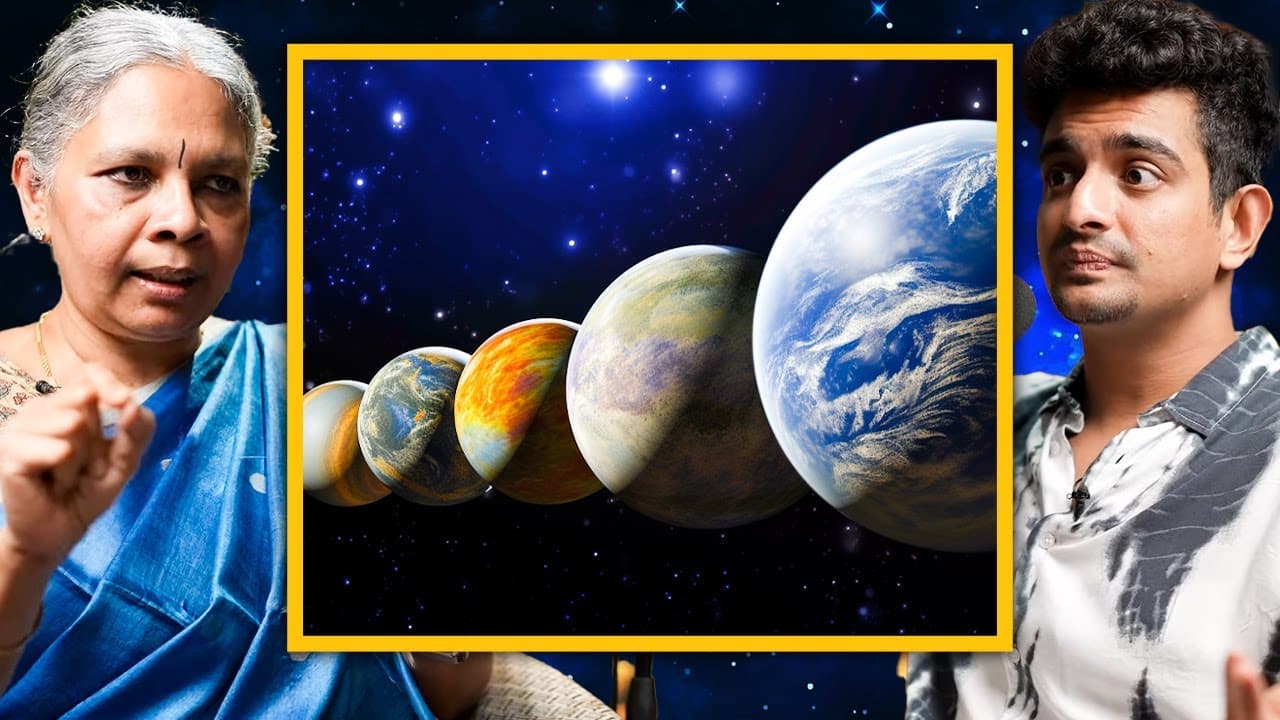
The possibility of undiscovered planets in our solar system prompts advanced studies in astronomy and mathematics.
Transcript
your friends are scrolling through short content but you my friend you're here to learn welcome to the clips do we know everything about our solar system no so okay someone had actually pitched this on the show I think it was abijit cha he said that there could even be more planets around our sun which are revolving around our sun which maybe we've... Read More
Key Insights
- ⛩️ Orbital calculations and gravitational modeling are vital for identifying discrepancies in planetary orbits, hinting at the possible existence of additional planets.
- 💆 The relationship between mass and distance significantly influences the movement of celestial bodies and their interaction with each other.
- 🦻 Precision measurement technology has dramatically evolved, aiding in our understanding and detection of distant celestial phenomena.
- 🥺 Gravitational effects can lead to observable anomalies, underscoring our current astrophysical limitations and the potential for new discoveries.
- 👨🔬 Advances in observation techniques allow scientists to detect minute changes in brightness, which contribute to the search for new planets.
- 👨🔬 Theories about unseen objects influencing the solar system demonstrate the evolving nature of astronomical research.
- 🪐 There is still much we don't know about our solar system, with the potential for hidden planets or objects yet to be discovered.
Install to Summarize YouTube Videos and Get Transcripts
Explore YouTube Video Summarizer or Get YouTube Transcript Extractor
Questions & Answers
Q: What is the basis of the speculation about undiscovered planets in our solar system?
The speculation arises from gravitational anomalies observed in the orbits of known planets and celestial bodies. Astrophysicists use orbital calculations to identify discrepancies between predicted and observed positions, suggesting the influence of yet-undetected objects. This process involves complex measurements and modeling, exposing gaps in our current understanding of the solar system's dynamics.
Q: How do astronomers detect planets that aren't emitting light?
Astronomers detect non-luminous planets by capturing reflected light and observing their gravitational influence on nearby celestial bodies. Telescopes on Earth detect slight variations in light and movement, known as wobbles, which imply the presence of unseen gravitational sources, indicating potential planets even in remote systems.
Q: Why is the gravitational center important in planetary motions?
The gravitational center, or center of mass, is crucial because it dictates how celestial bodies interact. Both the planet and the star exert gravitational forces on each other, resulting in orbits around their shared center of mass. This helps scientists make predictions about the behavior of planets based on their relative masses and distances.
Q: What technological advancements aid in detecting distant planets?
Technological advancements include precision telescopes and methods like the transit method, which measures tiny dips in brightness when a planet passes in front of a star. These advances have enabled astronomers to detect extremely subtle changes in light and movement, enhancing our ability to discover and study exoplanets.
Summary & Key Takeaways
-
The discussion revolves around the potential existence of more planets in our solar system, driven by residual gravitational effects not accounted for in current models.
-
Advanced orbital dynamics and mathematical models are critical in pinpointing gravitational discrepancies, which suggest unknown celestial bodies may exist.
-
Detection of planets relies on observing minute gravitational wobbles and light reflections, pushing the limits of modern technology and precision measurements.
Read in Other Languages (beta)
Share This Summary 📚
Summarize YouTube Videos and Get Video Transcripts with 1-Click
Try YouTube Summary with ChatGPT & Claude or YouTube Transcript Generator
Explore More Summaries from TRS Clips 📚




Summarize YouTube Videos and Get Video Transcripts with 1-Click
Try YouTube Summary with ChatGPT & Claude or YouTube Transcript Generator