Wien's bridge | Frequency Measurement | Electrical Instruments ( EIM ) | Lec - 54
TL;DR
Veen Bridge is used to measure unknown frequencies efficiently, particularly in audio ranges.
Transcript
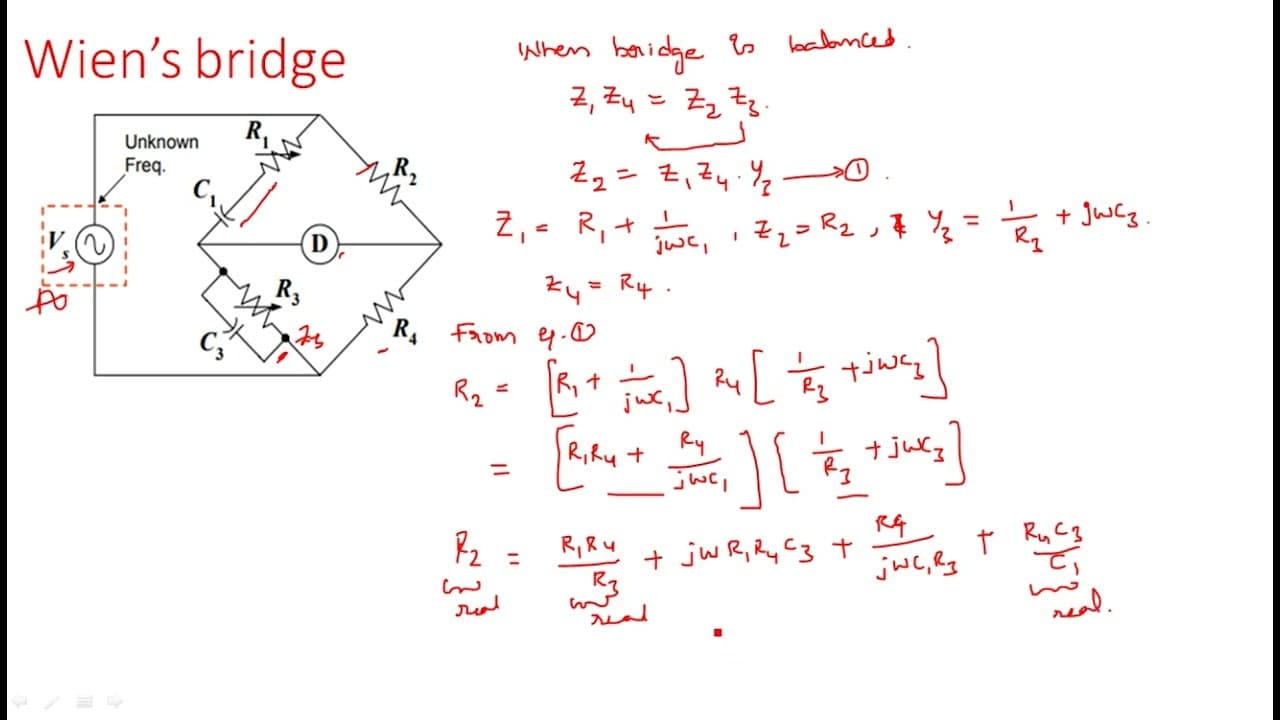
hi everyone in this video i am going to start the vin bridge concept so being bridge is used to measure the unknown frequency in the previous videos i have shared different types of bridges like shearing ridge haste bridge maxwell's bridge inductance comparison capacitance comparison all these bridges are used to measure the unknown components like... Read More
Key Insights
- 🦾 The Veen Bridge is constructed with four arms, including combinations of resistors and capacitors to achieve frequency measurement.
- 🧡 It operates effectively in the audio frequency range, which is critical for various electronic applications.
- 👖 The accuracy of the Veen Bridge spans from 0.5% to 1%, making it a reliable tool for precise measurements.
- 🎨 Replacing impedance with admittance in calculations simplifies the process significantly in designs involving parallel components.
- 🌉 The bridge can be utilized as a frequency determining element in signal generators and oscillators.
- 🌉 A balanced bridge condition is crucial for accurate frequency measurements, calculated using relationships among the circuit's components.
- 👋 Veen Bridge oscillators also serve in generating sine and square wave signals, illustrating versatility in applications beyond frequency measurement.
Install to Summarize YouTube Videos and Get Transcripts
Explore YouTube Video Summarizer or Get YouTube Transcript Extractor
Questions & Answers
Q: What is the primary purpose of the Veen Bridge?
The Veen Bridge is primarily designed to measure unknown frequencies of an applied signal, making it essential for various applications in audio and radio frequency ranges. It operates based on balancing different impedance components in its four-arm configuration to yield the accurate frequency of the input signal.
Q: Why is admittance favored over impedance in Veen Bridge calculations?
Admittance is favored in Veen Bridge calculations when dealing with parallel combinations of resistance and capacitance because it simplifies the mathematical expressions involved. Instead of complex impedance calculations, admittance allows for clearer additions, streamlining the process of equating values and ultimately solving for the unknown frequency.
Q: What frequency range can the Veen Bridge accurately measure?
The Veen Bridge can accurately measure frequencies within the audio frequency range, specifically from 20 Hz to 20 kHz. This capability makes it invaluable in applications where precise frequency measurements are crucial, particularly in audio engineering and related fields.
Q: How does the Veen Bridge relate to harmonic distortion analysis?
The Veen Bridge functions as a notch filter in harmonic distortion analyzers, allowing it to identify and isolate specific frequency components within a signal. This characteristic makes it an effective tool for analyzing signal quality and distortion in audio applications, ensuring that unwanted harmonics can be filtered out for clearer sound reproduction.
Summary & Key Takeaways
-
The Veen Bridge is an electronic circuit utilized for measuring unknown frequencies, built with a combination of resistors and capacitors.
-
When measuring frequencies, admittance is preferred over impedance for easier calculations, especially when components are in parallel.
-
The Veen Bridge is applicable in audio frequency ranges (20 Hz to 20 kHz) and serves various purposes, including harmonic distortion analysis and signal generation.
Read in Other Languages (beta)
Share This Summary 📚
Summarize YouTube Videos and Get Video Transcripts with 1-Click
Try YouTube Summary with ChatGPT & Claude or YouTube Transcript Generator