PS.2.3 Window Washer Free Body Diagrams
TL;DR
A complex problem is broken down into separate systems to simplify the analysis using Newton's second law.
Transcript
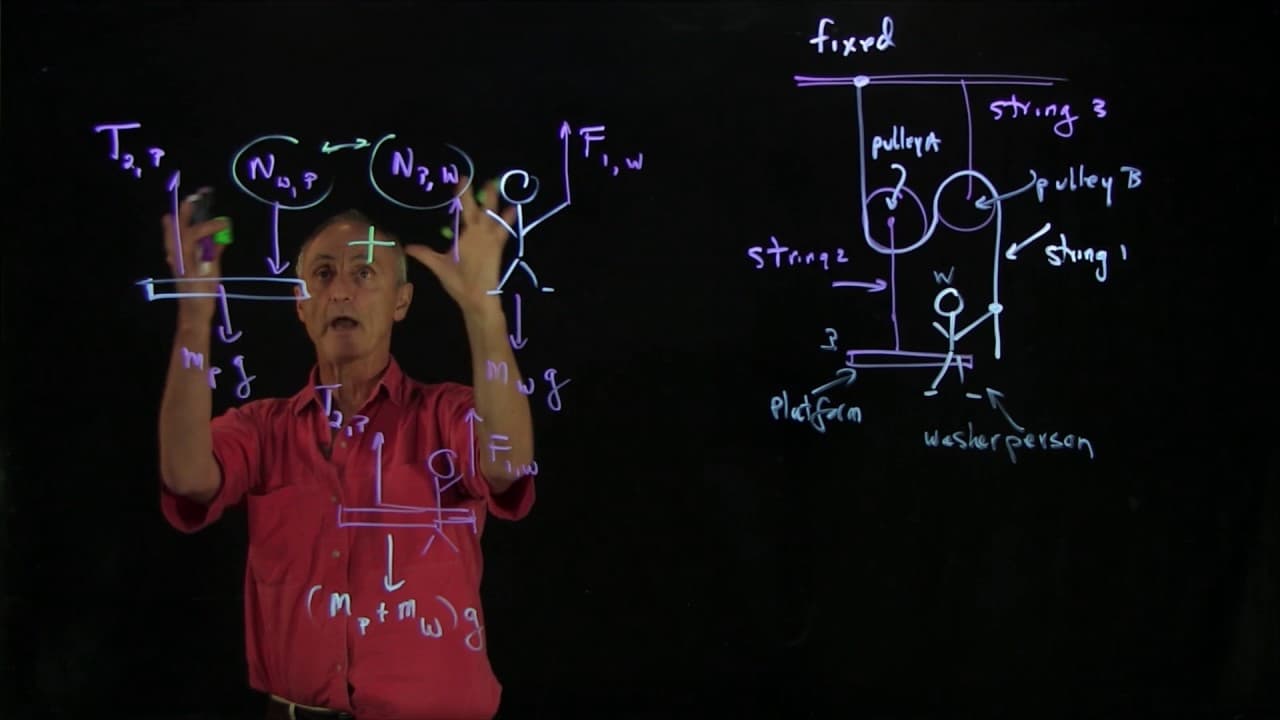
Let's consider what we call the window washer problem. What we have is suspended from some ceiling. We have a pulley. And the pulley is suspended by a rope, which we're going to call this string 3. And we have a rope that is wrapping around this pulley. And then it wraps around another pulley. So this rope is going around another pulley. And it's f... Read More
Key Insights
- 🍳 To solve complex problems, breaking them down into separate systems can simplify the analysis.
- 🥶 Free-body diagrams are essential tools for visualizing and understanding the forces acting on different components.
- 🆘 Identifying internal and external forces helps in selecting the most suitable approach for analysis.
- 👮 Newton's second law is utilized to determine the net force and acceleration of each system.
- ❓ Treating the pulley and string as a separate system helps further simplify the analysis.
- 👻 The assumption of a massless string makes calculations easier by allowing the tension to remain constant.
- ❓ Internal forces cancel in pairs, simplifying the overall analysis.
Install to Summarize YouTube Videos and Get Transcripts
Explore YouTube Video Summarizer or Get YouTube Transcript Extractor
Questions & Answers
Q: What is the purpose of separating the components into different systems?
Separating the components helps to identify internal and external forces which simplifies the analysis by allowing the cancellation of internal forces in pairs.
Q: Why are free-body diagrams used in this analysis?
Free-body diagrams are used to visualize and analyze the forces acting on each component separately, aiding in the understanding of how they interact with each other.
Q: How are Newton's laws of motion applied to this problem?
Newton's second law, F = ma, is used to determine the net force acting on each system and to calculate the acceleration of the components.
Q: Why is the assumption of a massless string made in this analysis?
Assuming a massless string simplifies the problem since the tension in the string remains constant throughout its length, making the analysis more manageable.
Summary & Key Takeaways
-
The window washer problem involves a person on a platform pulling ropes that are connected to pulleys.
-
The analysis begins by separating the person, platform, and pulleys into individual systems.
-
Internal and external forces are identified and considered to determine the most efficient approach to solving the problem.
Read in Other Languages (beta)
Share This Summary 📚
Summarize YouTube Videos and Get Video Transcripts with 1-Click
Try YouTube Summary with ChatGPT & Claude or YouTube Transcript Generator
Explore More Summaries from MIT OpenCourseWare 📚


Summarize YouTube Videos and Get Video Transcripts with 1-Click
Try YouTube Summary with ChatGPT & Claude or YouTube Transcript Generator