What Are Numerical Reasoning Tests and How to Excel?
TL;DR
Numerical reasoning tests assess your ability to interpret data from charts and graphs, requiring basic calculations. This video teaches how to tackle sample questions to improve your skills, encouraging viewers to practice and share answers in the comments.
Transcript
hi there everybody its Richard McMunn here from how to become calm I hope you're doing well and I had a little bit of spare time available today so I've put together this great training video based on numerical reasoning tests and it's actually focused on data interpretation test those kind of questions that you get asked in a test or exam where yo... Read More
Key Insights
- 📈 Numerical reasoning and data interpretation tests often involve charts, graphs, and complex information.
- 💁 Breaking down the information and focusing on specific sections can make solving the questions easier.
- 🏆 Calculating percentages and averages are common tasks in these tests.
- 📈 Practice and familiarity with different types of charts and graphs can improve performance.
- ❓ Paying attention to specific criteria, such as minimum percentages, is essential.
- ❓ Understanding how to calculate averages and differences is crucial.
- ⌛ Time management is critical due to the limited time provided for each question.
Install to Summarize YouTube Videos and Get Transcripts
Explore YouTube Video Summarizer or Get YouTube Transcript Extractor
Questions & Answers
Q: How are numerical reasoning and data interpretation tests typically structured?
Numerical reasoning tests often involve charts or graphs and require basic numerical calculations to find the answer. Data interpretation tests require breaking down complex information into manageable sections.
Q: How can you determine the number of students in a specific category based on the given chart?
By focusing on the relevant section and understanding the required criteria, such as the percentage needed to qualify, you can determine the number of students in that category.
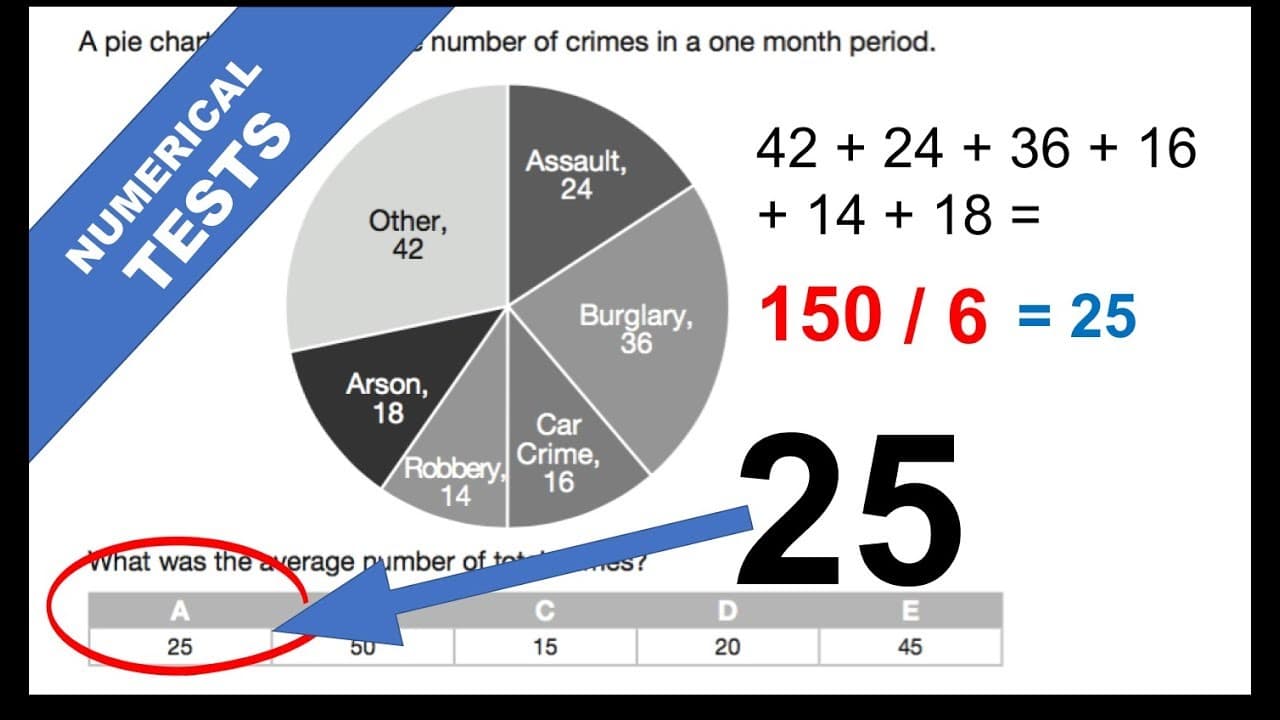
Q: How can you calculate the average number of crimes based on a pie chart?
Add up the total number of crimes represented by each segment of the pie chart, then divide the sum by the number of segments to calculate the average.
Q: How can you find the difference between the lowest and highest occurring types of crime?
Identify the values for each type of crime and subtract the lowest value from the highest value to find the difference.
Key Insights:
- Numerical reasoning and data interpretation tests often involve charts, graphs, and complex information.
- Breaking down the information and focusing on specific sections can make solving the questions easier.
- Calculating percentages and averages are common tasks in these tests.
- Practice and familiarity with different types of charts and graphs can improve performance.
- Paying attention to specific criteria, such as minimum percentages, is essential.
- Understanding how to calculate averages and differences is crucial.
- Time management is critical due to the limited time provided for each question.
- Continued practice with online tests can enhance skills and performance in these types of assessments.
Summary & Key Takeaways
-
The video focuses on numerical reasoning and data interpretation tests, specifically those that involve charts and graphs.
-
The presenter breaks down complex information into manageable sections to solve the questions.
-
Viewers are encouraged to try the questions themselves and share their answers in the comments section.
Read in Other Languages (beta)
Share This Summary 📚
Summarize YouTube Videos and Get Video Transcripts with 1-Click
Try YouTube Summary with ChatGPT & Claude or YouTube Transcript Generator
Explore More Summaries from CareerVidz 📚





Summarize YouTube Videos and Get Video Transcripts with 1-Click
Try YouTube Summary with ChatGPT & Claude or YouTube Transcript Generator