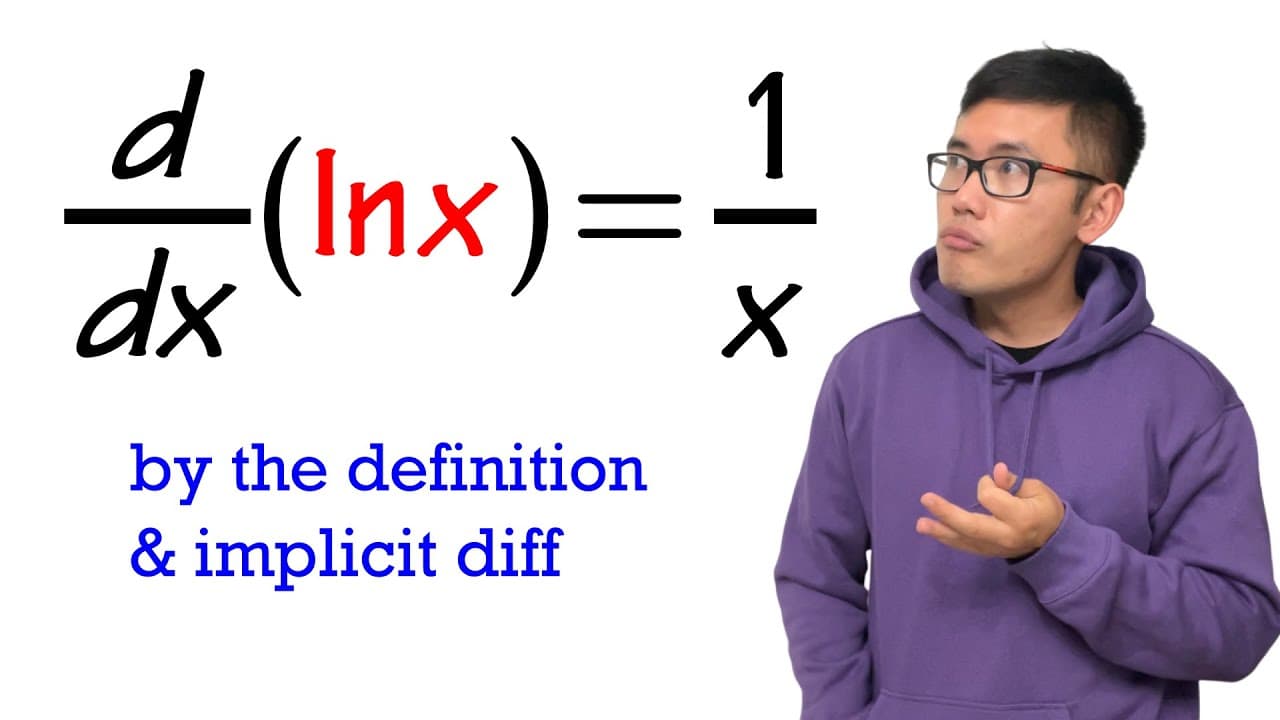
how do we know the derivative of ln(x) is 1/x (the definition & implicit differentiation)
TL;DR
This video explains how to find the derivative of Ln X using the definition of the derivative and the concept of e.
Transcript
okay in this video I will show you guys how to find it the relative of the function L and X and the best part is I'll show you guess two ways the first way is of course the good old definition of the derivative right and that gets dokdo it's our first so when we have the function f of X is equal to Ln X we know that f of X by definition this is equ... Read More
Key Insights
- 💁 The derivative of Ln X can be found using the definition of the derivative or by recognizing it as a form of the number e.
- 🥺 When applying the definition of the derivative, plugging in X+h into the Ln X function leads to the difference quotient formula.
- 💁 The concept of e is crucial in the second method, where (1+h/X)^(1/h) is recognized as a form of e.
- ❓ Both methods ultimately result in the derivative of Ln X being 1/X.
- ❓ Differentiating Ln X is important for analyzing exponential growth and decay problems.
- ⚾ The change of base formula for logarithms can be used to differentiate log base B of X, where B is any legitimate base.
Install to Summarize YouTube Videos and Get Transcripts
Explore YouTube Video Summarizer or Get YouTube Transcript Extractor
Questions & Answers
Q: What is the first method for finding the derivative of Ln X?
The first method involves using the definition of the derivative and plugging in X+h into the Ln X function. This leads to the difference quotient formula, which can be simplified to find the derivative as 1/X.
Q: How does the second method involve the concept of e?
In the second method, the expression (1+h/X)^(1/h) is recognized as a form of the number e. By using algebraic substitution and algebraic manipulations, the derivative of Ln X is found to be 1/X.
Q: Why is the derivative of Ln X equal to 1/X?
By applying either method, it is found that the derivative of Ln X is 1/X. This is a result of the properties of Ln and the number e, which cancel each other out in the final derivative expression.
Q: What is the significance of differentiating Ln X?
Differentiating Ln X allows us to find the rate of change of the natural logarithm function at any point. This is useful in various applications of calculus, especially in analyzing exponential growth and decay.
Summary & Key Takeaways
-
The video demonstrates two ways to find the derivative of Ln X: using the definition of the derivative and recognizing it as a form of the number e.
-
The first method involves plugging in X+h into the Ln X function to determine the difference quotient. By simplifying the expression, the derivative of Ln X is found to be 1/X.
-
The second method involves recognizing that Ln X can be represented as (1+h/X)^(1/h) as h approaches 0. By applying the properties of the number e, the derivative of Ln X is again found to be 1/X.
Read in Other Languages (beta)
Share This Summary 📚
Summarize YouTube Videos and Get Video Transcripts with 1-Click
Try YouTube Summary with ChatGPT & Claude or YouTube Transcript Generator
Explore More Summaries from blackpenredpen 📚
Summarize YouTube Videos and Get Video Transcripts with 1-Click
Try YouTube Summary with ChatGPT & Claude or YouTube Transcript Generator