What Happens When Potassium Reacts with Water?
TL;DR
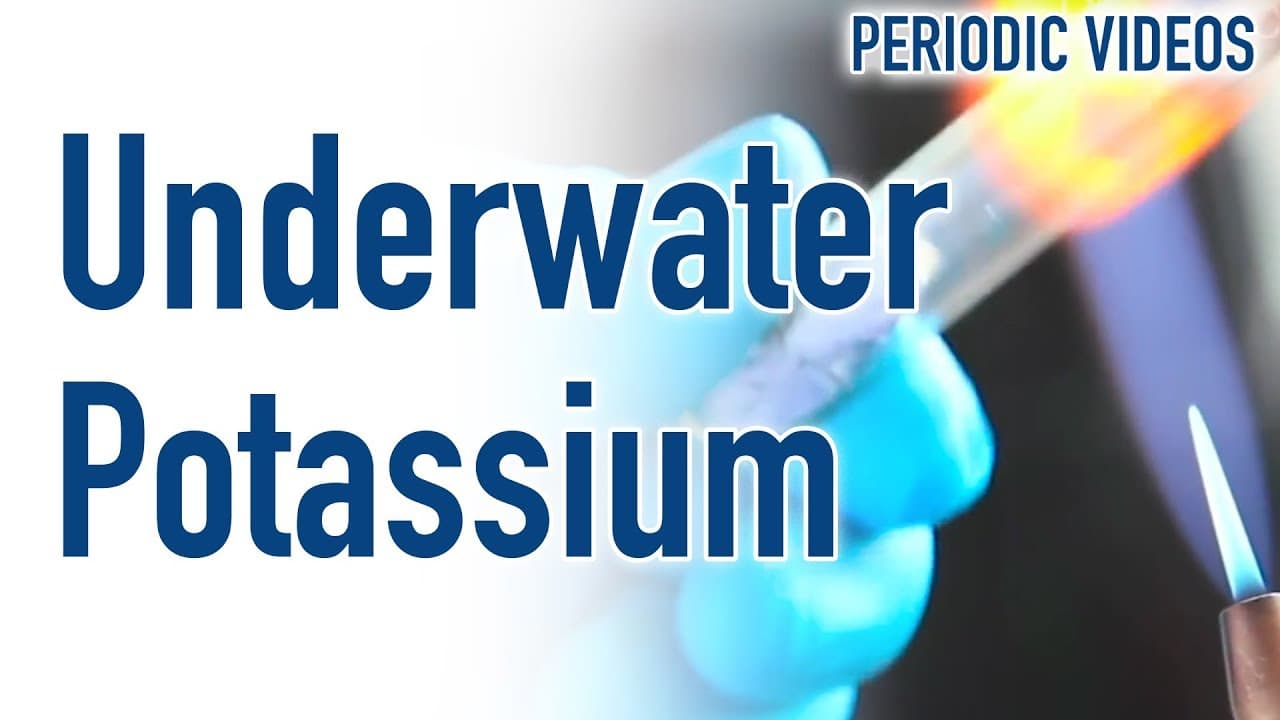
When potassium reacts with water, it produces hydrogen gas without an explosive reaction, unlike sodium. Due to its lower density, potassium floats and can escape to the surface, allowing for a safer reaction. However, if contained improperly, such as in a horizontal test tube, the reaction can produce significant pressure and a more violent explosion.
Transcript
you've probably already seen video on sodium reacting with water using Neil's new device his test-tube breaker but this week we're going to look at potassium and as you know potassium is more reactive than sodium one of the things which you might not realize in fact I had forgotten is that metallic potassium is less dense than metallic sodium so if... Read More
Key Insights
- 💦 Potassium reacts more violently with water compared to sodium.
- 💦 Careful containment of potassium can prevent explosive reactions during its reaction with water.
- 🧪 Horizontal breaking of the test tube led to a more significant explosion due to hydrogen pressure.
- ☠️ The density difference between water and hydrogen affects the rate of reaction and force produced during the reaction.
Install to Summarize YouTube Videos and Get Transcripts
Explore YouTube Video Summarizer or Get YouTube Transcript Extractor
Questions & Answers
Q: How does metallic potassium react with water compared to sodium?
Metallic potassium reacts more violently with water, producing hydrogen, and shooting to the surface due to its lower density compared to sodium. However, it can do so without causing explosive reactions due to certain containment measures.
Q: What was the difference in Neil's approach in the two experiments conducted with potassium?
Neil conducted one experiment vertically and another horizontally to break the test tube under the water. The horizontal method resulted in a sizable explosion due to the pressure of hydrogen generated, showcasing a different aspect of the reaction.
Q: Why did the containment of the potassium in the tube affect the reaction?
The containment of potassium in the tube affected the reaction as a small amount allowed for a fast reaction without explosiveness, while a larger lump in a small volume of glass led to a significant explosion due to the pressure of hydrogen buildup.
Q: How does the density of water compared to hydrogen affect the rate of reaction?
Water, being denser than hydrogen gas, can lead to faster reactions with potassium as it produces a large volume of gas quickly, generating enough force to create ripples on the water's surface.
Summary & Key Takeaways
-
Metallic potassium reacts with water more violently than sodium.
-
Potassium is less dense than sodium underwater, causing it to shoot to the surface.
-
The experiment shows potassium producing hydrogen without explosive reactions due to careful containment.
Read in Other Languages (beta)
Share This Summary 📚
Summarize YouTube Videos and Get Video Transcripts with 1-Click
Try YouTube Summary with ChatGPT & Claude or YouTube Transcript Generator
Explore More Summaries from Periodic Videos 📚
Summarize YouTube Videos and Get Video Transcripts with 1-Click
Try YouTube Summary with ChatGPT & Claude or YouTube Transcript Generator