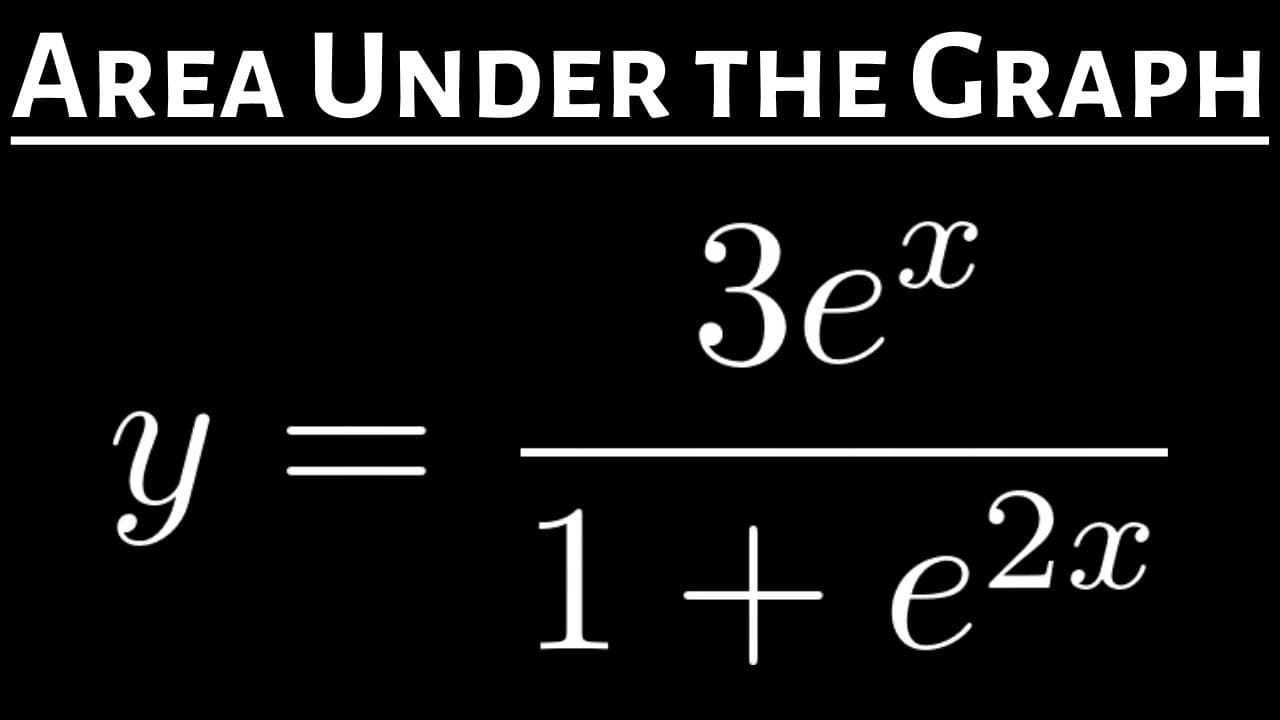
Area Under the Graph of y = 3e^x/(1 + e^(2x))
TL;DR
Find the area under a curve using integration, applying substitution and trigonometric formulas.
Transcript
find the area of the region to find the area of this region here under this graph so to do that all we have to do is integrate this function from zero to this x value here which they tell us is the natural log of the square root of three so let's go ahead and do it so we have the definite integral from zero to natural log square root of 3 of this f... Read More
Key Insights
- ❓ Integration is essential for finding areas under curves, requiring rewriting functions for simplification.
- 😑 Substitution techniques aid in transforming complex expressions into manageable forms suitable for integration.
- 🖐️ Trigonometric formulas like arctangent play a significant role in simplifying integrals involving certain functions.
- ⛔ Calculating areas under curves involves precise determination of limits of integration for accurate results.
- ❓ Mastery of integration techniques, substitutions, and trigonometric formulas enhances efficiency in calculating areas under curves.
- 🤩 Practice and familiarity with mathematical concepts like arctangent are key to solving integration problems effectively.
- 🦻 Utilizing calculator functionalities or trigonometric reasoning can aid in determining complex function values crucial for integration.
Install to Summarize YouTube Videos and Get Transcripts
Explore YouTube Video Summarizer or Get YouTube Transcript Extractor
Questions & Answers
Q: How do we find the area under a curve using integration?
To find the area under a curve, we use integration by rewriting the function and applying definite integrals from given limits.
Q: What role does substitution play in simplifying the integration process?
Substitution is crucial in simplifying integration by replacing complex expressions with simpler ones to apply known formulas efficiently.
Q: Why do we use trigonometric formulas when integrating certain functions?
Trigonometric formulas help in handling functions like arctangent efficiently, simplifying the integration process and obtaining accurate results for the area under the curve.
Q: How can we determine the limits of integration for finding the area under a curve?
The limits of integration are determined based on the given x-values corresponding to the region whose area under the curve we want to calculate, ensuring precision in the final result.
Summary & Key Takeaways
-
Use integration to find the area under a curve by rewriting the function.
-
Apply substitution and trigonometric formulas to simplify the integration process.
-
Calculate the area under the curve using definite integrals and trigonometric functions.
Read in Other Languages (beta)
Share This Summary 📚
Summarize YouTube Videos and Get Video Transcripts with 1-Click
Try YouTube Summary with ChatGPT & Claude or YouTube Transcript Generator
Explore More Summaries from The Math Sorcerer 📚


Summarize YouTube Videos and Get Video Transcripts with 1-Click
Try YouTube Summary with ChatGPT & Claude or YouTube Transcript Generator