3.3.3 The Framingham Heart Study - Video 2: Risk Factors
TL;DR
This lecture discusses the use of analytical models, specifically logistic regression, to predict and prevent heart disease by identifying risk factors and validating the models.
Transcript
In this lecture, we'll be using analytical models to prevent heart disease. The first step is to identify risk factors, or the independent variables, that we will use in our model. Then, using data, we'll create a logistic regression model to predict heart disease. Using more data, we'll validate our model to make sure it performs well out of sampl... Read More
Key Insights
- 🥰 Heart disease, specifically coronary heart disease (CHD), has been the leading cause of death worldwide since 1921.
- 🥰 The Framingham Heart Study and its data have played a significant role in earlier detection and monitoring of heart disease.
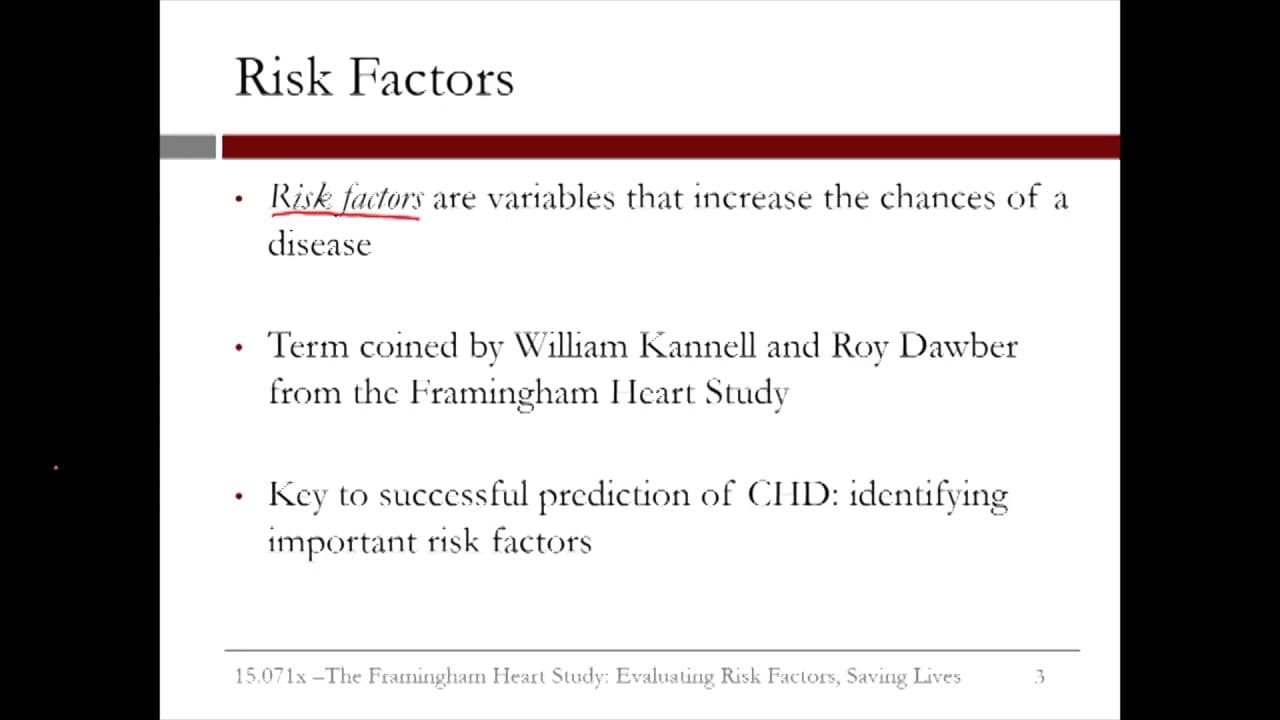
- 🥰 Risk factors, identified through studies like the Framingham Heart Study, are crucial for successful prediction and prevention of heart disease.
- ✳️ Analytical models, such as logistic regression, can be used to assess the risk of heart disease by analyzing identified risk factors.
- 😒 The development and use of the Framingham Risk Score have greatly contributed to predicting the 10-year risk of CHD.
- 🥰 Smoking, now established as a significant risk factor for heart disease, was a novel idea in the 1940s.
- 🎚️ Regular monitoring of blood pressure, cholesterol levels, BMI, and blood glucose levels can provide valuable insights into the risk of heart disease.
Install to Summarize YouTube Videos and Get Transcripts
Explore YouTube Video Summarizer or Get YouTube Transcript Extractor
Questions & Answers
Q: What is the first step in using analytical models to prevent heart disease?
The first step is to identify risk factors or independent variables that will be used in the model. These risk factors increase the chances of developing heart disease and are crucial for successful prediction.
Q: How is logistic regression used to predict heart disease?
Logistic regression is a statistical model used to predict binary outcomes, such as the presence or absence of heart disease. It uses the identified risk factors as independent variables to calculate the probability of an individual developing heart disease.
Q: What is the significance of the Framingham Risk Score?
The Framingham Risk Score, introduced in a 1998 paper, is a widely used tool to predict the 10-year risk of coronary heart disease based on logistic regression models. It is derived from the Framingham Heart Study data and has greatly contributed to early detection and monitoring of heart disease.
Q: What risk factors are included in the original data collection for the Framingham Heart Study?
The original data collected for the Framingham Heart Study includes demographic risk factors (sex, age, education level), behavioral risk factors (smoking status, average number of cigarettes), medical history risk factors (blood pressure medication, history of stroke, hypertension, diabetes), and physical examination risk factors (cholesterol level, blood pressure, BMI, heart rate, blood glucose level).
Summary & Key Takeaways
-
This lecture focuses on using analytical models to prevent heart disease by identifying and analyzing risk factors.
-
Logistic regression is used to create a model to predict heart disease and the 10-year risk of coronary heart disease (CHD).
-
The Framingham Risk Score, based on the Framingham Heart Study data, is discussed as an influential application of logistic regression for predicting CHD.
Read in Other Languages (beta)
Share This Summary 📚
Summarize YouTube Videos and Get Video Transcripts with 1-Click
Try YouTube Summary with ChatGPT & Claude or YouTube Transcript Generator
Explore More Summaries from MIT OpenCourseWare 📚



Summarize YouTube Videos and Get Video Transcripts with 1-Click
Try YouTube Summary with ChatGPT & Claude or YouTube Transcript Generator